
Remove the faulty configuration profile immediately, restore the previous working configuration, verify network connectivity, check firmware compatibility, and re-deploy to a test group before full rollout.
Managing AirPlay Payloads on Apple Devices: AirPlay Device Management
 Saipansab Nadaf
Updated on: Nov 07, 2025
Table of Contents
- Understanding the AirPlay Payload for Apple Device Management
- Preparing for Device Deployment: Profile Configuration for Data Migration
- Configuring AirPlay Payloads: Approved Destinations and Passwords
- Recovery Strategies: What to Do When Deployment Goes Wrong
- Security Risks and Data Protection Considerations During AirPlay Setup
- Integration with Broader Device Management and Data Migration Frameworks
- Conclusion
- Frequently Asked Questions
Enterprise adoption of Apple devices has surged significantly in recent years, with 76 percent of large enterprises reporting increased adoption of Apple devices, driving demand for streamlined device management solutions. With Apple TVs, iPads, and Macs being rolled out in conference rooms, classes, and workspaces, AirPlay settings are a major area of concern in the deployment plan.
The AirPlay payloads allow the administrators of the IT systems to pre-configure the destination of wireless display, passwords, and security level, which guarantees a painless connection, and at the same time, security of the network. Factors that lead to configuration errors, support tickets, and enable users to access approved AirPlay destinations without manual configuration can be avoided by proper management of these payloads during device deployment.
Key Takeaways
- AirPlay payloads enable IT administrators to preconfigure wireless display settings through MDM solutions.
- Proper deployment preparation includes auditing destinations, creating baseline profiles, and testing before full rollout.
- Configuration requires specifying approved devices using MAC addresses and enforcing password protection.
Understanding the AirPlay Payload for Apple Device Management
An Apple AirPlay payload is a configuration packet that instructs Apple devices on how to connect to the approved wireless displays and audio systems. In the context of an MDM solution like Pigeoncast for management devices, such payloads can be used to set all AirPlay options on the devices being managed by the administrator before the devices get to the end user.
The payload consists of guidelines on approved Apple TVs or speakers, passwords, and limited destinations. This preprogramming allows employees to walk into a conference room and instantly screen copy and never change their settings or call an IT specialist. The structure guarantees a uniform connection throughout the organization, besides undertaking security measures.
Preparing for Device Deployment: Profile Configuration for Data Migration
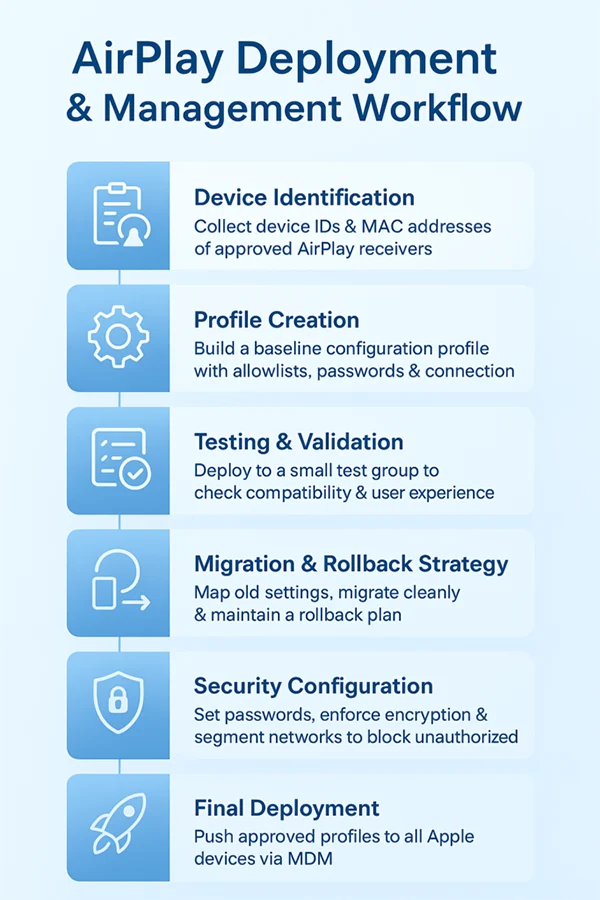
The key point of successful AirPlay implementation is to ensure that the right profile is configured at the planning stage. The administrators are advised to check the current Airpaly destination and record the device IDs of all the approved receivers. The second step is to develop a baseline configuration profile, which contains some required parameters, including device allowlists, password policies, and connection policies.
Before complete deployment, test the profile in a limited number of devices to determine compatibility problems or problems with user experience. Move existing settings of current devices in the case of migration between different management systems. Lastly, set a rollback strategy whereby it would be possible to quickly revert to past settings in case of deployment problems. This is a systematic way of reducing inconvenience in the changeover.
Pigeoncast on your Windows computer can also be a great solution, if you are willing to consider.
Configuring AirPlay Payloads: Approved Destinations and Passwords
To enable AirPlay payloads, one needs to allow approved destinations by specifying the device MAC address or device ID using the MDM console. The administrators are capable of imposing password rules on individual destinations, which prevents any unauthorised networking. The device identifier with the password, also encrypted, should be included in the payload.
In the case of an organisation, it is possible to set various destination profiles for various groups of users, such that each department gets access to only the relevant AirPlay on Windows receivers, and not the others.
Recovery Strategies: What to Do When Deployment Goes Wrong
In case of troubles with the deployment of Airplay payloads, these recovery steps should be used by the administrators:
- Immediately delete the compromised profile of the configuration in the affected devices.
- Recover the last operating setup.
- Check the network connection among devices and AirPlay receivers.
- Look at the firmware compatibility problems on the devices and the receivers.
- Rollout of the fixed profile to a test group should be re-deployed.
- Record the problem and solution that can be used in the future.
Security Risks and Data Protection Considerations During AirPlay Setup
Airplay networks pose a number of security threats that must be taken care of. There is a high possibility of unauthorised devices on the same network intercepting screen mirroring sessions or accessing sensitive materials displayed using AirPlay. To ensure that the AirPlay receiver is not exposed to guest networks and other untrusted devices, organisations need to use network segmentation.
All AirPlay destinations in the corporate environment should be a requirement of password protection. Also, administrators are expected to audit approved device lists and delete decommissioned receivers on a regular basis.
The use of encryption protocols is needed to secure the data when sending it, and the users should be educated on how to determine a legitimate destination of the AirPlay compared to a potential security threat.
Integration with Broader Device Management and Data Migration Frameworks
AirPlay payload management must be part of the current MDM systems and device enrollment processes. Other important settings may be configured together with configuration profiles when automatically provisioning devices.
This integration guarantees uniform implementation across any of the devices sold by Apple and has a centralised control mechanism. Companies that have moved out of old systems, maintaining the pattern of established connectivity in the process.
Conclusion
Organisations that need to utilize Apple devices in large-scale deployment require proper AirPlay payload management. Properly configured profiles, security measures, and integration with more extensive MDM frameworks can enable IT administrators to provide seamless, wireless connections while keeping the security of the networks.
These factors provide the high success of deployment and reduce he impact of disruption of operations due to careful planning, testing, and documented recovery procedures.
Frequently Asked Questions
What should I do if AirPlay deployment fails?
What security risks are associated with AirPlay?
Risks include unauthorised device access to screen mirroring sessions, potential data interception on shared networks, and connection to malicious AirPlay receivers. Mitigation requires network segmentation, mandatory passwords, and encryption.
Can I migrate AirPlay configuration between MDM systems?
Yes, most MDM platforms allow exporting configuration profiles that can be imported into new systems, preserving approved destination lists and settings during platform transitions.
Related Posts
How Poor Contract Visibility Leads to Revenue Leakage in Growing Companies
Growth is an important factor that determines the success rate of any business. When we witness new operations, partnerships and…

Managing Bitcoin Operations? Here’s How Salesforce Automation Helps
“Digital currency is here to stay, and it’s only a matter of how long before governments embrace it.” — Brad…

Why Modern Organizations Depend on Data Privacy Software
Data growth has significantly accelerated beyond what most compliance teams can manage, with personal records, financial details, contracts, and emails…

Converting Chats Into Leads While Maintaining Professionalism
The way marketing teams and businesses approach their potential clients to boost their sales has completely transformed in the last…
How to Delete iCloud Account? Complete Guide for 2026
Thinking, how can I delete iCloud or Apple account? It is not just about removing an account; it is about…

How Different Industries Use Specialized Software to Stay Competitive
In the market we have today, companies are always trying to find ways to work better and get results. The…

What Key Adjustments Enhance Visual Appeal Across Web Pages
Attractive web pages form the roots of any appealing website. For instance, imagine looking for content on Google, and you…

When is it Time to Consider IT Support Services for Your Business?
Every business needs to ensure smooth operations for a successful business. But despite trying hard to avoid barriers, technical issues…
How to Delete User Profile in Windows 10: Step-by-Step Guide
You don’t notice user profiles until one starts causing problems. A profile gets corrupted, a login error pops up, or…