Every time a customer clicks “Place Order”, they are doing something important that even they might not be aware of: trusting multiple businesses they may never even see. Their names, addresses, phone number and other details don’t just go to one company. They travel through warehouses, shipping systems, dashboards, and integrations powered by third-party logistics ( 3PL services).
Most customers never think about this. But for 3PLs, that invisible flow of data is constant and risky. One weak security decision can expose thousands of records in minutes and damage a business’s systems and reputation built over the years. And what makes it even more concerning are the reports stating that more than 80% of organizations reported being negatively impacted by cyber breaches in their supply chain over the past year.
That’s why cybersecurity is not just a “nice-to-have” thing for modern 3PLs; it has become a part of how trust is earned, kept, and protected in an industry that runs on speed and scale.
Key Takeaways
3PLs don’t just move inventory, they move trustSecurity gaps grow quietly inside fast-scaling operations
Integrations are helpful and risky at the same timeInternal access is just as dangerous as external threatsData protection is now part of the customer experience.
Why Customer Data Security Is a Critical Issue for eCommerce 3PLs
eCommerce customers never get to interact directly with 3PL, but their data passes through one anyway. That makes logistics providers silent custodians of extremely sensitive information.
A single order you place can reveal your personal details like full name, address, phone number, email IDs, order value, etc. And for cybercriminals, this is more than enough.
This risk can be amplified because 3PLs often serve multiple brands at once. Which means a breach would not just affect one business, but impact dozens of retailers at once. And this kind of exposure can permanently damage reputation and partnership.
Many eCommerce platforms also rely on mobile app development companies to build order tracking apps, warehouse dashboards, and customer-facing delivery interfaces. These apps can connect directly with 3PL syste,]ms, adding another layer of complexity.
In short, customer data security is no longer an IT concern; it’s a core part of operational credibility for modern logistics providers.
CASE STUDY How one weak integration puts multiple brands at risk
A growing 3PL partnered with several mid-sized eCommerce brands and relied heavily on system integrations for order syncing and inventory management. To speed up onboarding, one API connection was implemented without proper authentication.
And this proved to be a mistake because a vulnerability allowed unauthorized access to shipment and customer address data across multiple clients. This led to several brands pausing operations immediately, demanding audits and reconsidered ther partnerships.
Lesson: Security shortcuts scale just as fast as logistics operations, and the consequences scale even faster.
How Third-Party Logistics Providers Handle Sensitive Customer Data
From the moment an order is placed, data flows across the systems like this:
During thai transmission, 3PLs also exchange data constantly with eCommerce platforms, marketplaces, payment processors, shipping carriers, and return management tools. Each of these connections increases efficiency, but at the same time also expands the attack surface. And, without proper controls, even a slight slip or minor misconfiguration can give attackers a way in.
Key Cybersecurity Risks Facing 3PLs in eCommerce Operations
The top gateways for cyberattackers in eCommerce operations can be:
Data Breaches
The most common and damaging one of them all: Data breaches. For 3PLs, breaches often occur due to weak authentication practices, unpatched systems, misconfigured cloud storage, and phishing attacks targeting staff. And since 3PL systems store a load of data from multiple clients, even a minor incident of breach can expose massive datasets.
Unauthorized Access
It is not necessary that al threats come from outside. Sometimes the insiders even have evil motives, and that is why access control is extremely important. When warehouse staff, support teams, and third-party vendors all use the same systems, access management becomes a non-negotiable.
System Integration Vulnerabilities
Modern 3PL operations depend on integrations. APIs connect eCommerce platforms, inventory systems, carrier services, and analytics tools. Yes, they are helpful, but poorly secured integrations can expose data through unsecured endpoints, allow unauthorized system access, and bypass internal security controls.
Patching up these entrypoints for cyberattackers can significantly lower the chances of data getting compromised.
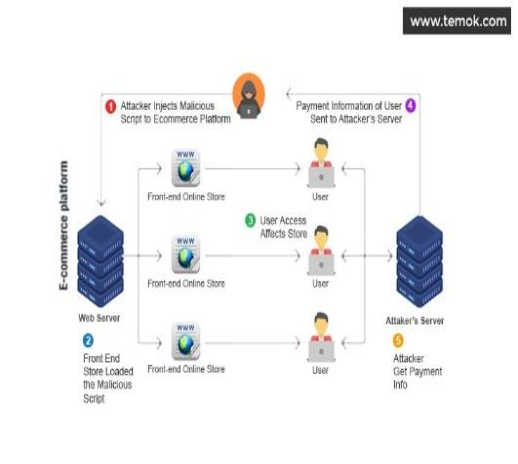
USEFUL INSIGHTS The infographic below explains how security threats take place in cybersecurity. Have a look to understand what really happens and to learn what mistakes you should avoid.
Cybersecurity Measures 3PLs Must Implement to Protect Customer Data
To protect customer data, 3PLs must implement the following cybersecurity measures:
Access Controls
Access control is often overlooked, but a really effective security measure. Any insider or outsider must not have access to client data that they do not need. They should only see the data necessary for their role.
For example, a warehouse picker doesn’t need access to customer contact or a support agent doesn’t need system-level permissions. Limiting access reduces damage even if the credentials are compromised.
Encryption Standards
Encryption means making the data unreadable. It protects the information even when the systems are breached. So 3PLs should ensure that data is encrypted at rest and in transit, secure key management practices are used, and legacy systems are upgraded or isolated.
This makes it extremely hard for cybercriminals to exploit the data even if they have somehow got the exposure to it.
Secure API Connections
APIs are important, but remember that they are also risky. Authentication tokens, key rotation, rate limiting, encrypted communication, and continuous monitoring for anomalies are some secure API practices that should be followed. Also, it should never be treated as “Trusted by default”; every connection must be secured, logged, and reviewed regularly.
PRO TIP If a system touches customer data, even indirectly, it deserves the same security attention as your core platform.
Incident Response and Vendor Risk Management
We can never be 100% sure about any system. But what matters is how quickly and effectively a 3PL responds when something goes wrong, such as in the case of data breaches.
A strong incident response plan should include clear escalation paths, defined response roles, data recovery containment procedures, and client communication protocols.
Aside from that, vendor risk management is equally important. 3PLs rely on multiple technology providers: cloud platforms, mobile app developers, analytics tools, and carriers. Every vendor system access introduces risk. Security reviews, contractual obligations, and periodic audits help ensure partners meet the same standards expected internally.
Ignoring vendor risk is one of the fastest ways to lose control over consumer data.
Final Thoughts
Consumer data security does not end at checking all the boxes or passing audits. It is all about respecting the trust that customer shows in any eCommerce brand.
As logistics operations grow more connected through inventory management systems, mobile apps, APIs, and vendor platforms, the responsibility to protect data grows with them. The reality is simple: breaches don’t just disrupt operations, they disrupt trust and confidence. And once these two things are lost, it is extremely hard to earn them back.
The 3PLs that stand out in the eCommerce industry won’t be the ones that grow fastest alone but those that move securely. By investing in strong cybersecurity practices today, logistics providers very obviously prevent data breaches bit on top of that, they also build long-term partnerships, protect reputatiosna dn future-proof their business.
Because in eCommerce delivering goods is just as important as delivering packages.
Frequently Asked Questions
Are businesses that don’t store payment data also at risk?
Yes. Names, addresses, order history, and delivery patterns are gold for attackers. You don’t need credit cards to be a target.
Is cybersecurity really a logistics problem?
It is now. If your systems move customer data, security is part of operations, just like picking, packing, and shipping.
Can one breach really affect multiple clients?
Absolutely, and that is actually the scariest part of being a 3PL. One incident can ripple across every brand you serve.
Is cloud hosting actually secure?
No. Cloud platforms are secure by default, but your configurations decide how safe the data actually is.
What is the first sign our security isn’t strong enough?
The first sign of security not being strong enough is when the teams say “We’ve always done it this way”, instead of “This is howwe protect data.”
Data growth has significantly accelerated beyond what most compliance teams can manage, with personal records, financial details, contracts, and emails…

 Saipansab Nadaf