Remember when advertising meant broad campaigns that targeted a mass audience with the same message, no matter if it was relevant to them or not? Well, the times have changed, and businesses today no longer rely on those conventional ways. Instead, they use artificial intelligence, automation, and audience data insights to deliver highly personalized ads in real time.
A report by Statista shows that global digital advertising spending is expected to surpass $800 billion in the coming years, showing how rapidly businesses are investing in data-driven marketing technologies.
And as the competition grows, AdTech has become essential for brands looking to improve targeting, campaign efficiency, and customer engagement. In this post, we will learn how it actually works and how AI helps transform digital advertising through data insights.
Key Takeaways
AI automation and data analytics are the cornerstone of AdTech’s efforts to enhance digital advertising.
Businesses can use audience data insights to create personalized ads.
Programmatic advertising automates ad buying and optimization.
The privacy laws are gaining momentum in AdTech
What Is AdTech
AdTech (Advertising Technology) is a term that describes the technology and platforms needed to develop, manage, serve, and report on internet advertising campaigns. It merges software, automation, artificial intelligence, and audience data, all aimed at boosting the performance of the advertising business.
With today’s AdTech, advertisers can automate the purchasing of advertising, target audiences, and track campaign performance in real-time. To grasp the broader implications, it is crucial to delve into the technologies that drive today’s digital advertising landscape.
The core functions of AdTech are audience targeting, campaign automation, real-time bidding, performance tracking, data analytics, and ad placement optimization.
The supply-side platform is a key element of this ecosystem, playing a role in managing and efficiently selling ad inventory.
Evolution of Digital Advertising with AI and Data Analytics
The world of digital advertising has transformed from a static banner section to smart, highly automated, and personalized advertising with AI and big data analytics. Machine learning algorithms are used by businesses today to predict user behavior, optimize campaigns, and enhance the performance of ads in real-time.
From Traditional Ads to Programmatic Advertising
The old way of advertising mainly depended upon manual negotiations and broad audience targeting. Today, advertising relies on programmatic technology, which is a form of automation for buying and placing ads.
Programmatic advertising can help companies target specific groups of people, reduce advertising waste, improve campaign efficiency, and provide ads as they are requested in real time.
Role of Machine Learning in Ad Optimization
Machine learning is one of the most vital technologies in AdTech. It enables platforms to constantly optimize ad performance based on user interactions and ad campaign information. Machine learning can assist with predictive audience targeting, automated bidding strategies, ad personalization, fraud detection, and performance forecasting.
When the AI models are advanced, companies will be able to make quicker and more precise advertising choices.
DO YOU KNOW? In 1994, the first clickable online ad was released and is believed to have had a click-through rate exceeding 40%, well above the average rate for digital advertising today.
How Audience Data Insights Drive Targeted Advertising
The foundation of digital marketing is audience data, and it is crucial to any marketer’s success. It is imperative for marketers to master success. Companies gather and study client info to determine their pursuits, online actions, buying habits, and engagement tastes.
This knowledge enables advertisers to craft highly personalized campaigns that boost advertising outcomes and conversion rates. Advertisers may have several different types of audience data that they review prior to running campaigns.
The following are common audience data sources:
Website activity
Search behavior
Purchase history
Mobile app usage
Social media engagement
Geographic location data
This information is fed into AI tools that can detect patterns and forecast the effectiveness of ads for targeted users. This data-driven approach will ensure that users are targeted correctly and businesses are not wasting money on advertising.
Key Components of the Modern AdTech Ecosystem
The integration of various platforms within the AdTech ecosystems supports the management of digital advertising operations for advertisers, publishers, and marketers. These are key factors to grasp in order to comprehend the mechanics of today’s advertising systems.
DSPs: Advertisers use Demand-Side Platforms (DSPs) to automatically buy digital ad inventory from websites, apps, and platforms.
Main functions: Automated ad buying, audience targeting, campaign optimization, and real-time bidding.
DSPs enable advertisers to control their campaigns from a single source.
SSPs: Supply-Side Platforms (SSPs) enable publishers to efficiently sell their ad inventory to advertisers.
Main functions: Inventory management, ad auction automation. Revenue optimization, real-time inventory sales.
SSPs have a close relationship with DSPs to automate digital advertising transactions.
CDPs: Customer Data Platforms (CDPs) are tools that gather and consolidate customer data from various sources, enabling the creation of comprehensive customer profiles.
Main functions: Data centralization, audience segmentation, personalized marketing, and customer journey tracking.
CDPs are used to enhance targeting and engagement for businesses.
Data Management Platforms: Data Management Platforms (DMPs) collect, interpret, and control huge amounts of information about audiences that is utilized in advertising and targeting.
Main functions: Audience analytics, behavioral targeting, third-party integration, campaign insights.
These platforms are crucial in enhancing the accuracy of ads and the effectiveness of campaigns.
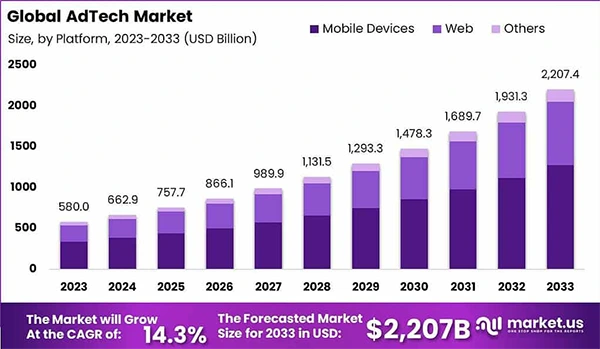
INTRIGUING INSIGHTS The global AdTech market was valued at USD 757.7 billion in 2025, and is expected to grow at a CAGR of 14.3%, reaching USD 2,207.4 billion by 2033.
Benefits of AI-Driven Advertising for Businesses
AI-powered advertising has many benefits for businesses. They can gain faster insights, targeted ads, and marketing efficiency by employing AI in advertising. While manual campaign management remains integral, AI-powered tools can streamline numerous tasks, avoiding the need for manual efforts.
The major benefits are improved audience targeting, higher conversion rates, improved return on investment (ROI), real-time campaign optimization, reduced advertising costs, and faster decision-making.
AI can also be utilized to customize ads for customers according to their choices and browsing habits, which can boost engagement rates. AI-powered AdTech platforms also offer more scalability and automation options for large-scale campaigns, making them more suitable for businesses that handle high-volume campaigns.
Data Privacy Challenges in AdTech and Compliance Needs
Although AdTech provides more sophisticated targeting options, it also presents significant privacy and consent issues. Compliance with privacy regulations is growing more critical, as businesses gather large amounts of customer data.
Organizations must first know the big privacy threats when putting advertising technologies into place.
Common privacy challenges
Excessive data collection
Lack of user transparency
Third-party data misuse
Cross-platform tracking concerns
Fraud and cybersecurity issues
In many countries, the government is adopting tougher online privacy laws to safeguard consumer data.
Ethical data practices and clear advertising policies are crucial for businesses to ensure that customers continue to have faith in the company.
Future Scope in AI-Powered AdTech
AI automation, predictive analytics, and privacy-centric advertising models are likely to be key trends that influence the future of AdTech. With the declining trust in third-party cookies, companies are turning their attention to gaining first-party data and understanding contextual marketing approaches.
There are a number of trends already seeing the light of day that will shape the future of digital advertising, including AI-generated ad creatives, predictive customer TV advertising, cookieless tracking technologies, real-time personalization, and advanced audience analytics.
AI, automation, and advanced analytics should be expected to be part of the most comprehensive observability platform solutions to monitor campaign performance and the efficiency of advertising in real-time.
New technologies such as PromQL are also being adopted to support complex monitoring queries and performance monitoring. With automation and data intelligence still on the rise for businesses, AdTech is one of the most dynamic and evolving sectors of digital marketing.
Frequently Asked Questions
What does AdTech mean?
AdTech refers to technologies used for managing and optimizing digital advertising.
What is programmatic advertising?
It is the automated buying and selling of digital ad space using AI and real-time bidding systems.
How does AI improve digital advertising?
AI improved targeting, personalization, bidding, and campaign optimization.
What are DSPs and SSPs?
DSPs help advertisers buy ads, while SSPs help publishers sell advertising inventory.
Why is data privacy important in AdTech?
Advertising platforms collect a large amount of user data, making privacy compliance essential for protecting customer information.

 Reviewed By Brijesh Kumar Singh
  Saipansab Nadaf