
They collect and analyze employee activity, productivity, collaboration, and feedback metrics to evaluate their overall contributions in real time.
How Data-Driven Performance Tools Are Transforming Employee Recognition in Tech Companies
 Reviewed By Brijesh Kumar Singh
  Kartik Wadhwa
Updated on: May 18, 2026
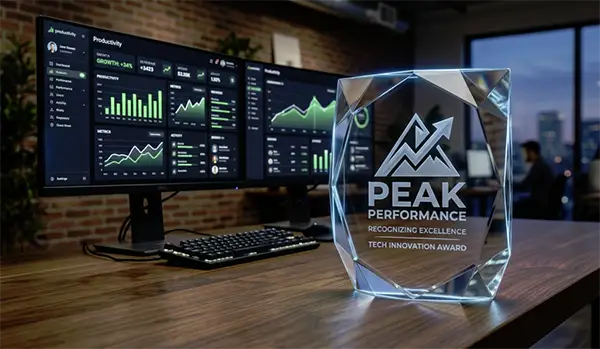
“People work for money but go the extra mile for recognition, praise, and rewards.”
— Dale Carnegie (Writer & Teacher)
Appreciation and recognition have always pushed employee performance. And in the tech field, this is increasingly becoming more and more data-driven. Data-driven performance tools, now part of a broader $100 billion market, are reshaping how companies identify and celebrate impact. Instead of relying on annual reviews or manager memory, organizations can now track thousands of real-time performance signals across engineering and product teams.
Metrics such as deployment frequency, system uptime, collaboration patterns, and peer sentiment enable leadership to recognize meaningful contributions accurately and fast.
In this article, I’ll tell you how data-driven performance tools are transforming employee recognition in tech companies through real-time analytics, AI insights, and personalized rewards.
KEY TAKEAWAYS
- Tech companies are replacing annual reviews with continuous, data-driven recognition systems.
- Real-time metrics help reduce bias and improve visibility into employee contributions.
- Physical and personalized rewards create a stronger emotional impact than digital recognition alone.
- AI-powered tools may soon predict when employees need support or appreciation before projects end.
The Death of the Subjective Annual Review
A new joinee had to wait almost 12 months from hiring to get to know his/her performance. But now managers are leveraging continuous listening tools to automate recognition prompts, which ensures that no significant contribution goes unnoticed due to human forgetfulness. When a developer pushes a critical patch or a designer hits a major sprint goal, the data reflects that achievement immediately.
This shift creates a culture of radical transparency. Employees no longer have to wonder where they stand or fight against the recency bias that often plagues manual evaluations. Instead, they see their progress in dashboards that value output over optics, transforming the manager from a subjective judge into a data-informed coach who can validate hard work with empirical proof.
Linking Digital Metrics to Tangible Recognition
As humans, living-breathing things have a greater impact on us, but data is clearly not. A Slack notification or a digital badge is good, but not as good as a physical commemoration. Personalized awards and trophies bridge this gap by turning fleeting data points into permanent milestones.
When a team lead presents custom trophies designed to last during a quarterly town hall, the award is no longer a generic gesture. It is a physical manifestation of specific metrics, such as the 30 percent increase in retention at Adobe after it switched to prioritizing real-time feedback loops. This combination of high-tech tracking and high-touch rewards creates a psychological anchor for the employee.
Leadership teams in the SaaS space are finding that physical artifacts serve as a constant reminder of their value within the organization. As people are working mostly from their homes, an award displayed on your workdesk connects you to your company in a more meaningful way than a PDF certificate on your workstation.
Modern recognition frameworks typically rely on three specific categories of data:
- Velocity and output metrics from project management software
- Quality scores derived from automated system performance monitoring
- Qualitative peer feedback captured through internal sentiment platforms
SURPRISING INSIGHT
In a study, employee engagement scores increased by 18% as AI-based performance monitoring systems identified employees who needed retention the most.
Engineering Culture and the Psychology of Achievement
But engineers and data professionals do like quantitative numbers more than qualitative appreciation. The use of system-level metrics, such as GitHub commits or Jira velocity, enables organizations to objectively trigger employee rewards based on the actual complexity of the work performed. This granular approach resonates with a workforce that inherently trusts data over narratives.
Recognition that feels earned through measurable effort drives much deeper engagement. When the data shows a team has exceeded its performance benchmarks, the subsequent celebration feels like a shared victory. This alignment between what is tracked and what is celebrated prevents the “recognition gap,” in which employees feel their most difficult work is misunderstood by leadership.
Designing a Future of Precise Appreciation
The AI is not slowing down, so expect these recognition systems to get even more advanced, even predictive. This will soon enable managers to intervene with support or praise before a project even reaches its conclusion. This proactive stance ensures that a team’s momentum is maintained through the highs and lows of a development cycle.
Conclusion
These tools are there to humanize the data. By taking the cold numbers from a dashboard and using them to fuel genuine appreciation, companies foster an environment where people feel seen and valued. It is about using the best technology available to improve the most basic human need: the desire for meaningful acknowledgment of a job well done.
For more insights into optimizing your team culture and maintaining high performance standards, explore our archives of interesting, actionable posts.
Frequently Asked Questions
What are data-driven performance tools?
Why are annual performance reviews becoming less effective?
Annual reviews often suffer from memory gaps and recency bias. Continuous feedback systems provide more timely and accurate recognition.
How do tech companies measure employee performance?
Metrics such as deployment frequency, project velocity, system reliability, peer feedback, and collaboration insights help in this.
Why does tangible recognition still matter in digital workplaces?
Physical awards and personalized recognition create lasting emotional connections and reinforce employees’ sense of belonging, especially in remote work environments.
Related Posts
8 Best AI Presentation Makers for Business-Ready Slides
Making a presentation doesn’t just mean designing slides. It’s about defining a clear structure, using defined logic, useful visuals, and…

Queue Management Software Troubleshooting Guide: 8 Common Faults and Fixes
The long wait times and ineffective management of customer queues can have a significant impact on customer satisfaction and business…
How to Use Similarweb Website Traffic Data for Competitor Research
Competitor research without traffic data is guesswork. You can guess who your rivals are, guess how big they are, guess…
Choosing the Right Hosting Model for Scalable Digital Platforms
The performance of digital business is directly related to website speed, uptime, and scalability. Slow page performance has a negative…

Why Businesses Struggle to Collect Reliable Data from the Web
Almost every company that depends on data runs into the same problem: although they can find the data they need,…

Why Financial Data Recovery Matters for Businesses
Financial data supports every part of a business, directly affecting cash flow, payroll, tax reports, audits, customer billing, and daily…

CMMC Compliance Is Coming for Manufacturers. Here Is What You Need to Do
“Cybersecurity is much more than a matter of IT.” — Stephane Nappo (Cybersecurity Professional) For manufacturers working within the defense…

How Data-Based Tools Influence Learning Performance
Learning has transformed in the modern age with the integration of new technologies to help students and professionals prosper in…

Why Offline Communication Tools Still Matter in a Digital-First Business World
Marketing teams and other professionals feel like SEO, reels and digital ads are the only way to do marketing. This…