
Queue management software is a system of managing customer flow, appointments, and queues digitally for businesses.
Queue Management Software Troubleshooting Guide: 8 Common Faults and Fixes
 Reviewed By Brijesh Kumar Singh
  Saipansab Nadaf
Updated on: May 20, 2026
Table of Contents
- Fault 1: System Downtime and Slow Performance
- Fault 2: Inaccurate Queue Status or Ticket Updates
- Fault 3: Poor Integration with Existing Business Systems
- Fault 4: Data Loss, Backup, and Recovery Problems
- Fault 5: Security Gaps and Unauthorized Access Risks
- Fault 6: Notification and Alert Delivery Failures
- Fault 7: Reporting, Analytics, and Dashboard Errors
- Fault 8: Poor User Experience for Staff and Customers
- Building a More Stable and Secure Queue Management System
- Conclusion
- Frequently Asked Questions
The long wait times and ineffective management of customer queues can have a significant impact on customer satisfaction and business performance. Industry research indicates that companies that do not manage queues well have return customer rates of approximately 62%, and those that manage queues well may experience a return rate of around 89%.
Customer expectations have readily increased in retail, healthcare, banking, and service sectors, and dependable queue management technology is fundamental to operating a successful business.
The contemporary queue management software benefits businesses with the ability to organize appointments, minimize wait times, enhance the operation of the service, and have a real-time overview of customer interactions.
But, as with all digital systems, there are technical issues that can impact queue management systems, affecting performance, reporting, and customer experience. By knowing which are the most prevalent and how to address them, businesses can ensure that operations run more smoothly and customer satisfaction is higher.
Key Takeaways
- The software is used for queue management, enhancing user flow, and user operational efficiency.
- Technical issues such as downtime and synchronization can arise.
- Failure to integrate can jeopardize business systems that are interconnected with each other.
- Operational data is backed up and secured.
- Easy-to-use systems enhance staff and customer experience.
What is Queue Management Software and Why Does it Matter for Businesses
Queue management software is used to manage the flow of customers in both physical and virtual environments. Rather than waiting in a queue, the new systems automatically generate tickets, inform customers, schedule appointments, and prioritize services. These are extensively employed in retail stores, hospitals and clinics, banks, government offices, and customer support centers. Here is how it works:
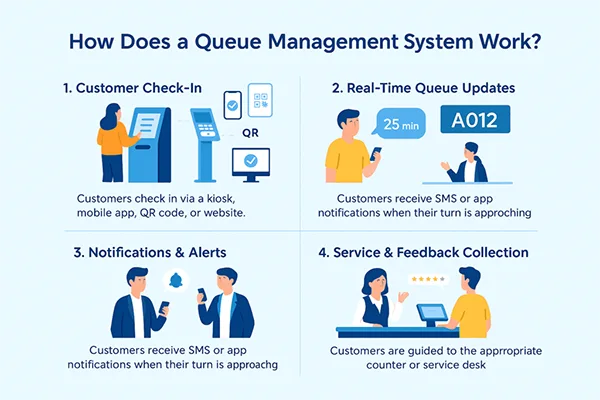
Reliable queue management enhances the efficiency of operations, minimizes congestion, better coordinates staff, and ensures a smoother customer experience. Modern queueing systems also provide businesses with performance metrics, such as identifying service bottlenecks and optimizing staffing levels.
Fault 1: System Downtime and Slow Performance
The most frequent problem businesses encounter is system instability during the prime operating time. There may be reasons for queue management systems to slow down, such as insufficient server resources, network congestion, outdated software, high traffic loads, and A lack of cloud infrastructure scalability.
If systems slow down or fail, customers quickly become frustrated because ticket updates and services become unreliable. Routine performance tracking, software upgrades, and scalable hosting infrastructure help minimize the risk of downtime significantly. Companies with several stores should also determine the ability of the infrastructure to handle and minimize the number of transactions at peak times.
Fault 2: Inaccurate Queue Status or Ticket Updates
The need for accurate queue information is critical for customers. Issues arise when ticket numbers or estimated wait times do not update accurately, or when the position in the queue does not update. These problems are frequently related to synchronization failures, weak internet connectivity, software bugs, or delayed database updates.
Just a few minutes of delays in queues can cause difficulties for customers and staff. Businesses should perform regular tests on real-time synchronization systems and make sure all service counters, kiosks, and/or digital displays are properly synced. Accurate visibility of queues is dependent on reliable data flow between devices.
Fault 3: Poor Integration with Existing Business Systems
One of the most common challenges faced by many businesses is when the queue software doesn’t integrate seamlessly with their current systems. For instance, a business that is utilizing retail queue management software will also utilize CRM platforms, appointment systems, payment software, or customer databases. In the absence of effective communication between these systems, operational inefficiencies are soon evident.
If a person has integration problems, they will likely experience:
- Duplicate customer records
- Delayed appointment updates
- Reporting inconsistencies
- Workflow interruptions
Selecting software that has the ability to support different kinds of API, which are compatible with various integration types, minimizes these problems. Integrations should also be tested before being deployed on a full scale in the business.
INTERESTING STAT
73% of Gen Z & Millennials would leave if the waiting time exceeds 5 minutes.
Fault 4: Data Loss, Backup, and Recovery Problems
Valuable customer and operational data is being processed in queuing management systems every day. A loss of that information would impact business continuity due to a failure in the hardware, accidental deletion, or a hacking attack.
Typically, businesses experience data recovery issues when they:
- Skip regular backups
- Do not use legacy storage systems
- Did not play recovery after a disaster
- Failing to test recovery procedures
Good backup systems feature automated scheduling, encrypted storage, and testing their backups for recovery. Cloud-based backup environments may offer greater redundancy and quicker recovery options than local-only storage solutions. The data in the queue must be handled as any other data in the business operation.
Fault 5: Security Gaps and Unauthorized Access Risks
Queue systems may contain critical customer and operational information, such as appointment details, contact information, and service history. Businesses face the risk of unauthorized system access, data leaks, insider misuse, residential theft, and malware attacks.
Typical security issues include weak passwords, having users with too many permissions, or failing to keep software up to date. Access controls, multifactor authentication, role-based permissions, and regular security audits contribute significantly to lowering system vulnerabilities.
Customer privacy continues to have a constantly evolving landscape, and safeguarding queue management information is growing in significance.
Fault 6: Notification and Alert Delivery Failures
Today, many queue management systems use SMS, email, or application messages to provide customers with notification information, such as appointment or service availability. There can be issues if alerts are not sent properly, due to messaging gateway issues, API failures, invalid customer data, or network outages. Customers’ satisfaction can be impacted by scheduling confusion caused by missing notifications.
It is important for businesses to keep a close watch on delivery success rates from time to time and keep having backup methods of communication in case of any emergency. Notification systems should be tested regularly to maintain consistency during high demand.
Fault 7: Reporting, Analytics, and Dashboard Errors
By analyzing queuing data, businesses can assess how well their operations are working, how long it takes customers to get in line, and how efficiently their staff is working. But if the dashboards are incorrect or there are reporting mistakes, then the business decisions can be poor.
The following are common causes of analytics problems:
- Incomplete data collection
- Incorrect metric configuration
- Delayed synchronization
- Integration inconsistencies
If a system fails to report, managers might not be able to pinpoint exactly where the trouble is in the service or in the operation. It’s crucial for businesses to periodically test the accuracy of their reporting and audit the setup of their dashboards to keep performance metrics accurate and useful.
Fault 8: Poor User Experience for Staff and Customers
There’s no point in having technically viable systems if they’re not easy to use. When an interface is complicated, a workflow is not clear, or a kiosk is poorly designed, both the employees and customers are likely to become frustrated. This can impede the service operations and not enhance them.
Poor visibility is normally found in self-service kiosks, mobile queue systems, staff dashboards, and appointment booking interfaces. It helps to have systems that are easy to navigate, have clear workflows, and provide support that is responsive. Another important factor is training employees, which is a key factor in enhancing adoption and consistency
Building a More Stable and Secure Queue Management System
It is not sufficient to install software to achieve long-term success in queue management. To run smoothly, businesses require a robust infrastructure, security measures, seamless integration, and system maintenance.
With consistent performance monitoring, backups, and critical integrations being thoroughly tested and user experience being enhanced, organizations are significantly more likely to sustain stable queue operations over time.
In an era of ever-changing customer expectations, efficient queue management systems will be increasingly crucial to the quality of service, efficiency, and customer retention in business sectors.
INTERESTING FACT
Certain sophisticated queue management systems now employ AI to accurately forecast customer waiting times dynamically, taking into account real-time traffic conditions and historical service statistics.
Conclusion
Businesses that deal with customer appointments and service lines or have a high volume of interactions with customers are increasingly dependent on queue management software as an essential part of their operations. These systems help streamline processes and enhance customer experience, but when they aren’t working properly, technical issues like downtime, integration problems, security concerns, and faulty reporting can have a significant impact on their efficiency.
By knowing about the typical queue management error types and how to prevent them, and by taking proactive measures in maintaining, securing, and recovering the queuing environment, businesses can achieve more stable, scalable, and customer-friendly queueing environments.
Frequently Asked Questions
What is queue management software?
Why do queue systems have downtime?
There are usually due to server overload, network problems, and outdated infrastructure.
What are the ways of securing the queue management data in a business?
Backups, encryption, access controls, and regular security monitoring.
What is the advantage of using queue management in business?
It helps minimize confusion when waiting, increase communication, and make service operations smoother.
Related Posts

8 Best AI Presentation Makers for Business-Ready Slides
Making a presentation doesn’t just mean designing slides. It’s about defining a clear structure, using defined logic, useful visuals, and…

How to Use Similarweb Website Traffic Data for Competitor Research
Competitor research without traffic data is guesswork. You can guess who your rivals are, guess how big they are, guess…

Choosing the Right Hosting Model for Scalable Digital Platforms
The performance of digital business is directly related to website speed, uptime, and scalability. Slow page performance has a negative…

How Data-Driven Performance Tools Are Transforming Employee Recognition in Tech Companies
“People work for money but go the extra mile for recognition, praise, and rewards.” — Dale Carnegie (Writer & Teacher)…

Why Businesses Struggle to Collect Reliable Data from the Web
Almost every company that depends on data runs into the same problem: although they can find the data they need,…

Why Financial Data Recovery Matters for Businesses
Financial data supports every part of a business, directly affecting cash flow, payroll, tax reports, audits, customer billing, and daily…

CMMC Compliance Is Coming for Manufacturers. Here Is What You Need to Do
“Cybersecurity is much more than a matter of IT.” — Stephane Nappo (Cybersecurity Professional) For manufacturers working within the defense…

How Data-Based Tools Influence Learning Performance
Learning has transformed in the modern age with the integration of new technologies to help students and professionals prosper in…

Why Offline Communication Tools Still Matter in a Digital-First Business World
Marketing teams and other professionals feel like SEO, reels and digital ads are the only way to do marketing. This…