
An SSL certificate is a way to authenticate a website’s identity and enable an encrypted connection.
How to Choose the Right Hosting Partner for Your Growing Business
 Kartik Wadhwa
Updated on: Jan 20, 2026
Table of Contents
- Why Your Hosting Partner Matters More Than You Think
- Define Your Hosting Needs Right Away
- Assess Uptime Guarantees (and SLAs)
- Prioritize Security and Data Protection
- Scalability: Grow Without Issues
- Performance: Speed, Locations & Tech Stack
- Clear Pricing and Honesty
- Solid Customer Support & Onboarding
- Reputation and Real User Feedback
- Backup and Recovery Plans
- Terms, SLAs, and Exit Strategy
- Stats Worth Noting
- Choose a Partner, Not Just a Provider
- Frequently Asked Questions
The requirements for your website, whether they be operational, security, or performance-related, expand along with your business. At this point, regulating a reliable hosting company becomes crucial.
Hosting solutions providers like Atlantic are designed for growing businesses. They do more than simply host your website; they also ensure that it functions properly, remains secure, can expand with your business, and you have all the support you require.
We’ll walk you through some advice today to help you decide on a hosting partner who will support you in reaching your objectives and provide some valuable insights that are not easily available.
Let’s begin!
Key Takeaways
- Understanding the importance of a hosting partner
- Uncovering your needs
- Looking at the important security features
- Decoding clear pricing and customer support
- Exploring the crucial metrics of backup and recovery
Why Your Hosting Partner Matters More Than You Think
Before we tackle one tip, let’s try to understand the big picture. A reliable hosting partner can affect every aspect of your online presence.
Uptime = Availability = Revenue
Let’s say that during a period of high sales, your website crashes. No action is taken despite your visitors’ constant clicking. They’re gone, poof.
Website downtime has financial consequences. Hosting uptime can measure how often your server stays online and accessible.
All the minutes (or hours) that your site isn’t functioning translate to lost opportunities, unhappy clients, or money slipping through your fingers.
Security Protects Trust and Reputation
Every business on the internet needs to have proper security. This means firewalls, backups, and protection from malware. Furthermore, many companies use protocols like DMARC (Domain-based Message Authentication, Reporting, and Conformance) to protect their emails.
A good web hosting provider can integrate security tools that improve your domain’s email reputation and protect your business from common threats.
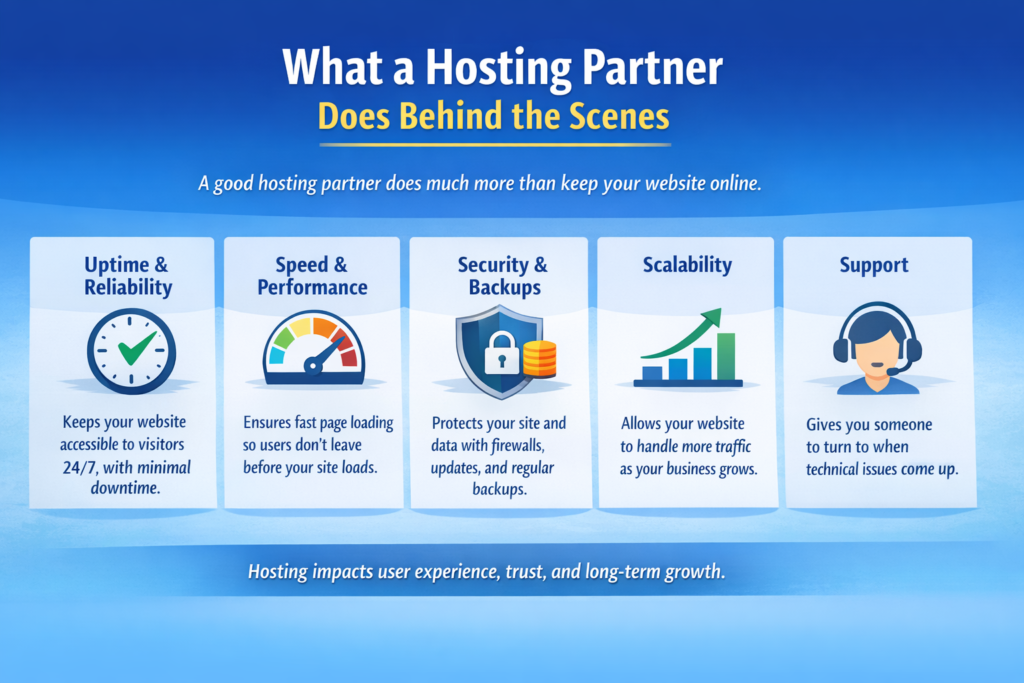
Alt text: What a hosting partner does behind the scenes.
Define Your Hosting Needs Right Away
Fully understand just what it means to your business. Ask yourself:
- What kind of website do I want? Just a blog, an e-commerce site, or maybe an SaaS app?
- How much traffic do I expect now? How much do I expect in 6 months?
- Do I require email hosting, databases, or custom applications?
- Do I have the need for geographic presence (customers in Europe, Asia)?
Different needs entail different types of hosting:
- Shared Hosting: It’s good for your budget, but it’s limited in performance.
- VPS (Virtual Private Server): The next step from shared hosting, it offers a bit more control.
- Cloud Hosting: Excellent for small businesses that experience fluctuating traffic.
- Dedicated Servers: For optimal performance, suitable for big businesses.
Assess Uptime Guarantees (and SLAs)
Not all hosting companies are the same when it comes to uptime. You have to look for:
Uptime Guarantees and Monitoring
Always check the Service Level Agreement (SLA). An SLA is a contract that specifies expected uptime and provides compensation if those expectations are not fulfilled.
Reputable providers provide clear status pages or uptime monitors that can display actual performance over time.
Why It Is Relevant for Search Engine Optimization and Your Customers
Google and other search engines favor stable and fast-loading sites. Your ranking may suffer when your website is slow or unavailable, which could lead to unhappy customers.
If you choose your host wisely, it could even positively affect your online marketing performance.
Interesting Facts
Downtime can be costly, with small businesses potentially losing between $137 and $427 per minute and larger companies over $16,000 per minute
Prioritize Security and Data Protection
Security is not an ‘add-on,’ it’s the baseline. Some core security essentials you should look for are:
- SSL certificates (encrypt user data)
- Automated backups (so you don’t lose data)
- Firewalls and scanning for malware
- DDoS protection (prevents malicious overload attacks).
Scalability: Grow Without Issues
Today, you could serve hundreds of visitors daily. Tomorrow, thousands. Your hosting partner should allow you to scale:
- Plans are simple to upgrade or downgrade.
- Smoothly boost CPU, bandwidth, or storage
- Make support available for cloud or hybrid infrastructure.
Scalability saves you from expensive transitions later on because you have outgrown your plan.
Performance: Speed, Locations & Tech Stack
Performance isn’t limited to the server. It’s also about the user experience.
Speed influencers:
- SSD storage for quick read/write operations
- Content Delivery Networks (CDNs) to serve content fast worldwide
- Server locations close to major audience hubs
The ability to get faster loading speeds reduces the bounce rates
Clear Pricing and Honesty
Your budget matters, but cheap web hosting isn’t always the better choice if you’re running a bit low on cash.
Watch for:
- Low introductory prices with sky-high renewal costs
- Hidden fees
- Billing traps when you require additional bandwidth or domains
A good host is upfront about their costs.
Solid Customer Support & Onboarding
Things can go wrong, and when they do, you need help that really fixes problems. Faster response and smart support teams can save hours of time and unexpected downtime.
Search for:
- Availability (available 24/7 by phone, chat, etc.)
- Quick issue resolution
- Helpful documentation and tutorials
If the support team is struggling to answer basic questions beforehand, just think about how they would help you if you were in a crisis. Pay attention.
Reputation and Real User Feedback
Reviews are more than just ratings. They share stories about:
- Actual uptime experiences
- Support responsiveness
- Unexpected costs
- How easy it was to scale or migrate
Look for reviews on independent review sites and on online forums. Even social media will do the trick.
Backup and Recovery Plans
Even the best systems aren’t perfect. So here are the things that can help if things go wrong:
- Automated backups (preferably daily)
- Off-site storage
- Easy restoration tools
A good hosting partner will make sure that your data is backed up and easy to recover.
Terms, SLAs, and Exit Strategy
It may be a little awkward (if you’re signing the contract in person), but take the time to read the:
- Hosting terms of service
- SLA details
- Their cancellation policy
You must know what will happen if you have traffic spikes, if you decide to downgrade, or if you decide to leave. A good host will not hold you hostage with penalties.
Stats Worth Noting
When a host promises that the uptime will be 99.9%, this means there will still be almost 9 hours of downtime in a year. The outcome will be less than an hour of downtime if that guarantee is raised to 99.99% uptime, which can be essential for business continuity.
Performance can also make an impact on revenue (big time). According to Google’s findings, when a site loads in more than three seconds, 53% of mobile visitors will leave the site, which has a massive impact on conversion rates.
Those stats show that your hosting choice isn’t a technical detail. It can make an impact on your revenue.
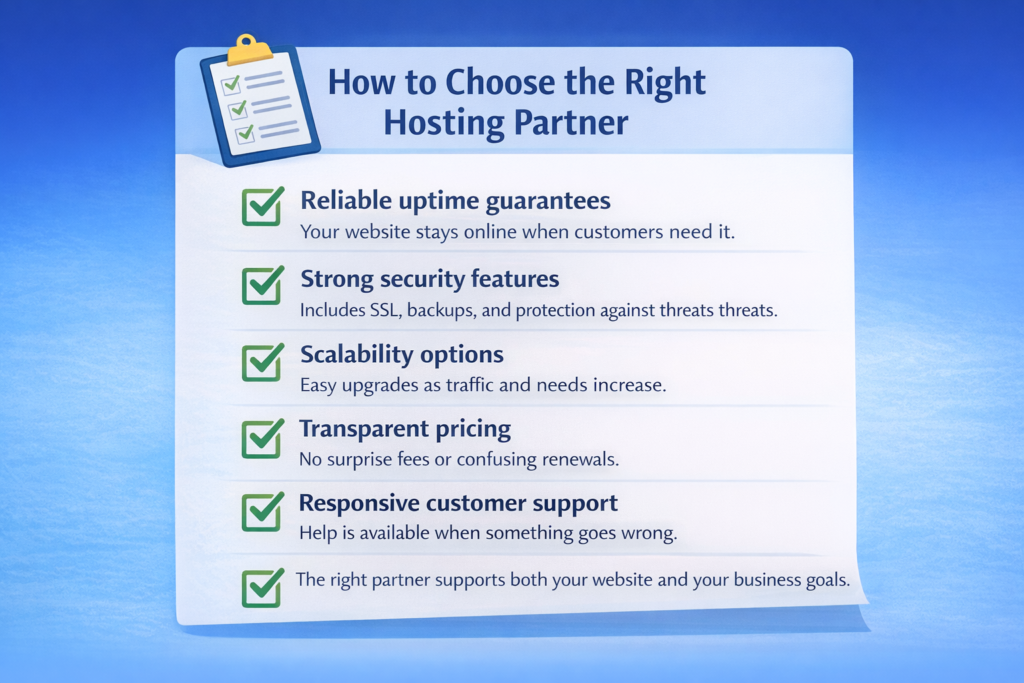
Alt text: How to choose the right hosting partner.
Choose a Partner, Not Just a Provider
When you choose a hosting partner, you’re choosing the foundation of your online presence.
The right partner will:
- Understand what your needs and goals are
- Give you stability and security
- Stand by you during difficult times
- Be able to grow with you
- Protect you (not only your site, but also your online reputation)
Whether it is the launch of your first business website or if you want to upgrade from a shared host, remember to review your hosts using the checklist above.
It’s also worth remembering that the right hosting partner doesn’t just support your website today. They help you plan for the future. If you want more traffic, new features, or additional security, having a provider that can adapt with you reduces the stress of doing it all by yourself.
Think about choosing your host as choosing a new relationship. Trust and transparency are important factors. Trust your gut and just go for it. We wish you the best of luck.
Frequently Asked Questions
What security is for web hosting?
Why is host security important?
Host security is crucial for protecting individual devices and hosts on a network from cyber threats, data breaches, and cyberattacks.
Is it safe to host your website?
While self-hosting offers control over security, it also entails a higher risk of security breaches if not managed correctly.
Related Posts
Simple Ways to Clean Audio Data for Better Model Performance
Most of the machine learning teams do not struggle because their processing systems are not capable—they struggle because their audio…

How to Check for Malware on Mac in 2026?
Can Mac computers get viruses? Macs are not as safe as people think. Yes, macOS has built-in tools like XProtect…

10 Best Lightroom Preset Alternatives in 2026
“Photography is the story I fail to put into words.” — Destin Sparks (Landscape Photographer) For years, Lightroom presets have…
Elementor Hosting vs SiteGround: Which is Faster in 2026?
A website’s performance is mainly determined by its Speed. Even a slight delay can reduce conversions by a significant margin.…

10 Best Visual UGC Platforms for eCommerce Brands in 2026
“People influence people. Nothing influences people more than a recommendation from a trusted friend.” — Mark Zuckerberg (Meta CEO) That…

The Data Models Powering the Next Creative Revolution in Video Generation
Artificial intelligence has evolved from a mere tool to the cornerstone of advancements in the new era. Over the years,…

Solar Software Companies: How Platforms Improve Cross Team Collaboration
“If everyone is moving forward together, then success takes care of itself.” — Henry Ford (Industrialist & Business Magnate) Handoffs…

What Healthcare Leaders Expect From Digital Tools
Healthcare executives are under pressure to protect patient safety, clinician time, and data privacy while modernizing the delivery of care.…

How to Reset Android Phone When Locked? (Safe Factory Reset Methods)
Locked out of your Android phone or stuck on the screen? It happens more than you think. A forgotten PIN,…