Healthcare has changed drastically in the past few years, thanks to technology. However, there’s still something holding it back: the burden of administrative work. Clinics report spending nearly 28 hours per week on administrative tasks, leaving less time for direct patient care and contributing to burnout. (Source: PR Newswire)
And this is where data-driven AI assistants come to the rescue. They help schedule appointments faster, respond to patient queries instantly, and support clinicians behind the scenes.
In this post, we will learn a bit more about data-driven virtual medical assistant and see how they are becoming a survival tool for modern healthcare practices.
Key Takeaways
AI assistants are best at removing friction, not making decisions.
The real win isn’t automation; it’s time reclaimed.
Patients notice faster responses more than flashy tech.
Staff burnout often occurs once repetitive tasks disappear.
AI works best when it supports people, not replaces them.
Role of Virtual AI Assistants in Healthcare Practices
Think of virtual AI assistants as supporting staff. They handle routine, repetitive, and time-consuming tasks that traditionally consumed a significant portion of the staff’s time. They manage stuff like addressing patient inquiries, coordinating schedules, and fixing appointments, allowing healthcare professionals to focus on more crucial tasks and give their best to patients.
Let’s understand more with the help of a case study.
CASE STUDY A mid-sized primary care clinic was struggling to manage tasks with overflowing phone lines and missed appointment calls. The front-desk staff was under extreme pressure, always multitasking. This harmed the overall reputation and efficiency of the clinic since patients were put on hold, and staf spend hours answering the same questions about appointment availability, insurance acceptance, and all. Then, they decided to put virtual AI assistants in place to handle incoming patient queries and appointment scheduling. Within a few weeks, they could see the results. The AI assistant had gracefully taken over these monotonous tasks, which helped the professionals to focus on more important work behind-the-scenes.
How Data Powers Virtual AI Assistants in Healthcare
Now, the question arises, “What exactly is the role of data in all this?” Well, data forms the core of every AI assistant in healthcare as they rely on structured and unstructured data such as appointment histories, patient interactions, and systems logs to understand patterns and respond accordingly.
With more data flowing, AI assistants get a chance to learn continuously and improve with it. Accurate, well-maintained data results in better predictions, smoother workflows, and more personalized patient interactions.
PRO TIP When shifting to virtual assistants. Take smaller steps and do not transfer all the responsibilities at once. This reduces the chances of complications and makes transitions smoother.
Key Use Cases of AI Virtual Assistants in Healthcare Operations
Virtual AI assistants handle a series of healthcare operations, some common ones are:
Appointment Scheduling
They are capable of navigating through loads of data. Check availability in real time and schedule appointments. This reduces scheduling conflicts, even sends reminders to the patients, helping minmize nor shows or queues of people at a given time.
Patient Support
Patients sometimes need assistance with administrative work, and AI assistants can take care of that, too, in some cases. They can answer common questions and guide patients through forms or procedures. On top of that, they are 24/7 available to answer client queries in real time.
Clinical Assistance
Modern assistants support clinical teams by organizing patient information, summarizing records, and assisting with documentation workflows, reducing clerical fatigue and improving data accessibility for healthcare professionals.
These things lift a huge burden off the staff’s shoulders and give them time to breathe and manage other tasks that require manual effort.
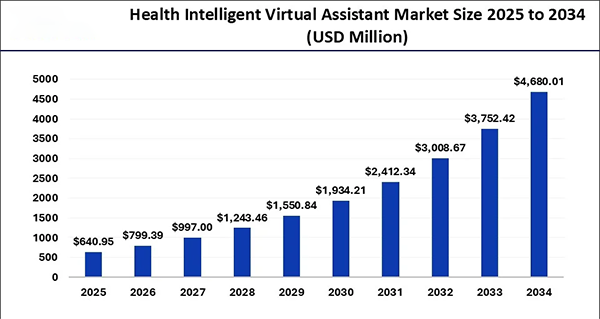
Since these assistants prove to be immensely helpful for organizations, the health intelligent virtual assistant is on the rise and is expected to reach $4,680.01 million in 2035 from $640.95 million in 2025.
Data Privacy, Security, and Compliance in AI-Driven Healthcare Systems
Since healthcare systems deal with a lot of sensitive patient data, they must comply with certain regulations and standards to ensure the patient information stays protected at every stage. Organizations must keep these considerations in account when choosing an AI assistant, going for the one that offers secure data storage, controlled access, encryption, and audit trails.
They should also make sure the data used by AI assistants is accurate, properly managed, and recoverable in case of system failures or cyber incidents.
DataRecovee – Your Health Data Backup and Recovery Tool
For AI assistants to actually benefit an organization, they require reliable data, including strong backup and recovery solutions in place. DataRecovee can help you achieve that and support healthcare practices by safeguarding critical health data against accidental loss, system failures, or cyber threats.
It can be your ultimate data backup and recovery tool and help you maintain continuity, protect patient information, and keep AI-driven systems running smoothly. Remember that having a dependable backup and recovery tool is not just a precaution but a necessity today.
Conclusion
Healthcare never really slows down; every day is full of appointments, urgent needs, and continuous decision-making. This makes it hectic for the working professionals. AI assistants lessen their burdens by handling monotonous tasks such as appointment scheduling, patient support, and clinical tasks on their own.
Since there are a lot of sensitive details about the patients involved, data security should be prioritized. AI support systems should be trained to comply with all the regulations. For those looking for reliable data backup and recovery solutions, DataRecovee can be the one for you and help you maintain continuity and manage data.
Frequently Asked Questions
Do patients feel comfortable talking to an AI assistant?
Most patients do, especially since it gives fast, clear answers. Patients care more about speed and clarity than whether the first response comes from a human or AI.
What happens when the AI doesn’t know the answer?
If the AI doesn’t know the answer to a certain question, it steps aside and transfer to query to manual staff instead of guessing the answers.
Does using AI make a practice feel less personal?
Only if it’s poorly set up. When done right, AI can handle the busywork so humans can be more present where it matters.
Can AI assistants work outside office hours?
Yes, and this is one of the biggest advantages they offer. Patients can get help even when the clinic is closed.


 Kartik Wadhwa