
Data-driven marketing is a strategy where companies analyze customer data to design more targeted and effective marketing campaigns.
What is Data-Driven Marketing? How Companies are Adopting Data-Centric Strategies
 Mahima Dave
Updated on: Jan 22, 2026
Table of Contents
- Understanding Data-Driven Marketing
- Why Data is Becoming Central to Modern Marketing Strategies
- How Companies Implement Data-Driven Marketing Approaches
- Role of Data Migration and Integration in Marketing Analytics
- Tools and Technologies Powering Data-Driven Marketing
- Protecting Customer Data While Leveraging Insights
- Common Challenges Businesses Face in Data-Driven Marketing
- Conclusion
- Frequently Asked Questions
Marketing once heavily relied on instinct, creative ideas, brand messages, and educated guesses about what the customers might want. Although it might have worked for some, it wasn’t the smartest way to do work. Then entered data, analytics, and measurable insights. And the results? It helped businesses create smarter campaigns, better customer experiences, and more effective marketing strategies.
Even McKinsey reports noted that organizations that use customer analytics extensively are 23 times more likely to acquire customers and 6 times more likely to retain them compared to companies that rely less on data.
This proves that data makes a huge difference! So, if you are a business owner wanting to learn how data-driven marketing works and what strategies yield the best results. This guide might be the only thing you need.
Key Takeaways
- Data-driven marketing makes decisions about marketing based on analytics and customer data.
- Companies using customer analytics are far more likely to acquire and retain customers.
- Personalization is one of the biggest advantages of data-centric marketing strategies.
- Data integration helps businesses build a complete view of their customers.
- Protecting customer privacy is essential for sustainable data-driven marketing.
Understanding Data-Driven Marketing
Businesses use customer data and analytics to make marketing decisions in a strategy called data-driven marketing. Marketers don’t just start campaigns based on guesses; they look at data like:
- How customers browse
- History of purchases
- Demographics
- Reading and responding to emails and ads
- Social media interaction
These insights help marketers figure out what exactly the customers want, when they want it, and how they like to talk to brands. The goal is to send messages that are more relevant, come at the right time, and are tailored to each person, which will lead to more engagement and sales.
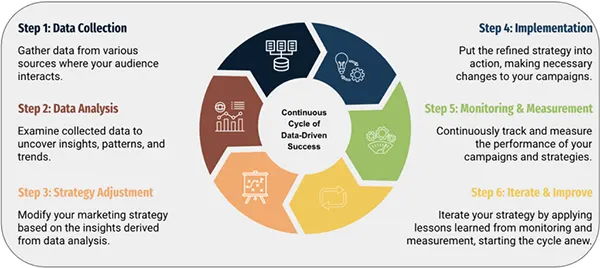
To understand better, the infographic below gives a gist of what it actually is:
Why Data is Becoming Central to Modern Marketing Strategies
Every day, the digital ecosystem produces huge amounts of data. Companies that know how to read and use this data can make better choices. The following factors explain why data has become the backbone of modern insights:
Customer Insights
Data shows patterns in how customers act that would otherwise be hard to see. For instance, marketers can look at what products customers look at the most, how long they stay on a website, or what kinds of posts they like on social media.
Companies can use these insights to learn more about their target audience and adjust their marketing campaigns accordingly.
Personalization
People are expecting more and more personalized experiences. Businesses can use data-driven marketing to customize content, suggest products, and ads to each user. You might have noticed how e-commerce sites often show products that you have searched for or bought by you.
This level of personalization makes marketing seem more relevant, which often leads to more sales.
Performance Tracking
One of the best things about data-driven marketing is that you can get accurate, measurable results. Marketers can track metrics such as:
- Click-through rates
- Conversion rates
- Customer acquisition costs
- Campaign return on investment
By analyzing these numbers, businesses can quickly identify what works and adjust their strategies in real-time.
How Companies Implement Data-Driven Marketing Approaches
Collecting data is the first step in using a data-driven marketing strategy. Companies need to make systems that help them sort, look at, and act on data in the best way possible.
A lot of businesses make centralized marketing analytics platforms that bring together customer data into one dashboard.
This lets marketing teams keep an eye on campaigns, look at how people act, and improve their plans all the time. Companies also choose to work with partners like Uinno software product development agency, for the industry expertise they bring into the processes.
These partners help them create digital platforms that can grow, add analytics tools, and make marketing technology solutions that are unique to their needs, allowing teams to turn raw data into useful information.
Role of Data Migration and Integration in Marketing Analytics
Many times, marketing data comes from more than one place, like CRM systems, email systems, advertising tools, and customer support systems. Marketers have a hard time getting a full picture of how customers act if these systems stay separate. This is when data migration and integration become very important.
Businesses can get a better picture of each customer by putting all of their information into one place. This unified data environment makes it easier to divide up your audience, target them better, and get more accurate marketing information. Integration also makes it easier for teams to work together by making sure everyone uses the same data source.
Tools and Technologies Powering Data-Driven Marketing
Modern data-driven marketing depends on a lot of different technologies that are made to gather, study, and use customer data. Some of the most common tools are:
- Customer relationship management systems (CRM)
- Platforms for automating marketing
- Customer data platforms (CDPs)
- When analytics tools
- Personalization engines that use AI
These technologies are good for businesses and enable them to automate marketing processes while continuously analyzing customer interactions.
FUN FACT
The concept of data-driven marketing dates back to catalog retailers in the early 20th century, who analyzed customers’ purchase records to decide which products to feature in their mail-order catalogs.
Protecting Customer Data While Leveraging Insights
Data can be a great way to market, but it also comes with responsibilities. Businesses need to make sure that they handle customer information in a safe and moral way. This means following privacy laws like GDPR and other global data protection frameworks, as well as having strong data protection policies and encrypting sensitive information.
Managing data responsibly builds trust with customers and makes sure that data-driven marketing strategies will work in the long run.
Common Challenges Businesses Face in Data-Driven Marketing
Even though it has its benefits, using a data-driven approach to marketing strategies can be hard; it brings its own set of challenges. One common problem is data fragmentation, which happens when customer data is spread out over several platforms. If you don’t integrate things properly, it gets hard to get useful information.
Data quality is another problem. If your data is wrong or out of date, it can lead to inaccurate conclusions and campaigns that don’t work. Some businesses also face privacy and compliance concerns, particularly when managing large amounts of personal customer data.
Overcoming these requires a combination of technology, expertise, and strong governance frameworks.
Conclusion
To be good at marketing, you need to be both creative and smart. With data-driven marketing, companies can stop guessing and start making decisions based on how real customers act. Companies can make campaigns that feel more relevant and work better if they know what people want, when they want it, and how they interact with brands.
But collecting information is not enough to make data-driven marketing work. It needs the right infrastructure, dependable analytics tools, and good ways to handle data.
Companies that invest in these skills now will be better able to connect with customers, keep up with market changes, and compete in a world that is becoming even more digital with each passing day. The data that customers leave behind is often the most useful information in modern marketing.
Frequently Asked Questions
What is data-driven marketing?
Why is data important in modern marketing?
Data helps businesses understand customer behavior, personalize experiences, and measure the performance of marketing campaigns.
What tools are used for data-driven marketing?
Common tools include CRM systems, marketing automation platforms, analytics tools, and customer data platforms.
Can small businesses use data-driven marketing?
Yes, even small businesses can analyze website analytics, email campaign data and customer interactions to improve marketing strategies.
Related Posts
Simple Ways to Clean Audio Data for Better Model Performance
Most of the machine learning teams do not struggle because their processing systems are not capable—they struggle because their audio…

How to Check for Malware on Mac in 2026?
Can Mac computers get viruses? Macs are not as safe as people think. Yes, macOS has built-in tools like XProtect…

10 Best Lightroom Preset Alternatives in 2026
“Photography is the story I fail to put into words.” — Destin Sparks (Landscape Photographer) For years, Lightroom presets have…
Elementor Hosting vs SiteGround: Which is Faster in 2026?
A website’s performance is mainly determined by its Speed. Even a slight delay can reduce conversions by a significant margin.…

10 Best Visual UGC Platforms for eCommerce Brands in 2026
“People influence people. Nothing influences people more than a recommendation from a trusted friend.” — Mark Zuckerberg (Meta CEO) That…

The Data Models Powering the Next Creative Revolution in Video Generation
Artificial intelligence has evolved from a mere tool to the cornerstone of advancements in the new era. Over the years,…

Solar Software Companies: How Platforms Improve Cross Team Collaboration
“If everyone is moving forward together, then success takes care of itself.” — Henry Ford (Industrialist & Business Magnate) Handoffs…
What Healthcare Leaders Expect From Digital Tools
Healthcare executives are under pressure to protect patient safety, clinician time, and data privacy while modernizing the delivery of care.…

How to Reset Android Phone When Locked? (Safe Factory Reset Methods)
Locked out of your Android phone or stuck on the screen? It happens more than you think. A forgotten PIN,…