
Digital infrastructure provides businesses with enhanced communication, collaboration, efficiency, innovation, flexibility, and scalability, leading to overall improved operations and growth potential.
Why Practical Digital Infrastructure Is Useful For Financial Firms
 Saipansab Nadaf
Updated on: Feb 16, 2026
Ever wondered why practical digital infrastructure is so useful for financial firms? Well, the answer is here.
According to the Ministry of Communications, India’s digital economy contributed 11.74% to GDP in 2022-23 (₹31.64 lakh crore) and employed 14.67 million workers. Productivity in this sector is five times higher than in others, with its share projected to reach 20% of GVA by 2029-30.
This article aims to highlight the need for a digital infrastructure in a finance firm, focus on how it actually works, and streamline its core, enhance the efficiency of the client experience, ensure security and resilience, and more!
Key Takeaways
- Focusing On What Actually Works
- The Heart of the Operation: Streamlining the Core
- Security and Resilience
- Efficiency and the Client Experience

Focusing On What Actually Works
While Artificial Intelligence, blockchain, and hyper-automation
have their place, a “practical” infrastructure focuses on the fundamentals first.
It’s about building a reliable backbone that can support these advanced tools, rather than putting the cart before the horse.
A practical approach means your systems are:
- Reliable: They don’t crash during peak trading hours or when you’re trying to close a month-end report.
- Scalable: They can grow with you, handling more data, more transactions, and more clients without needing a complete, expensive overhaul every two years.
- Integrated: They actually talk to each other. Your customer relationship management (CRM) system should be able to pull data from your accounting software without requiring a team of developers to build a custom bridge.
This foundation is what allows a firm to be agile. It shifts the focus from technical issues to serving clients and growing the business.
Fun Fact
Coins stay in circulation for about 20 to 30 years, which is when they become too worn to use. At that time, the Federal Reserve takes them out of circulation and melts them down to use for other purposes.
The Heart of the Operation: Streamlining the Core
At the center of any financial firm’s operations lies its transaction processing and record-keeping. This is where the concept of core banking software technology becomes so critical.
While the term originated in retail banking, the principle applies across wealth management, investment firms, and even corporate treasury departments.
This is the system of record. It’s where client balances are tracked, trades are settled, and interest is calculated.
In the past, these systems were clunky, mainframe-based monoliths that were updated once a decade and required a PhD to navigate.
But the Modern, practical infrastructure modernizes this core.
It moves it to more flexible, often cloud-based, environments.
The benefits are immediate:
- Faster Processing: Trades and transactions that used to take hours to settle can now happen in near real-time. This isn’t just a convenience; in a fast-moving market, it’s a competitive advantage.
- Better Data: When the core system is digital and integrated, you have a single source of truth. You’re not reconciling spreadsheets from three different departments to figure out a client’s total exposure. The data is clean, consistent, and accessible.
- Regulatory Reporting Made Easier: Regulators demand mountains of data, often with tight deadlines. A solid core system can generate these reports automatically, pulling the necessary information instantly, rather than having a team work through the weekend to compile it manually.
Security and Resilience
If you ask a client what they value most in a financial firm, “keeping my money safe” is usually at the top of the list.
In the digital age, that means cybersecurity. Practical digital infrastructure is built with security in mind, not as an afterthought.
This isn’t about building an impenetrable fortress (which doesn’t exist) but about building a resilient one.
It means:
- Robust Firewalls and Encryption: The digital equivalent of a vault door, ensuring that data is unreadable even if it’s intercepted.
- Multi-Factor Authentication (MFA): A simple but incredibly effective layer of defense that prevents unauthorized access, even if a password is compromised.
- Automated Backups and Disaster Recovery: This is the unsung hero of good infrastructure.
For example, imagine a server failure, a natural disaster, or a ransomware attack. With a practical setup, operations can be switched to a backup system in a different location within minutes or hours, not weeks.
The firm survives the incident, and client assets remain protected.
Efficiency and the Client Experience
Ultimately, all of this infrastructure work has one goal: to make the business better.
When the digital plumbing works, the entire firm operates more efficiently. Manual data entry is reduced, errors are minimized, and staff are freed from tedious administrative work to focus on higher-value tasks.
This efficiency directly impacts the client. When you have a 360-degree view of a client because your systems are integrated, you can offer better, more personalized advice.
When you can onboard a new client in a day instead of a week because your digital forms and compliance checks are automated, you make a great first impression.
Which ultimately attracts more clients to your business, causing growth.
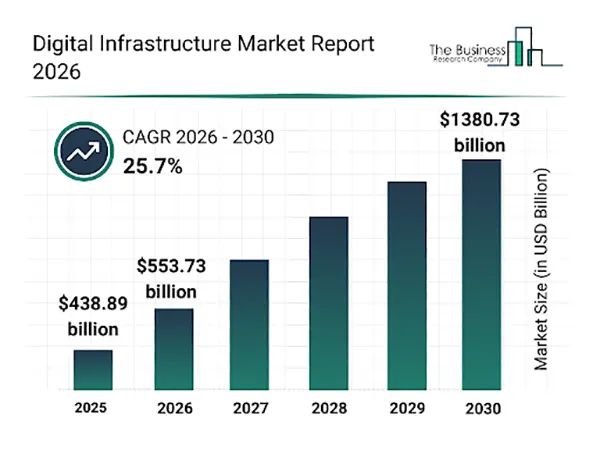
The infographics further depict the digital infrastructure market report in 2026 :
In conclusion, practical digital infrastructure isn’t just a technical necessity; it’s a strategic business asset.
It’s the foundation upon which trust is built, efficiency is gained, and growth is achieved.
It may not be glamorous, but for a financial firm looking to thrive in a complex and competitive world, it’s absolutely indispensable.
Frequently Asked Questions
Why is digital infrastructure important?
What is the purpose of digital?
The purpose of Digital Technology is to enhance efficiency, communication, and access to information. It facilitates tasks like data processing, automation, and connecting people across the globe, transforming various aspects of daily life and business.
What are the benefits of digital?
Digital offers the opportunity for simple solutions to be put in place that solve complex business issues.
How digital is the world?
This impressive figure means that close to three-quarters of the world’s population is now online, and current trends suggest that we’ll reach that next momentous milestone on the world’s digital journey sometime in 2026.
Related Posts
How Poor Contract Visibility Leads to Revenue Leakage in Growing Companies
Growth is an important factor that determines the success rate of any business. When we witness new operations, partnerships and…

Managing Bitcoin Operations? Here’s How Salesforce Automation Helps
“Digital currency is here to stay, and it’s only a matter of how long before governments embrace it.” — Brad…

Why Modern Organizations Depend on Data Privacy Software
Data growth has significantly accelerated beyond what most compliance teams can manage, with personal records, financial details, contracts, and emails…

Converting Chats Into Leads While Maintaining Professionalism
The way marketing teams and businesses approach their potential clients to boost their sales has completely transformed in the last…
How to Delete iCloud Account? Complete Guide for 2026
Thinking, how can I delete iCloud or Apple account? It is not just about removing an account; it is about…

How Different Industries Use Specialized Software to Stay Competitive
In the market we have today, companies are always trying to find ways to work better and get results. The…

What Key Adjustments Enhance Visual Appeal Across Web Pages
Attractive web pages form the roots of any appealing website. For instance, imagine looking for content on Google, and you…

When is it Time to Consider IT Support Services for Your Business?
Every business needs to ensure smooth operations for a successful business. But despite trying hard to avoid barriers, technical issues…

How to Delete User Profile in Windows 10: Step-by-Step Guide
You don’t notice user profiles until one starts causing problems. A profile gets corrupted, a login error pops up, or…