
Not necessarily. They are just different. If your data changes often and doesn’t fit into rigid tables, document databases can make your work easier. But if that is not the case and you’re managing complex relationships that require strict accuracy, relational databases are a safer choice.
Document Databases: Strengths, Weaknesses, and Comparison With Relational Databases
 Mahima Dave
Updated on: Dec 24, 2025
Table of Contents
- What are Document Databases?
- Core Characteristics of Document Databases
- Strengths and Weaknesses of Document Databases in Practice
- How Relational Databases Approach Structure and Data Integrity
- Comparing Document Databases and Relational Databases by Use Case
- Choosing the Right Database Model for Performance and Growth
- Conclusion
- Frequently Asked Questions
Data is no longer a byproduct of business; it is the business.
With every click on an e-commerce site, organizations are generating enormous volumes of information. In fact, some reports say that every day, an estimated 402.74 million terabytes of data are created, ranging from social media content and customer interactions to sensor logs and financial records.
But here comes the next question: How do these organizations store it in a way that keeps the systems fast, scalable, and reliable?
One thing is certain: The traditional models cannot keep up with such huge amounts of data. And that’s when document databases enter the conversation.
This guide explains exactly what they are, how they are different from the conventional ways, and how they work.
Key takeaways
- Document databases store data as flexible documents, not rigid tables.
- They are ideal for evolving applications and fast development cycles.
- They scale horizontally, making them strong for large, distributed systems.
- Relational databases remain superior for strict data integrity and complex transactions.
- The smartest architecture often combines both models.
What are Document Databases?
Document databases are like a flexible data container. Instead of storing the information in a traditional approach, in rows and columns like spreadsheets, they store everything related to one item inside a single “document.”
For example, if you are saving customer information in document databases, one customer file could include information like their name and contact details, order history, shipping addresses, and preferences. Since all this stays together in one place, this makes document databases easier to work with.
PRO TIP
Don’t choose a database just because it is trendy. Choose it because it aligns with your workload, growth plan, and team expertise.
Core Characteristics of Document Databases
The core characteristics that differentiate document databases from others include:
Schema Flexibility
Document databases are extremely flexible and allow dynamic schemas, letting you add new fields without migrating the entire dataset, store different structures in the same collection, and evolve your data model as your application grows. This can be extremely useful for startups, agile teams, and products in rapid development phases.
JSON-Based Storage
Usually, document databases store data in JavaScript Object Notation, aka JSON-like formats. This makes them easy to integrate with web applications, developer-friendly, and natural for APIs and front-end systems, reducing friction between application code and data storage.
Horizontal Scalability
Document databases distribute data across multiple machines using sharding, instead of upgrading a single server (vertical scaling). This helps handle massive datasets, enable seamless elastic scaling, support high traffic loads, and improve fault tolerance.
Strengths and Weaknesses of Document Databases in Practice
Every system has its strengths and weaknesses. In the case of document databases:
Performance at Scale
It outperforms the relational systems in read-heavy workloads and applications that retrieve full objects (like user profiles and product listings). This is because the related data is stored together, requiring fewer joins, enabling faster queries, and reducing latency.
Extremely useful for content management systems, e-commerce platforms, real-time analytics, and mobile apps.
Development Speed
Development is faster because:
- Developers don’t need to predefine strict schemas
- Data structures map directly to application objects
- Changes can be deployed without heavy migrations
This flexibility is helpful in environments where the requirements often change.
Data Consistency Trade-Offs
Many document databases prioritize availability and partition tolerance over strict consistency. This aligns with the CAP theorem, common in NoSQL systems.
Potential trade-offs are:
- Eventual consistency instead of immediate consistency
- Limited multi-document ACID transactions (though modern systems increasingly support them)
- More responsibility is placed on developers for enforcing data.
How Relational Databases Approach Structure and Data Integrity
Relational databases store data in tables and predefined schemas. Their major characteristics include:
- Structured rows and column
- Foreign key relationships
- Strong ACID compliance
- Normalization to reduce redundancy
This helps ensure data consistency, referential integrity, and predictable query performance, which is extremely useful in financial systems, banking applications, ERP platforms, and complex reporting environments.
But because of this, schema changes require careful planning and a migration script, which may slow down development.
Comparing Document Databases and Relational Databases by Use Case
Document and relational databases differ significantly. Here is a structured comparison between the two, covering their real-world use cases.
| Use Case | Document Database | Relational Database |
| Rapid product prototyping | Excellent | Slow due to schema design |
| Complex financial transactions | Can be done, but harder | Ideal option |
| Content-heavy applications | Great fit | Requires joins |
| Strict data integrity needs | Depends on implementation | Strong guarantees |
| Large-scale distributed apps | For horizontal scaling | Complex to scale |
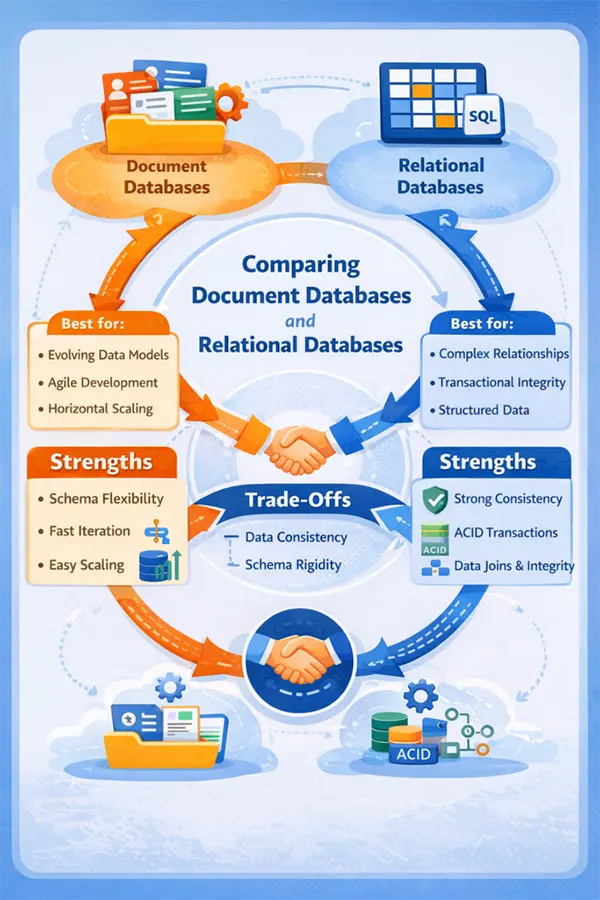
To summarize it all, if the application revolves around flexible, evolving data structures, document databases are a great option. And if a system depends on precise relationships and transactional integrity, relational databases are better.
Choosing the Right Database Model for Performance and Growth
There is no “one model fits all” in the database. So you must weigh your requirements to choose the best fit. Ask the following questions to make an intelligent decision:
- Does the data structure change frequently?
- Do you require strict transactional consistency?
- Will your system need to scale across multiple geographic regions?
- Are you building analytics-heavy or relationship-heavy queries?
Some organizations also adopt a polyglot persistence strategy, with the help of both document and relational, depending on the service. For instance, a product catalog may use a document database, a relational system for payment processing, and analytics might use a columnar data warehouse.
For further clarity, the infographic below compares the two options. Take a look!
Conclusion
With modern data realities like high volume, high velocity, and high variety, document databases have made a significant place in the systems. They offer flexibility, scalability, and developer speed, all the qualities that are important in today’s digital workflows.
On the other hand, relational databases remain the standard for structured data and transactional integrity. So, it is up to you which database model you choose to rely on, as both offer distinct advantages for specific workloads.
In the end, database architecture is not just about storage, but it is about enabling performance reliability and sustainable growth.
Frequently Asked Questions
Are document databases better than relational databases?
Do document databases support transactions?
Yes, modern ones like MongoDB now support multi-document ACID transactions.
Why do developers like document databases so much?
Because they feel natural. The data format is usually JSON that looks very similar to how data is handled inside modern applications. Developers can move faster without constantly reshaping data into tables and managing complex joins.
Can document databases handle large-scale applications?
Absolutely. They are designed for horizontal scaling, which means they can spread data across multiple servers. That’s one reason many large web and mobile platforms use them.
Related Posts
How Poor Contract Visibility Leads to Revenue Leakage in Growing Companies
Growth is an important factor that determines the success rate of any business. When we witness new operations, partnerships and…
Managing Bitcoin Operations? Here’s How Salesforce Automation Helps
“Digital currency is here to stay, and it’s only a matter of how long before governments embrace it.” — Brad…
Why Modern Organizations Depend on Data Privacy Software
Data growth has significantly accelerated beyond what most compliance teams can manage, with personal records, financial details, contracts, and emails…
Converting Chats Into Leads While Maintaining Professionalism
The way marketing teams and businesses approach their potential clients to boost their sales has completely transformed in the last…

How to Delete iCloud Account? Complete Guide for 2026
Thinking, how can I delete iCloud or Apple account? It is not just about removing an account; it is about…

How Different Industries Use Specialized Software to Stay Competitive
In the market we have today, companies are always trying to find ways to work better and get results. The…
What Key Adjustments Enhance Visual Appeal Across Web Pages
Attractive web pages form the roots of any appealing website. For instance, imagine looking for content on Google, and you…
When is it Time to Consider IT Support Services for Your Business?
Every business needs to ensure smooth operations for a successful business. But despite trying hard to avoid barriers, technical issues…

How to Delete User Profile in Windows 10: Step-by-Step Guide
You don’t notice user profiles until one starts causing problems. A profile gets corrupted, a login error pops up, or…