
Not at all. Even small teams benefit from knowing what they’re building next and why. The roadmap just gets simpler as the organization gets smaller.
When to Build: In-House vs Outsource Technology Roadmap
 Kartik Wadhwa
Updated on: Dec 16, 2025
Table of Contents
- What is a Technology Roadmap in Modern Enterprises
- Key Factors That Influence Build vs Outsource Decisions
- When Building Technology In-House Makes Sense
- When Outsourcing the Technology Roadmap Is the Better Choice
- Creating a Hybrid Approach to Technology Roadmap Execution
- Conclusion
- Frequently Asked Questions
Have you ever hit a point where your business knows it needs better technology but isn’t sure who should build it? That moment usually arrives faster than expected, and this is where the build vs outsource debate starts. The pressure in such situations is extreme, after all, your business’s future relies on one small decision.
Even studies show that over 70% of digital transformation initiatives fail largely due to poor planning and execution made early on, including how and where the technology is built.
And this is why a technology roadmap is important. It is not just a technical plan but a business commitment. If you haven’t prepared one for your business, this is your sign to get started with this guide.
Key Takeaways
- A technology roadmap connects business goals to actual technology decisions.
- It helps teams stop reacting and start planning.
- Roadmaps aren’t fixed; they evolve as the business evolves.
- Clear priorities prevent wasting time, tools, and budget.
- The best roadmaps balance ambition with what teams can realistically deliver.
What is a Technology Roadmap in Modern Enterprises
A technology roadmap is a strategic plan made by an organization to outline how tech initiatives affect their business objectives over time. For example, imagine an e-commerce company is aiming to increase its sales in the next two years.
The technology roadmap might start with upgrading website performance in the first quarter, then introducing personalization features innthe later months, and migrating to a scalable cloud infrastructure the following year. Each step here is tied directly to a business outcome.
For modern enterprises, roadmaps are like living documents that help them decide what their next step should be as they scale over time. They might hire professional web development services to bring their desired outcomes.
DO YOU KNOW?
Most tech delays happen because priorities weren’t clear upfront.
Key Factors That Influence Build vs Outsource Decisions
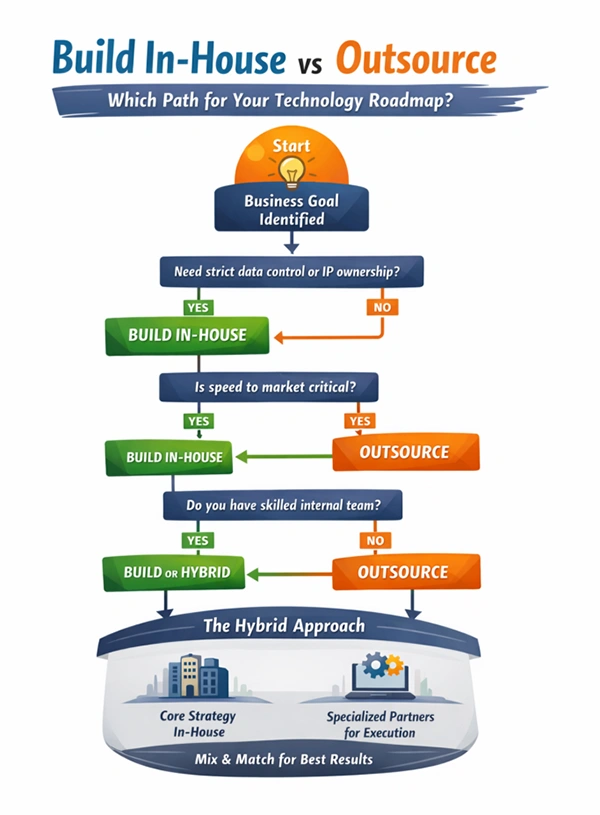
Build vs Outsource? This is where the real confusion starts. Well, the choice between them depends on multiple factors such as internal expertise, budget constraints, security requirements and growth timelines. So, if an organization is capable of managing all these things, in-house building can be a great option for them; otherwise, outsourcing would be a smart move.
To make such decisions, leadership must weigh how critical the tech is to the company’s core identity, how fast results are needed, and whether the internal teams are realistically capable of supporting the roadmap without disruptions.
When Building Technology In-House Makes Sense
Building technology in-house can be complicated and would be best if:
Need for Data Control and Security
Organizations deal with sensitive customer, financial, or proprietary data that must be protected at all costs. Internal systems and role-based acces helps this data from falling into the wrong hands, providing tighter control to teams.
Long-Term Strategic Differentiation
If technology is an integral part of business and is essential for long-term differentiation, it is better to build in-house controls, as custom solutions developed in-house are harder for competitors to replicate and evolve with the business’s unique progress.
Availability of Skilled Internal Teams
There’s no use in investing in tech if the internal teams are not experienced and skilled enough to handle it all. Strong internal talents reduce dependency on external vendors and allow faster iteration over time.
Customization and Integration Requirements
Complex integrations with legacy systems or highly customized workflows often benefit from in-house teams since they understand existing systems deeply, making customization more efficient and less risky.
When Outsourcing the Technology Roadmap Is the Better Choice
After learning about in-house integration, let’s learn when outsourcing is favorable:
Speed to Market and Scalability Needs
In-house teams require a certain amount of time to integrate tech with the existing systems and make everything work. Whereas, external teams accelerate development timelines by providing ready-to-deploy expertise. This is especially beneficial for brands launching new products within a fixed timeline or responding quickly to market opportunities.
Access to Specialized Expertise
Outsourcing provides access to niche skills that may not be easily available or expensive to hire internally. So, for advanced features, it is best to go with outsourcing as they offer proven skills and experience.
Cost Predictability and Resource Optimization
Usually, specialized outsourcing teams define their scopes and costs in advance, saving organizations from any unexpected delays or expenses that are quite possible in internal operations. This also supports resource optimization as it redeuces the financial uncertainiyty of hiring, training and maintaining large teams.
Reduced Operational Overhead
Managing in-house teams require a lot: looking after the infrastructure, recruitment, employee retention and what not. All this can make the bills longer and longer with each step. But with outsourcing shifts, businesses do not need to worry about anything like this.
Creating a Hybrid Approach to Technology Roadmap Execution
Modern enterprises have found a middle ground now: The Hybrid Approach. This included strategic planning on managing in-house teams while outsourcing execution or specialized components. This approach provides the benefits of both and offers more flexibility, allowing businesses to scale efficiently without sacrificing their long-term vision.
A hybrid roadmap enables companies looking to outsource software development do so while maintaining an in-house team to support the operations.
Now that we have discussed all the possibilities, here is a flowchart summarzing it all:
Conclusion
As a growing company, choosing between in-house development and outsourcing can be extremely puzzling. Nonetheless, the decision needs to be made when the time comes. Both offer their own set of advantages. In-house is better for companies that are capable of putting the infrastructure in place and dealing with sensitive data. While outsourcing is good for those who do not have the resources and can’t take the headache of recruiting and training the internal teams.
The modern firms have also found a solution that provides the benefits of both, i.e., the hybrid approach. So, it is upto the organizations how they build a tech roadmap, considering the points highlighted above in this post.
Frequently Asked Questions
Is a technology roadmap only for big enterprises?
How often should a technology roadmap be updated?
Whenever reality changes. New customer needs, budget shifts, or market pressure are all good reasons to revisit it; most teams review theirs quarterly.
Does a roadmap lock us into specific tools or vendors?
No. A good roadmap focuses on outcomes and priorities, not rigid tools. Flexibility is part of the plan.
Who should outsource parts of the roadmap and still keep control?
Ideally, it’s shared ownership; business leaders set direction, while technical teams shape how it’s executed.
Related Posts
Simple Ways to Clean Audio Data for Better Model Performance
Most of the machine learning teams do not struggle because their processing systems are not capable—they struggle because their audio…
How to Check for Malware on Mac in 2026?
Can Mac computers get viruses? Macs are not as safe as people think. Yes, macOS has built-in tools like XProtect…
10 Best Lightroom Preset Alternatives in 2026
“Photography is the story I fail to put into words.” — Destin Sparks (Landscape Photographer) For years, Lightroom presets have…
Elementor Hosting vs SiteGround: Which is Faster in 2026?
A website’s performance is mainly determined by its Speed. Even a slight delay can reduce conversions by a significant margin.…

10 Best Visual UGC Platforms for eCommerce Brands in 2026
“People influence people. Nothing influences people more than a recommendation from a trusted friend.” — Mark Zuckerberg (Meta CEO) That…

The Data Models Powering the Next Creative Revolution in Video Generation
Artificial intelligence has evolved from a mere tool to the cornerstone of advancements in the new era. Over the years,…

Solar Software Companies: How Platforms Improve Cross Team Collaboration
“If everyone is moving forward together, then success takes care of itself.” — Henry Ford (Industrialist & Business Magnate) Handoffs…

What Healthcare Leaders Expect From Digital Tools
Healthcare executives are under pressure to protect patient safety, clinician time, and data privacy while modernizing the delivery of care.…

How to Reset Android Phone When Locked? (Safe Factory Reset Methods)
Locked out of your Android phone or stuck on the screen? It happens more than you think. A forgotten PIN,…