
AI powered data migration refers to using artificial intelligence to move data from one device to the another.
AI-Powered Data Migration: The Future of Data Transfer and Recovery in 2026
 Mahima Dave
Updated on: Nov 19, 2025
Table of Contents
- Why AI Matters in Modern Data Migration
- Key AI Technologies Transforming Data Migration
- Intelligent Data Mapping and Automated Schema Matching
- AI-Driven Data Quality and Validation
- Predictive Error Detection and Risk Prevention
- AI in Cloud and Hybrid Data Transfers
- Enhancing Data Recovery With AI Automation
- AI for Compliance, Governance, and Security
- Real-Time Monitoring and Self-Healing Pipelines
- The Future of AI in Data Migration (2026–2030)
- Frequently Asked Questions
Imagine this: you are a business owner, thinking of upgrading to modern software. But it is not as easy as shifting to a new computer once the old one starts acting up. Because you have tons of data that powers your business operations. Deleting all that before moving to the next device is not an option as that data holds extreme significance for your workflow. A confusing situation indeed, isn’t it? Fortunately, there is a solution for it.
Well, this is not just a situation created in your head but a reality to many and this is where AI powered data migration comes into the picture, it acts as a crossing bridge when transferring data from one end to another, ensuring proper, safe transfer. And the good news is that it reduces manual effort by up to 80%, accelerating timelines by 30-40% and achieving success rates of 96-99%. (BuzzClan: AI Powered Data Migration)
This post dives deeper into the subject and discusses how AI is transforming data migration and how the future of it might seem like. Continue reading to learn more!
KEY TAKEAWAYS
- AI integration in modern data migration helps streamline workflows and boost efficiency.
- Machine learning, generative AI, and NLP are some key technologies that transform data migration.
- AI powered data migration follows a preventive approach by eliminating all the errors and sealing vulnerabilities before they turn into bigger problems.
- It allows real time monitoring and self healing pipelines.
- The future of AI in data migration will be bright and full of possibilities with the help of upcoming innovations.
Why AI Matters in Modern Data Migration
Let’s go back a few years, when the AI magic was not in the picture. Data migration pipelines were all about manual mapping, rule based transformations, and reactive troubleshooting. These methods were effective; however, they were not apt for large-scale, multi-cloud, and unstructured datasets.
With the integration of AI, systems learn from historical migrations to optimize the new ones, detect errors before they disrupt workflows, automate mapping, transformation, validation, and testing, and accelerate migration without compromising data quality. These factors ultimately help streamline workflows and boost efficiency.
Want to go deeper into this field? You can start by enrolling in the generative AI leadership course and building a basic understanding as the first step.
Key AI Technologies Transforming Data Migration
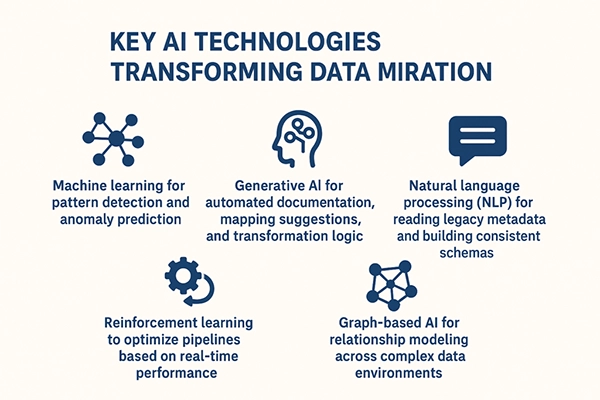
We have already crossed the times when data migration meant doing everything manually. AI has changed everything but do you know what exactly the key AI technologies are that transform these processes? They are as follows:
Intelligent Data Mapping and Automated Schema Matching
Usually, when companies shift from an old system to a new one, the structure of the data doesn’t match as different systems use different names, formats and layouts. This is where AI comes to the rescue, again, with intelligent data mapping and automated schema matching.
It automatically detects relationships between fields, suggests optimized mapping rules, reconcile mismatched schemas without manual interventions, and understands legacy systems through NLP-driven metadata extraction.
AI-Driven Data Quality and Validation
Data should not just be moved; it should be understood. And this is exactly why maintaining data quality is important. AI systems take care of this aspect by bringing quality assurance through ML based detection of inconsistencies, automated profiling or source and target datasets, pattern recognition for missing, duplicate or corrupted data, and intelligent transformation rule adjustments.
Which means that AI not only validates results but also improves them by learning from previous quality issues.
Predictive Error Detection and Risk Prevention
Waiting for migration failures, to fix them after everything is ruined, is not a smart move. In these cases, once things go downhill, bringing them back to the desired outcome is an almost impossible job.
Therefore, a proactive and predictive error detection approach is the most sensible way to go. It reduces downtime risks, schema conflicts, resource bottlenecks, integration failures and anomalies in data flow.
AI in Cloud and Hybrid Data Transfers
In cloud and hybrid data transfers, AI takes things a step further by selecting cost and performance efficient routes, providing auto-scaling resources in real time, predicting bandwidth spikes and orchestrating parallel transfer across regions. Ultimately, all this results in faster migration with minimal disruption.
Enhancing Data Recovery With AI Automation
The role of AI in data does not end at migrations; it extends to various other aspects, one of which is data recovery. It helps with automated detection of corrupted snapshots, intelligent rehydration of lost or incomplete datasets, prioritization of mission-critical assets, and AI-guided rollback workflows.
Not only that but self learning recovery systems ensure that organizations comply with the industry standards and strict RTO/RPO guidelines.
AI for Compliance, Governance, and Security
With automation, real-time compliance checkups, and detecting suspicious patterns in a timely manner, AI makes data governance much simpler and stronger. With this, it also seals all the vulnerabilities in a system, that makes the whole process much more secure, preventing data leaks or unauthorized access.
SURPRISING FACT
Approximately 60% of data migration time is generally spent on just figuring out where the data should be sent.
Real-Time Monitoring and Self-Healing Pipelines
As highlighted before, AI adds functions like real-time monitoring and self-healing pipelines to the systems, which means that AI constantly monitor the data migration process as it happens and it detect and fies the issues in real time, that too, without any manual help.
Let’s understand it better with the help of an example: suppose a company is transforming 10 thousand files to another system and some issues arises, be it files failing to upload or slow network. In traditional ways, it would require a human to notice all these failures in order to fix it. But, with AI, these smart structures are always on a love out for such situations and detect them instantly, diagnosing its root cause and fixing them automatically, without any human intervention.
The Future of AI in Data Migration (2026–2030)
Already, AI has transformed data migration, for the better. But in the future, specifically in the years 2026-2030, we can expect fully autonomous migrations, generative AI agents, cross platform orchestration, digital twin models, and many other features that will simplify the whole process tenfold.
It is safe to say that by 2030, data migration will shift from high risk IT events to an automated, continuous and intelligent operation supported by evolving AI systems.
Frequently Asked Questions
What is AI Data Migration?
Why is AI becoming important for data migration?
AI is becoming crucial for data migration as it boosts the speed of the process and help ensure accuracy and quality of the data.
Can AI prevent migration failures?
Yes. AI can prevent migration failures by predicting the risks associated with it early, as it follows a proactive approach.
Is AI migration only for big companies?
No, AI migration is not just a ‘big company’ thing. Even smaller businesses and individuals can benefit from it.
Related Posts
How Poor Contract Visibility Leads to Revenue Leakage in Growing Companies
Growth is an important factor that determines the success rate of any business. When we witness new operations, partnerships and…
Managing Bitcoin Operations? Here’s How Salesforce Automation Helps
“Digital currency is here to stay, and it’s only a matter of how long before governments embrace it.” — Brad…
Why Modern Organizations Depend on Data Privacy Software
Data growth has significantly accelerated beyond what most compliance teams can manage, with personal records, financial details, contracts, and emails…
Converting Chats Into Leads While Maintaining Professionalism
The way marketing teams and businesses approach their potential clients to boost their sales has completely transformed in the last…

How to Delete iCloud Account? Complete Guide for 2026
Thinking, how can I delete iCloud or Apple account? It is not just about removing an account; it is about…

How Different Industries Use Specialized Software to Stay Competitive
In the market we have today, companies are always trying to find ways to work better and get results. The…
What Key Adjustments Enhance Visual Appeal Across Web Pages
Attractive web pages form the roots of any appealing website. For instance, imagine looking for content on Google, and you…
When is it Time to Consider IT Support Services for Your Business?
Every business needs to ensure smooth operations for a successful business. But despite trying hard to avoid barriers, technical issues…

How to Delete User Profile in Windows 10: Step-by-Step Guide
You don’t notice user profiles until one starts causing problems. A profile gets corrupted, a login error pops up, or…