Supply chain systems are all about accuracy. Because even the slightest error can reflect on a series of tasks: one incorrect purchase order can delay shipments, and one invoice mismatch can stall payments for weeks.
In traditional supply chain operations, manual data entry error rates can be as high as 4%, which might seem like a small number, but it directly translates to thousands of transactions containing mistakes every month. (Source: Commport)
Now, these can be expensive mistakes, and this is where EDI systems come to the rescue. An EDI system is like a shared business language between two computers that eliminates the chances of human error when talking business.
However, these are also of little to no use if chosen incorrectly. So in this guide, we will walk you through the important considerations you must keep in mind to find the best enterprise EDI integration provider for your supply chain business.
Key Takeaways
EDI is like a silent engine behind smooth supply chain communication.
Even small data errors can create expensive disruptions.
Real-time validation and monitoring prevent most compliance issues.
Interaction quality matters more than just document transmission. The right provider rows with your business, not against it.
Why EDI Failures Cause Costly Supply Chain Disruptions
Electronic Data Interchange, or EDI, forms the base of supply chains, and any disruptions to it can lead to costly blunders. In case it fails, it impacts different areas of work. Usually, this is what happens:
Purchase orders do not transmit properly
Advanced shipping notices are filled with incorrect data
Invoices mismatch ERP records
Retail compliance violations that can lead to penalties
Shipments delayed or rejected altogether
In high-volume supply chains, even 1% error rate can cause damage to thousands of dollars in losses per week. So, as much as these problems cause operational headaches, they also leave a mark on finances.
That is why you must choose a reliable provider, one like Orderful enterprise EDI, to make sure your work stays on track.
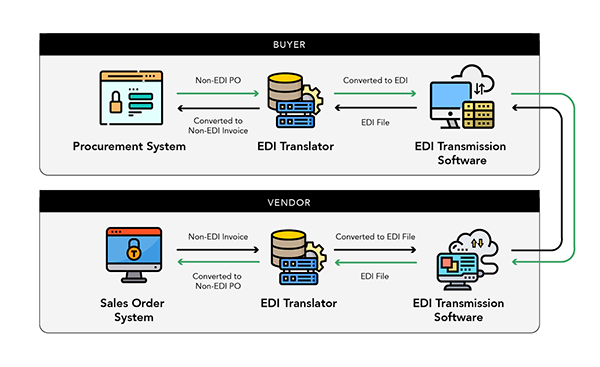
INTRIGUING INSIGHTS The infographic below shows how Electronic Data Exchange works. Have a look to understand better.
How Enterprise Systems Depend on Accurate EDI Integration
Modern supply chains rely on a tightly connected ecosystem, one like dominoes, where a single falling block can take down the whole system. Here, EDI acts as the translator between your internal systems and external trading partners. So if integration is incomplete or poorly mapped,
Your ERP may show incorrect inventory levels
The finance team may process inaccurate invoices
The warehouse may ship against outdated orders
And with this, the whole sync of the business will shatter, causing one issue after another.
Core Capabilities an Enterprise EDI Integration Provider Must Offer
Not all EDI providers are suitable for enterprise supply chains. That is why, when choosing one for your business, do not forget to look for the following features.
Standards Compliance
No one wants hefty penalties. Make sure the provider you choose fully supports ANSI X12 (common in North America), EDIFACT (widely used internationally), and any other retail-specific sets, depending on the area you operate from.
System Compatibility
It must integrate seamlessly with SAP, Oracle, Microsoft Dynamics, NetSuite, and custom ERP environments. Or else, the scalability might suffer. So, look for API-first architecture, pre-built connectors, custom mapping flexibility, and cloud native infrastructure.
Data Validation
The best enterprise EDI providers validate data before it becomes a problem. They include field-level checks, format enforcement, duplicate detection, and business rule validation to ensure they catch any errors before they reach trading partners.
Provider Features That Help Reduce Supply Chain Errors
To ensure your system remain error free and smooth, choose a provider that offers these features:
Real-Time Monitoring
Delayed reports inform you about the mistake that has already been made, not leaving much room for unraveling it. But real-time monitoring allows you to track transaction status instantly and take action when needed.
Error Handling
No system can be 100% error-proof at all times. Hence, you should choose a provider who knows how to handle things when the situation goes downhill. For that, they must offer clear, human-readable error logs, automated retry mechanisms, guide correction workflows, and root cause diagnostics.
PRO TIP When evaluating an EDI provider, ask them to walk you through a real failed transaction scenario and not just a successful demo. Because how they handle errors tells you far more than how they handle success.
Automated Alerts
Automated alerts flag small errors early and prevent them from turning into a massive slip. Email or Slack alerts, threshold-based monitoring, failure document notifications, and compliance risk warnings are some of the non-negotiable ones.
Evaluating EDI Providers Based on Scalability and Industry Experience
When a business grows, complexity follows. Planning for it in the future can save you from headaches later.
Ask potential providers:
Can they handle increased transaction volume without latency?
Do they support onboarding new trading partners quickly?
Have they worked with retailers in your specific industry?
Do they understand compliance requirements in your sector?
Having answers to this will help you gain confidence and choose a provider that is capable of handling your scaling business. Otherwise, if the provider can’t grow with you, you’ll eventually outgrow them, and migration costs are never easy on the pocket.
Conclusion
Selecting a worthy EDI provider can help you protect your supply chain from several invisible risks. Find a partner that ensures standard compliance, integrates seamlessly with enterprise systems, validates data proactively, provides real-time visibility, reduces costly errors, and scales alongside your growth.
All this will shield your supply chain and keep it moving smoothly, quietly, and consistently behind the scenes. Because in supply chain operations, the best technology is the kind you never have to worry about.
Frequently Asked Questions
Is EDI only for large enterprises?
Not anymore. While big retailers require it, cloud-based EDI solutions have made it accessible for mid-sized and even growing businesses.
Can’t we just use email or PDFs instead of EDI?
Yes, you can, but the difference is that someone will still have to manually enter that data into a system. And that is where the most mistakes happen. EDI removes the copy-paste step entirely, eliminating mistakes.
How long does EDI implementation usually take?
It depends on complexity and trading partners. With modern API-based providers, onboarding can take weeks instead of months, especially if pre-built integrations are available.
Is switching EDI providers difficult?
It can be difficult, more so in legacy systems. That’s why choosing a scalable, future-ready provider from the beginning saves major migration headaches later.

 Mahima Dave