
Choosing the right SaaS development partner is important because it affects everything from product quality and security to how well your SaaS scales in the future. The wrong choice can slow down growth and increase costs.
Comprehensive Guide to Choosing a SaaS Development Partner
 Mahima Dave
Updated on: Nov 25, 2025
A reliable saas application development company doesn’t just build software but helps companies design a scalable, secure and user-friendly solution that grows with their needs. However, this is not the case for everyone. Building a SaaS product is exciting, but it only takes one wrong decision to ruin it all
Choosing the wrong development partner can quickly lead to delays, budget overruns, and technical headaches. And this is why up to 90% of SaaS startups fail within the first few years, often due to strategic mistakes rather than their lack of effort or innovation.
Since there are so many options available, choosing the right one for your requirements can be extremely difficult. To save you from any kind of strategic mistake, this guide breaks down the key factors, evaluation criteria, and comparison points you must take into account to make an informed decision.
Key Takeaways
- A good SaaS partner thinks beyond just building the app.
- Cloud, scalability, and security should be planned from day one.
- Experience with SaaS models matters more than general development skills.
- Clear communication and project management reduce risks.
- The best partnerships are built for the long term, not just launch.
Key Factors to Look for in a SaaS Development Company
Different SaaS development companies offer different levels of expertise. To choose the one that fits your needs the best, you should look for the following factors:
Technical Capabilities and Cloud Expertise
For a successful SaaS product, a strong cloud expertise is extremely important. Development partners should be well-equipped with the knowledge of using modern cloud platforms like AWS, Azure, or Google cloud. Therefore, choose someone who has considerable experience in cloud-native application development, containerization, microservices, cloud security, and cost optimization.
Understanding of Subscription-Based Models
Even a well built software can struggle to support monetization if it does not understand use plans, pricing tiers, billing and payment integrations, usage tracking, and analytics. Hence, a capable SaaS application is the one that knows the technical and business requirements behind subscriptions.
Scalability and Performance Planning
Businesses grow over time, and so do their requirements, and this is why scalability shouldn’t be an afterthought in SaaS; it should be treated as a necessity. The partner should design systems that handle increasing users, data, and traffic without performance issues in the future.
Remember that, planning for scale early in the process will save you from costly rebuilds later.
Security Standards and Compliance Awareness
When it comes to SaaS development, security is non-negotiable. The chosen collaborator must follow best practices and be aware of trending industry regulations such as GDPR.
To work on a security-first approach, partners should include important security aspects like data encryption, strong authentication, access control, role-based permissions, and compliance with regional and global data protection laws.
Assessing Portfolios, Case Studies, and Testimonials
You cannot judge a company without looking at its work. So, to take a valuable glance into a company’s real-world capabilities, ask for their portfolios and case studies. Make sure to choose someone who has worked on similar projects as yours and provides measurable outcomes and performance improvements that help form long-term client relationships.
Though these might seem small, but taking these factors into account when choosing a SaaS development partner can make huge differences and help you make better decisions.
DO YOU KNOW?
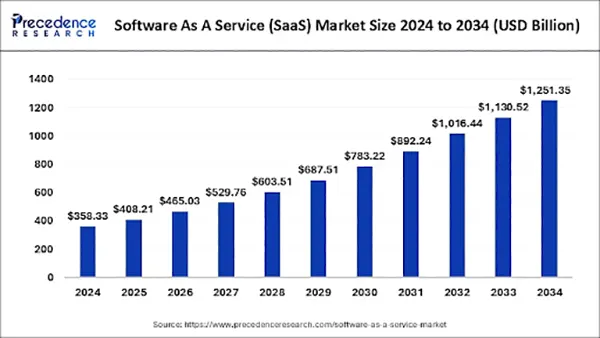
The Software as a Service (SaaS) market was measured at $358.33 billion in 2024 and is expected to grow exponentially and reach $1,251.35 million in 2034.
How to Evaluate Expertise in SaaS App Development
Surface-level claims tell you what the vendor wants you to know, and evaluating technical depth and problem-solving ability gives you the real insights. Here is what you should look for:
Architecture and Infrastructure Knowledge
SaaS partners should clearly explain their architectural decisions. This includes multi-tenant architecture, database strategies, and fault-tolerant systems to ensure better performance,, easier updates, and lower maintenance costs.
API Integration Capabilities
Most of the modern SaaS platforms do not work in isolation and rely on other systems to provide the best results. Which means, API integration expertise becomes essential for connecting third-party tools, payment gateways, analytics platforms, and CRMs. Your partner should be well-equipped with the knowledge of RESTful, GraphQL APIs, secure data exchange, and scalable integration frameworks.
UI/UX Design for SaaS
User retention depends on user experience. A well-designed SaaS interface should be intuitive, clean, and consistent. Good UI/UX reduces onboarding friction and improves adoption. So, design with user workflows in mind, balance functionality with simplicity, and optimize interfaces for different devices.
Cybersecurity Practices
Strong cybersecurity practices build trust, and a reliable SaaS application development company should proactively identify risks and implement safeguards. Regular security testing, audits, secure coding practices, and monitoring and incident response planning are some effective practices for online security.
Ongoing Support and Maintenance
SaaS products evolve continuously, and no, the work does not end after launch. Ongoing support and maintenance are equally important. Ensure your partner offers:
- Real-time bug fixes and performance monitoring
- Regular updates and enhancements
- Technical support and documentation
These features take you ahead of your competitors and provide long-term support so that the product stays competitive and stable.
FUN FACT
Some of today’s most successful SaaS products started with just one core feature. What made them grow wasn’t complexity, but choosing a development partner who built the products to evolve over time
Comparing SaaS Development Firms
With so many options around, narrowing down to one that checks all the boxes for you can be quite overwhelming, and this is where a structured comparison comes to the rescue.
Pricing Models
Pricing models can be of various types depending on the services provided by the development partners. The most common ones include:
| Pricing Model | When It Works Best | Benefits | Considerations |
| Fixed Price | When the scope is clear and predictable feature set. | Cost is certain, and requires simple planning | Once the development begins, flexibility is limited. |
| Time & Materials | Evolving product scope | Flexible, transparent billing | If the scope expands, the costs increase. |
| Dedicated Team | Better option for long-term product development | Full control, stable team, and rapid scaling | Requires internal product ownership |
Choose a model that aligns with your budget, offers transparency, and allows flexibility for future changes.
Team Structure and Seniority
Balanced teams with optimal experience in developing, designing, and project managing will give you better outcomes, so understand who will actually work on your project. For this, ask them about developer experience levels, team stability, and access to technical leadership.
Project Management and Collaboration
To prevent any delays and misunderstandings in the processes, clear communication and structured project management are important. Look for:
- Agile or iterative development approaches
- Regular updates and progress reports
- Collaboration tools for transparency
Keep in mind that strong project management keeps everyone aligned.
Cultural Fit and Long-Term Partnership Potential
A SaaS project is not a one-time project but a long journey. Therefore, cultural alignment and shared values matter a lot. A good partner understands your business goals, communicates openly and proactively, and is invested in long term success. This mindset turns a typical vendor relationship into a reliable partnership.
Conclusion
Selecting a SaaS development partner is a strategic decision that is not only about technical skills. The ideal SaaS development company combines cloud expertise, scalability planning, security awareness, and strong collaboration practices.
By understanding the considerations mentioned above in the content and evaluating capabilities, experience, and long-term alignment, businesses can build SaaS products that are secure, scalable, and ready for sustained growth. So choose wisely, and for more such information, do check out our other blogs.
Frequently Asked Questions
Why is choosing the right SaaS development partner so important?
What should I look for in a SaaS application development company?
For a SaaS application development company, look beyond coding skills and focus on strong cloud expertise, SaaS experience, security awareness, and good communication. matter just as much.
How can I check if a company is truly experienced in SaaS development?
You can check it by reviewing their case studies, ask about similar projects, and see how well they explain architecture, scalability, and real-world challenges.
Is ongoing support really necessary after launch?
Yes, SaaS products need regular updates, security checks and performance improvements to stay competitive and reliable.
Related Posts
How Poor Contract Visibility Leads to Revenue Leakage in Growing Companies
Growth is an important factor that determines the success rate of any business. When we witness new operations, partnerships and…
Managing Bitcoin Operations? Here’s How Salesforce Automation Helps
“Digital currency is here to stay, and it’s only a matter of how long before governments embrace it.” — Brad…
Why Modern Organizations Depend on Data Privacy Software
Data growth has significantly accelerated beyond what most compliance teams can manage, with personal records, financial details, contracts, and emails…
Converting Chats Into Leads While Maintaining Professionalism
The way marketing teams and businesses approach their potential clients to boost their sales has completely transformed in the last…
How to Delete iCloud Account? Complete Guide for 2026
Thinking, how can I delete iCloud or Apple account? It is not just about removing an account; it is about…

How Different Industries Use Specialized Software to Stay Competitive
In the market we have today, companies are always trying to find ways to work better and get results. The…
What Key Adjustments Enhance Visual Appeal Across Web Pages
Attractive web pages form the roots of any appealing website. For instance, imagine looking for content on Google, and you…
When is it Time to Consider IT Support Services for Your Business?
Every business needs to ensure smooth operations for a successful business. But despite trying hard to avoid barriers, technical issues…
How to Delete User Profile in Windows 10: Step-by-Step Guide
You don’t notice user profiles until one starts causing problems. A profile gets corrupted, a login error pops up, or…