
Generic project management tools track tasks, but they often do not capture field reality, enforce operational stages, or connect to the systems teams already use. As volume grows, teams need structure in addition to tracking.
Solar Software Companies: How Platforms Improve Cross Team Collaboration
 Reviewed By Brijesh Singh
  Mahima Dave
Updated on: Apr 07, 2026
Table of Contents
- Why Does Cross Team Collaboration Break Down in Solar Operations as You Scale?
- What Are the Most Common Collaboration Workflows Solar Teams Need to Coordinate?
- How Do Platforms Reduce Miscommunication and Duplicate Work Across Teams?
- How Do Integrations Improve Collaboration When Teams Use Multiple Specialized Tools?
- How Do Field Updates and On-Site Documentation Improve Office-to-Field Collaboration?
- What Should You Look for When Evaluating Collaboration Platforms for Solar Teams?
- Conclusion
- Frequently Asked Questions

“If everyone is moving forward together, then success takes care of itself.”
— Henry Ford (Industrialist & Business Magnate)
Handoffs are a real problem in solar teams as work is spread across various tools, roles, and contexts. This intensifies rework and slows coordination as everyone is asking the other about the “work status”.
Easing handoff friction for solar software companies requires tools like Scoop that structure workflows, capture field updates, and connect all team systems.
In this article, I’ll talk about platforms that improve cross-team collaboration in solar firms. The following sections will help you choose the right software solution to fit the operations in your solar firm.
KEY TAKEAWAYS
- Solar teams are dispersed across geography, roles, and tools.
- Systems refuse to support collaboration as firms scale.
- Look for solutions that reduce miscommunication and duplicate work.
- Office and field teams need information about each other, so the solution needs to centralize all systems.
Why Does Cross Team Collaboration Break Down in Solar Operations as You Scale?
When the system has to handle more tools, people, and operations than it’s designed to, it obviously will break down. The work still gets done, but the handoffs between roles start to depend on people remembering to message each other, re-enter data, or chase approvals.
What Kinds of Handoffs Create the Most Rework Between Sales, Design, Permitting, Field, and Service Teams?
A work needs the highest reworking during handoff when the state changes, but the context doesn’t. A sold deal becomes an install. A design revision affects permitting. A permit delay pushes scheduling. A site issue becomes a service ticket.
If the handoff is a PDF, a spreadsheet row, or a Slack message, the next team is forced to rebuild context. That is where missed details and duplicate work show up.
Why Do Updates Get Lost When Teams Rely on Spreadsheets, Slack, and Disconnected Tools?
Updates get lost because these tools do not enforce structure or ownership. Slack is fast, but it is not a system of record. Spreadsheets can track status, but they cannot capture field reality, approvals, photos, or the sequence of steps that need to happen.
When the same project lives in multiple places, the team stops trusting any single view. People create side systems to protect themselves, and collaboration slows down.
What Does “One Source of Truth” Actually Mean in Day-to-Day Solar Execution?
A real source of truth is not just a dashboard. It is a place where the workflow lives, where ownership is clear, and where updates are captured in a consistent format.
In practice, it means your team can answer these questions without a meeting: what is the next step, who owns it, what is blocked, and what proof exists that the step is complete.
What Are the Most Common Collaboration Workflows Solar Teams Need to Coordinate?
Most tasks in a solar operation are dependent on the prior one. Collaboration improves when platforms make the task chain visible, and each task has a clear owner and definition of done.
How Do Solar Teams Keep Sales-to-Ops Handoffs Clean Once a Project Is Sold?
A clean handoff starts with structured intake. The operations team needs the scope, site constraints, customer expectations, and any special terms that affect delivery.
Platforms help when they turn the handoff into a repeatable workflow, not a one-off message. Instead of a single “kickoff” packet, the handoff becomes a set of required fields, tasks, and approvals that move forward in sequence.
What Has to Stay Aligned Between Design Changes, Permitting Status, and Install Readiness?
The workstream breaks when changes in one area are not reflected in the others. A design revision that changes layout, equipment, or assumptions can invalidate a permit submission, delay material procurement, or make a crew show up to an unready site.
Collaboration improves when the platform ties readiness to specific conditions. For example, permitting is not “in progress,” it is a set of required steps with dates, documents, and sign-offs that directly control when scheduling can happen.
How Do Service and O&M Teams Keep History, Photos, and Context Accessible Across Stakeholders?
Service and O&M work depend on context. A technician needs the job history, prior issues, site documentation, and what was promised to the customer.
Platforms store field information, and it’s visible to the rest of the organization. When photos, notes, and checklists are attached to the work itself, office teams can coordinate next steps without constant follow-up.
How Do Platforms Reduce Miscommunication and Duplicate Work Across Teams?
Inconsistent processes or unclear accountability are mostly responsible for miscommunication. Platforms reduce it when they replace informal coordination with structured workflows.
How Does Standardizing Workflows Reduce Ambiguity in Ownership and Next Steps?
Standardized workflows clarify what happens next and who is responsible for moving work forward. Instead of “waiting on permitting,” the workflow defines the exact step, the required artifact, and the owner.
This reduces the hidden labour of coordination. Teams spend less time asking for status and more time executing.
What Role Do Task Dependencies and Stage-Based Workflows Play in Keeping Teams Aligned?
Dependencies prevent teams from working in the wrong order. Stage-based workflows make it clear which steps are complete, which are active, and which cannot start yet.
When stages are tied to real criteria, a project cannot be marked ready unless the prerequisites exist. That protects the schedule, reduces last-minute surprises, and improves collaboration across departments.
How Does Real-Time Visibility Help Teams Spot Blockers Before They Cascade?
Visibility matters when it is specific. A platform should help teams see where work is stuck, why it is stuck, and what downstream work is at risk.
When blockers are surfaced early, teams can reassign work, escalate approvals, or shift resources before delays compound. This is where collaboration becomes proactive, not reactive.
How Do Integrations Improve Collaboration When Teams Use Multiple Specialized Tools?
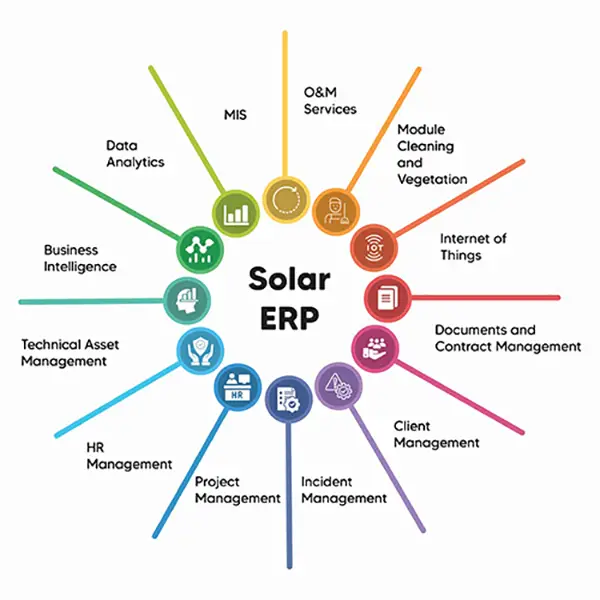
All solar teams use different tools: CRM, design tools, monitoring systems, accounting, and scheduling. Collaboration improves when these systems share information seamlessly with each other.
The following infographic lists all the departments that need connecting for efficient operations:
When Should You Integrate Instead of Replacing Tools?
Integration is the right choice when a specialized tool is already doing its job well. Design and proposal tools, accounting systems, and CRMs often have deep functionality that teams rely on.
Replacing them can disrupt operations, as coordination is further reduced. Integrating lets teams keep what works while improving how work moves between roles.
What Data Should Flow Between CRM, Design Tools, and Field Execution Systems?
The most valuable data flows are the ones tied to execution. From CRM to operations, you need accurate customer and project context. From design tools to execution, you need revisions, constraints, and readiness signals. From field execution back to CRM and finance, you need completion proof, change notes, and updates that affect billing and customer communication.
The goal is not to sync everything. The goal is to sync the fields that prevent re-entry and misalignment.
How Do Integrations Prevent “Double Entry” and Conflicting Versions of the Truth?
Double entry happens when each team owns a different tool, and each tool requires the same information. Integrations don’t let this happen. They assign a system of record for each type of data, and then keep other systems updated automatically.
This reduces errors and speeds up handoffs, because teams can trust that the core information is consistent across the stack.
How Do Field Updates and On-Site Documentation Improve Office-to-Field Collaboration?
Office teams need field information to analyze, strategize, and come up with actionable insights. The field team uses those insights to work efficiently. Platforms improve collaboration when they make field updates structured, timely, and usable.
Why Does Field Documentation Matter for Cross Team Coordination Beyond the Install Crew?
Field documentation is not just for the technician. It affects customer communication, quality control, future service, and billing.
When documentation is missing or scattered, the office has to chase context. When it is captured consistently, the rest of the organization can act with confidence.
What Should Technicians Capture to Keep Downstream Teams Moving (Photos, Checklists, Approvals)?
Technicians should capture evidence that answers operational questions. Photos that show site conditions and completion. Checklists that confirm steps were done. Approvals that document changes or customer sign-off.
The key is consistency. The platform should make it easy to capture these updates in the same structure every time, so downstream teams do not have to interpret a different format on every job.
How Do Structured Updates Improve Reporting Reliability and Reduce Back-and-Forth?
Structured updates reduce back-and-forth because they remove ambiguity. Instead of a vague note, the update is tied to a step, an owner, a timestamp, and supporting documentation.
This improves reporting because metrics are based on execution data, not after-the-fact reconstruction. It also improves collaboration because teams can move forward without needing to validate every detail in a meeting.
What Should You Look for When Evaluating Collaboration Platforms for Solar Teams?
Just tracking activity is not enough. Software solutions need to improve the collaboration and, in turn, operations.
Which Features Actually Improve Execution, Not Just Visibility?
Look for features that enforce structure. Workflow stages, required fields, and ownership rules. Field documentation tied to tasks. Dependencies that protect sequencing. Dashboards that surface blockers, not just counts.
If a feature does not change how work gets executed, it will not meaningfully improve collaboration.
What Should You Ask About Workflows, Permissions, and Accountability?
Ask how the platform defines stages and what makes a step complete. Ask whether ownership can be assigned per stage. Ask how permissions work across internal teams, subcontractors, and partners.
Accountability improves when the platform makes responsibility explicit. If everyone can update anything, status becomes subjective and harder to trust.
How Can You Tell if a Platform Will Scale With Volume, Services, and Organizational Complexity?
Scaling requires consistency. The platform should support repeatable workflows, not one-off templates that drift over time.
It should also support multiple work types, install, service, and O&M, without forcing everything into the same generic project model. As complexity grows, collaboration depends on keeping the operating system stable while the organization evolves.
Conclusion
Software solutions standardize workflows, clarify accountability, and connect various systems. Most importantly, they centralize communication so everybody is informed about the “work status”.
When evaluating solar software companies, focus on execution. Look for structured workflows, field documentation, and integration support that reduce double entry and keep teams aligned as volume grows.
Frequently Asked Questions
What Causes Cross-Team Collaboration Issues Even When Teams Use “Project Management” Tools?
How Do You Reduce Delays Caused by Approvals and Handoffs?
Reduce delays by making approvals part of the workflow, with clear owners, required artifacts, and escalation paths. Handoffs improve when the receiving team gets structured context, not a one-off message.
What’s the Best Way to Improve Collaboration Without Forcing a Full Tech-Stack Replacement?
Start by identifying where context breaks during handoffs. Then connect the tools you already use so key execution data flows between teams. Improving coordination often comes from better orchestration, not ripping out specialized systems.
Related Posts
What Healthcare Leaders Expect From Digital Tools
Healthcare executives are under pressure to protect patient safety, clinician time, and data privacy while modernizing the delivery of care.…
How to Reset Android Phone When Locked? (Safe Factory Reset Methods)
Locked out of your Android phone or stuck on the screen? It happens more than you think. A forgotten PIN,…

How to Transfer Contacts from Android to iPhone: 4 Easy Methods
Switching from Android to iPhone should not feel like rebuilding your life from scratch. Restoring contacts on iPhone should be…
White Label Ad Server vs Development From Scratch: What to Choose
Even though the DSP segment is the largest market within AdTech at the moment, an ad server remains a crucial…
How Data Infrastructure Powers Next-Gen Mobile Recognition Apps
Modern digital applications have evolved with time, offering various functionalities to users that weren’t possible or even imaginable before. But…

How Poor Contract Visibility Leads to Revenue Leakage in Growing Companies
Growth is an important factor that determines the success rate of any business. When we witness new operations, partnerships and…

Managing Bitcoin Operations? Here’s How Salesforce Automation Helps
“Digital currency is here to stay, and it’s only a matter of how long before governments embrace it.” — Brad…

Why Modern Organizations Depend on Data Privacy Software
Data growth has significantly accelerated beyond what most compliance teams can manage, with personal records, financial details, contracts, and emails…

Converting Chats Into Leads While Maintaining Professionalism
The way marketing teams and businesses approach their potential clients to boost their sales has completely transformed in the last…