
IT professionals, system admins, repair technicians, and anyone who is passionate about the subject should go for these courses.
Top Data Recovery Courses for Professionals to Master in 2025
 Kartik Wadhwa
Updated on: Nov 19, 2025
Table of Contents
- Why AI is Transforming Data Recovery in 2025
- Understanding Artificial Intelligence in Data Recovery
- Top Courses That Teach Data Recovery & Backups
- Hands-On Skills You’ll Gain from Data Recovery Courses
- How to Choose the Right Course Based on Your Role
- Real-World Applications of Data Recovery Professional
- The Future: AI-Driven, Self-Healing Data Infrastructure
- Frequently Asked Questions
We are living in 2025, and it is not wrong to say that data is Gold today; small pieces of it can change a lot. Be it any business or organization, everything nowadays works with data. And, with every byte we collect, we get the responsibility to protect it. But accidents happen,two out of three companies have experienced significant data loss, which not only costs them millions of dollars but their reputation and customer trust as well.
This is where data recovery professionals come as the knights in shining armor. They are equipped with the know-how of the field and can help recover the precious data. Want to know pursue a career in data recovery? This post will explain everything, from the top courses like masters in artificial intelligence to real world applications of it. Continue reading to learn more!
Why AI is Transforming Data Recovery in 2025
Once, data recovery meant those slow, traditional ways that required a certain level of tech skills and everything had to be done manually. Cut to today, AI integration has changed the way things work and is now reshaping how data recovery systems learn, diagnose, and self-correct.
Here is an example of how it works: Suppose a company uses an AI tool to constantly read tiny vibrations, temperature changes, and read/write errors of its hard drives. This allows:
- Predictive Failure Forecasting: The system predicts failure before it happens, saving from downtimes and panic.
- Automated Forensic Reconstruction: In case the SSD gets corrupted, AI scans through the disk and looks for familiar patterns to reconstruct files faster, even when the key parts are missing.
- Self-Healing Systems: This means that the smart systems fix the issue itself when it happens, meaning that even before a human notices any issue. It automatically marks suspicious blocks as unsafe, copies clean versions from other replicas, and relocates the data to a healthy node.
This proactive measure enables higher accuracy and speed, reduces human-driven error, and addresses sophisticated threats like ransomware-encrypted backups.
Understanding Artificial Intelligence in Data Recovery
Since almost all organizations today heavily rely on data, the data environments are growing more complex (cloud storage, distributed systems, and encrypted storage). This is why recovery data manually proves to be inefficient and risky.
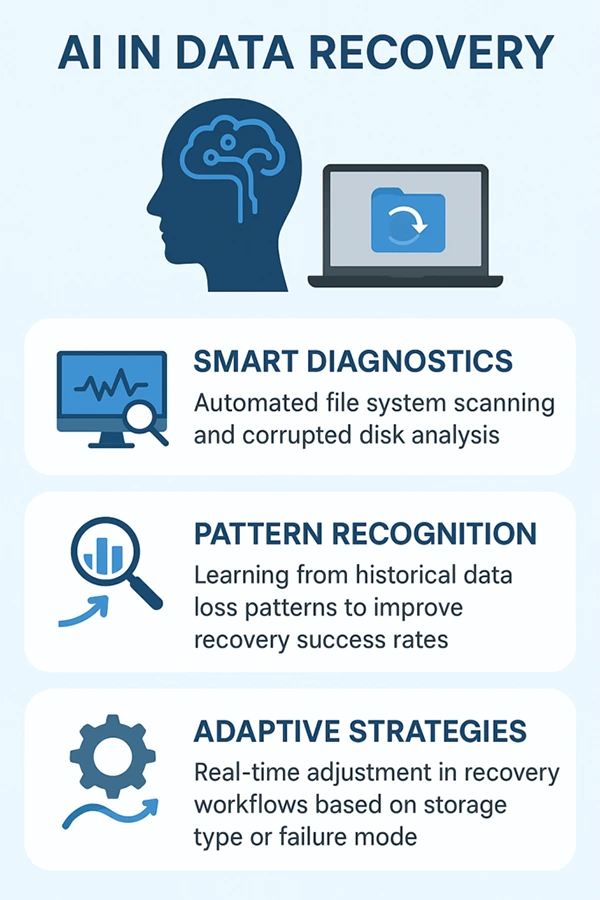
However, with smart diagnostics, pattern recognition, and adaptive strategies, AI changes the whole picture. Here is how it helps:
Top Courses That Teach Data Recovery & Backups
Want to make a career in this field? Here are the noteworthy data recovery and backup courses that can help you on your journey:
| Course/ Program | Focus Area | Target Audience |
| IIT Bombay CSE | Helps individuals move from basic manual data recovery to automated and proactive AI-driven systems with highly accurate techniques. | IT Professional, cybersecurity & digital forensics experts, and data/cloud engineers. |
| Backup & Restore with AWS | A vendor offered training resources including an e-book, labs, tutorials, TechTalks and videos. | Cloud Engineers and solution architects. |
| Cohesity Certified Protection Professional-NetBackup | Key topics include configuring storage devices, backups, and restorations, management and day-to-day backup operations. | NetBackup administrators and backup engineer. |
| Commavault Professional Certification | Covers different skill levels, from beginners who want to learn how to back up, monitor, and recover data, manage storage policies, and store deduplicate data to advanced users who wish to learn how to customize these features to meet specific needs. | Backup administrator and data protection professionals. |
| CompTIA Cloud + (V4) | Participants learn how to analyze cloud models, migrate workloads, manage environments, ensure security compliance, apple DevOps practices and troubleshoot issues. | Cloud engineers and systems administrators. |
These courses are designed to balance both, traditional enterprise backup offerings and modern cloud-native approaches. This helps ensure working professionals that they stay relevant across different organizational technology stacks and maturity levels.
Hands-On Skills You’ll Gain from Data Recovery Courses
Data recovery courses are not about only theoretical rote learning. These give you practical learning experience with hardware like HDDs and SSDs, software and file systems, and advanced techniques like forensic recovery and data encryption.
Understanding these concepts will make you industry-ready for enterprise-grade restoration, legal forensic investigation, and AI-driven backup strategies.
How to Choose the Right Course Based on Your Role
Since there are numerous courses available in the market, how to choose the right one that fits your needs? Well, the answer is simple: consider the following factors:
- Self Assessment: Be very clear about your career goals. Ask yourself, what do you enjoy the most and would like to pursue further in your journey? And reflect on your current skill set to identify the areas you lack and choose something accordingly.
- Course Research: Research well. Closely examine the market trends, evaluate course relevance, review the curriculum, and most importantly, choose something that provides practical experience rather than just going for a theoretical one.
- Practical & Financial Considerations: Make sure the institution you choose is credible and well reputed. Check their flexibility and fee schedule and evaluate the ROI.
- Seek Guidance: No one would know about the field better than someone who is actively working in it. Talk to professionals and alumni who are experienced in the field. You can also consider seeking career counseling, if needed.
These points will help you make the right decision for yourself and ensure a rewarding future.
DO YOU KNOW?
Nearly 30% of people realize that they’ve lost their valuable data when they’ve already accidentally deleted the files, and when the “undo” key cannot recover the damage.
Real-World Applications of Data Recovery Professional
Data is basically the currency right now and this currency will be even stronger in the future, and which is why recovery courses are so in demand. If we talk about real word applications, data professionals prove to be extremely helpful in the following cases.
- Evidence retrieval in forensic and law enforcement.
- Disaster recovery for firms and businesses.
- Cloud restoration of files deleted due to human error.
- Cybersecurity incident response.
- Physical media repair for damaged hard drives, be it SSDs or any other device.
Experts are well-equipped with the knowledge of using specialized software and hardware to retrieve lost, corrupted, or deleted data, helping individuals and organizations manage their data better.
The Future: AI-Driven, Self-Healing Data Infrastructure
The experts in this field have already covered a long way, and the future is even brighter. In the coming years, we can expect self-healing data systems, where the storage systems detect and fix the anomalies on their own, saving time and effort. And the main fuel of these systems will be the advanced innovations, namely, AI, ML, and predictive algorithms.
A proactive, smarter approach to data recovery is on the table in the years ahead. The individuals who master this skill today will be the architects of tomorrow’s data architecture. So, if you are someone who is interested in pursuing and moving forward in this field, this is your sign to choose a course tomorrow and ensure a bright career in the future.
For more details and guidance, check out our other blogs!
Frequently Asked Questions
Who should enroll in a data recovery course?
What do you learn in data recovery courses?
Data recovery courses are of different types, created for individuals with different level of skillsets. Some are for beginners, covering basics like SSD/HDD repair techniques, and there are expert ones as well that offer a more advanced level of understanding and topics.
Do these courses include hands on practice?
Yes, data recovery is something one can only understand with practical learning. Most of the courses offer hands on training.
Can data always be recovered?
Short answer, no. Data cannot be recovered in every scenario, especially overwritten data, extreme physical damage, or dead NAND chips.
Related Posts
How to Check for Malware on Mac in 2026?
Can Mac computers get viruses? Macs are not as safe as people think. Yes, macOS has built-in tools like XProtect…
10 Best Lightroom Preset Alternatives in 2026
“Photography is the story I fail to put into words.” — Destin Sparks (Landscape Photographer) For years, Lightroom presets have…
Elementor Hosting vs SiteGround: Which is Faster in 2026?
A website’s performance is mainly determined by its Speed. Even a slight delay can reduce conversions by a significant margin.…
10 Best Visual UGC Platforms for eCommerce Brands in 2026
“People influence people. Nothing influences people more than a recommendation from a trusted friend.” — Mark Zuckerberg (Meta CEO) That…
The Data Models Powering the Next Creative Revolution in Video Generation
Artificial intelligence has evolved from a mere tool to the cornerstone of advancements in the new era. Over the years,…
Solar Software Companies: How Platforms Improve Cross Team Collaboration
“If everyone is moving forward together, then success takes care of itself.” — Henry Ford (Industrialist & Business Magnate) Handoffs…
What Healthcare Leaders Expect From Digital Tools
Healthcare executives are under pressure to protect patient safety, clinician time, and data privacy while modernizing the delivery of care.…

How to Reset Android Phone When Locked? (Safe Factory Reset Methods)
Locked out of your Android phone or stuck on the screen? It happens more than you think. A forgotten PIN,…
How to Transfer Contacts from Android to iPhone: 4 Easy Methods
Switching from Android to iPhone should not feel like rebuilding your life from scratch. Restoring contacts on iPhone should be…