
UGC is User-Generated Content, which refers to any type of content that is generated by customers, such as reviews, photos, videos, and social posts.
UGC Data Analytics for Ecommerce: Turning Customer Content Into Sales Insights
 Reviewed By Brijesh Kumar Singh
  Mahima Dave
Updated on: Apr 08, 2026
Table of Contents
- What Types of UGC Data Ecommerce Brands Should Track
- How UGC Analytics Improves Product Discovery and Buyer Trust
- Using Customer Content Insights to Optimize Sales Funnels
- Role of AI and Automation in UGC Data Analysis
- Data Privacy, Accuracy, and Compliance Considerations
- Conclusion
- Frequently Asked Questions
Today, customer content is one of the most powerful components in e-commerce. In many industries, the influence of reviews, social media posts, unboxing videos, product images, and customer testimonials is more impactful than traditional advertising.
Forbes found that people trust the content made by other customers more than promotional efforts by brands.
With the rise of competition in ecommerce, brands are more than ever turning to UGC (User-Generated Content) analytics to gain deeper insights into customer behavior, boost product discoverability, and optimize conversion efforts. Businesses can identify customer buying trends, measure customer sentiment, and uncover the products that resonate most with customers and build trust.
Key Takeaways
- UGC analytics helps ecommerce brands understand customer behavior and buying trends.
- Reviews, photos, and videos influence buyer trust and product discovery.
- Customer content insights improve sales funnel optimization.
- AI helps brands analyze large-scale UGC data more efficiently.
- Privacy and content authenticity remain critical in UGC strategies.
What Types of UGC Data Ecommerce Brands Should Track
User-generated content is a lot more than marketing value. It also provides valuable insights into behavior and performance that ecommerce companies can leverage to optimize their sales strategies. Today’s brands are keeping tabs on various types of customer content on sites, marketplaces, and social media.
Common UGC data sources are:
- Product reviews
- Customer ratings
- Social media mentions
- Video testimonials
- Product photos
- Influencer collaborations
- Community discussions
Brands also review engagement metrics associated with customer content, including:
- Click-through rates
- Conversion rates
- Shares and saves
- Time spent on product pages
- The acquisition of content after interaction with content
Many ecommerce businesses now have specialized tools and top visual UGC platforms to organize and analyze customer-generated media more effectively. By monitoring these insights, brands can get a picture of what customers purchase and why.
INTRIGUING INSIGHTS
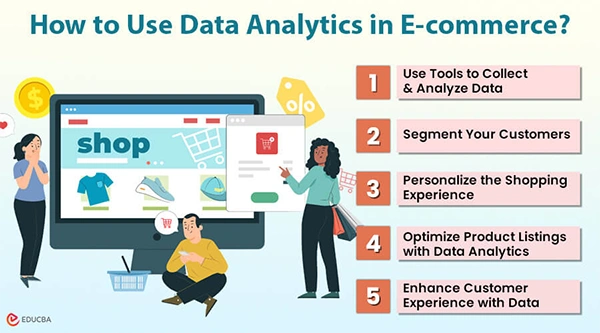
Here are some ways businesses can use data analytics in e-commerce.
INTERESTING FACT
Studies have shown that many online shoppers spend more time viewing customer photos and reviews than reading official product descriptions before making a purchase.
How UGC Analytics Improves Product Discovery and Buyer Trust
Real customer experiences can be more convincing than polished ads to consumers. This makes UGC one of the best trust-building tools for ecommerce. By studying brands on which content works best, they can enhance product visibility and boost the confidence of purchase.
With the help of UGC analytics, businesses can identify:
- The most commonly used products
- Images that are most engaging
- Reviews influencing conversions
- Social proof driving purchase decisions
For instance, whenever an ecommerce brands leverage the best Visual UGC platforms, it can pick out genuine customer photos and reviews and showcase them right on the product pages, thereby boosting consumers’ trust.
This technique can lead to higher engagement, since potential buyers are exposed to products in use by real people and not professional marketing photos. With increasingly discerning online shoppers, authentic customer content can be an increasing driver of product discovery and conversion optimization.
Using Customer Content Insights to Optimize Sales Funnels
Businesses can particularly benefit from the UGC analytics when they link the content produced by their customers with the performance of their sales funnels. Ecommerce brands no longer look at reviews and social engagement as one-off marketing tools, but rather, they study how these customer contributions affect customer behavior at every step of the purchase process.
Identifying High-Converting Products
Certain products are more likely to capture more attention from customers and elicit positive feedback than others. By tracking review volume, social shares, customer-uploaded media, and conversion performance, brands can detect the product that has greater sales potential and prioritize in campaign or home page placement. This assists businesses in making more efficient use of their advertising budgets.
Tracking Sentiment Across Customer Touchpoints
Sentiment analysis reveals customer sentiments towards products, shipping, customer service, and satisfaction, which aids in understanding their emotions and motivations in ecommerce. AI can identify trends in review language, social media comments, support conversations, and product feedback trends.
This lets brands know what is being complained about regularly, or what problems people have with a product, or what is new in their preferences, before it influences reputation.
Finding Content That Drives Purchase Decisions
Not every customer content makes an equal impact on conversions. Certain product images, reviews, or videos create much greater purchasing potential than others.
Businesses often analyze:
- What reviews drive more add-to-cart conversions?
- Which videos boost product page engagement?
- What are the photos of customers that are converting?
These insights enable brands to strategically place UGC to better within their ecommerce platforms and marketing campaigns.
Role of AI and Automation in UGC Data Analysis
With the increasing amount of customer content, ecommerce teams can struggle to analyze it manually. Brands can now process and organize UGC at scale with AI and automation technologies.
Modern systems can automatically:
- Categorize customer content
- Detect sentiment patterns
- Identify trending products
- Recommend high-performing visuals
- Flag inappropriate/ fake reviews
Also, automation can boost scalability by analyzing thousands of reviews, images, and interactions in real-time, helping ecommerce teams. In the era where ecommerce environments are growing, AI-driven analytics is critical to running large-scale customer content strategies.
Data Privacy, Accuracy, and Compliance Considerations
Although UGC analytics provides valuable insights, businesses need to take care of the data of their customers ‘ data as well. With the collection and analysis of customer content comes privacy and compliance requirements, particularly with respect to customer identities, behavior monitoring, or social data.
The following are some of the top priorities for ecommerce brands:
- Clear rules about data collection
- Consent management
- Secure data storage
- Content moderation standards
- The review will be verified for accuracy
Companies also need to take care that automated systems don’t further spread fake reviews or exaggerated product claims. It is crucial to ensure that customers’ trust and the brand’s reputation are not compromised by maintaining trustworthy and ethical UGC practices.
Conclusion
Nowadays, user-generated content stands as one of the most valuable data sources in ecommerce. UGC analytics can also boost authenticity and engagement, provide valuable insights into customer behavior, enhance product discovery, and optimize conversion strategies, offering real customer insights.
Ecommerce brands can leverage e-commerce review data, social content, customer sentiment, and engagement patterns to make better decisions regarding marketing campaigns, product positioning and customer experience. In addition to AI-powered automation and ethical data management, UGC analytics is playing a pivotal role in converting customer-generated content into actionable sales insights.
The more that brands can utilize the UGC data, the more competitive they will be in digital marketplaces as ecommerce becomes more customer-centric.
Frequently Asked Questions
What is UGC in eCommerce?
How does UGC play a role in ecommerce brands?
It enhances customer trust, product visibility, and customer interaction.
What does UGC analytics measure?
It tracks engagement, sentiment, conversions, and customer interaction with content.
How does AI help analyze UGC?
AI automates content categorization, sentiment analysis, and trend detection.
Related Posts

8 Best AI Presentation Makers for Business-Ready Slides
Making a presentation doesn’t just mean designing slides. It’s about defining a clear structure, using defined logic, useful visuals, and…

Queue Management Software Troubleshooting Guide: 8 Common Faults and Fixes
The long wait times and ineffective management of customer queues can have a significant impact on customer satisfaction and business…

How to Use Similarweb Website Traffic Data for Competitor Research
Competitor research without traffic data is guesswork. You can guess who your rivals are, guess how big they are, guess…

Choosing the Right Hosting Model for Scalable Digital Platforms
The performance of digital business is directly related to website speed, uptime, and scalability. Slow page performance has a negative…

How Data-Driven Performance Tools Are Transforming Employee Recognition in Tech Companies
“People work for money but go the extra mile for recognition, praise, and rewards.” — Dale Carnegie (Writer & Teacher)…

Why Businesses Struggle to Collect Reliable Data from the Web
Almost every company that depends on data runs into the same problem: although they can find the data they need,…

Why Financial Data Recovery Matters for Businesses
Financial data supports every part of a business, directly affecting cash flow, payroll, tax reports, audits, customer billing, and daily…

CMMC Compliance Is Coming for Manufacturers. Here Is What You Need to Do
“Cybersecurity is much more than a matter of IT.” — Stephane Nappo (Cybersecurity Professional) For manufacturers working within the defense…

How Data-Based Tools Influence Learning Performance
Learning has transformed in the modern age with the integration of new technologies to help students and professionals prosper in…