
The percentage of visitors to a site that complete a purchase or desired actions.
How to Calculate Ecommerce Conversion Rates Using Accurate Conversion Data
 Reviewed By Brijesh Kumar Singh
  Saipansab Nadaf
Updated on: Apr 15, 2026
Table of Contents
- What Ecommerce Conversion Rate Means
- Why Conversion Rate Data Matters for Ecommerce Businesses
- Key Conversion Metrics Every Ecommerce Team Should Track
- Ecommerce Conversion Rate Formula and Basic Calculation
- How to Collect Accurate Conversion Data from Ecommerce Platforms
- Common Mistakes That Affect Conversion Rate Accuracy
- Conclusion
- Frequently Asked Questions
E-commerce businesses have a ton of data on their customers and sales, but that is not enough to ensure revenue growth if the company’s just getting traffic. The real question is how well a website engages its visitors into paying customers.
As per the Statista report, ecommerce sales are on the rise every year, and for online retailers, conversion optimization is becoming more crucial than ever in the increasingly saturated online marketplace.
By analyzing conversion rates, businesses can gain insights into the performance of their website, product pages, checkout process, and marketing campaigns. Knowing accurate conversion data allows ecommerce teams to better understand customer behavior, enhance user experience, and fine-tune sales strategies.
As a small online retailer or large eCommerce website, knowing your key conversion metrics is vital to the growth of your business.
Key Takeaways
- The conversion rate on ecommerce is the efficiency of converting traffic into customers.
- The accurate conversion data leads to better marketing and sales optimization.
- Abandonment tracking can be used to identify checkout issues.
- To ensure clean conversion reporting, a reliable analytics setup is critical.
- The conversion analysis makes better ecommerce decisions.
What Ecommerce Conversion Rate Means
E-commerce conversion rate is the percentage of people who convert on a website, typically by making a purchase. Conversion analysis looks at how effective your web visitors are at going through the buying process, rather than just traffic. If a web retailer has 10,000 visitors who make purchases, the conversion rate will represent the success rate of converting the visitors into customers.
Businesses can take advantage of the analytics tools available on popular e-commerce platforms like Shopify, which lets them track conversions, customer activity, and sales metrics in real time.
The conversion rates are to measure our website usability, product demand, checkout performance, marketing effectiveness, and customer engagement. The conversion rate is typically a better sign of a better shopping experience if higher.
Why Conversion Rate Data Matters for Ecommerce Businesses
Conversion data offers much more than just raw sales figures. Based on the behavior of customers on products, pages, and checkout systems, businesses can discover shortcomings that could be impacting revenue potential. Here are the ways accurate conversion tracking benefits ecommerce teams:
- Improve customer experience
- Optimize marketing campaigns
- Reduce abandoned carts
- Increase sales efficiency
- Understand customer behavior
A business that has a high number of visitors but low conversions, for instance, could have a problem with its pricing, website speed, product descriptions, or checkout friction. Businesses frequently make decisions based on assumptions rather than measurable trends in performance without reliable conversion data.
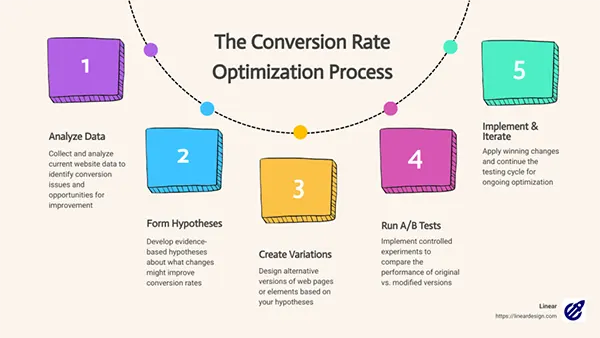
The following visual explains how conversion rate optimization helps businesses improve ecommerce performance and customer conversions.
Key Conversion Metrics Every Ecommerce Team Should Track
There are several key metrics to track along the customer journey to optimize conversions.
Website Visitor-to-Buyer Rate
Represents the percentage of visitors that turn into paying customers. It assists businesses in determining if products have an attractive variety, the navigation of the website is good, marketing is relevant, and customer trust signals are on point. A low rate of visitors buying the product can be a sign that there are issues with targeting, pricing, or the usability of the website.
Cart Abandonment and Checkout Completion Rate
At the checkout phase, a lot of online businesses suffer from the loss of revenue. The monitoring of abandonment rates can provide insights into problems like complicated checkout forms, unexpected shipping costs, limited payment options, and technical errors.
The checkout completion data provides a business with the ability to streamline the buying journey and minimize friction in the transaction.
Product Page and Campaign Conversion Data
Some product pages and marketing campaigns are more effective than others. Businesses should monitor product-specific conversions, landing page performance, email campaign conversions, paid advertising results, and conversions, mobile vs desktop conversions. This aids the ecommerce team in identifying which products, promotions, or traffic sources really deliver the best sales performance.
Ecommerce Conversion Rate Formula and Basic Calculation
To create accurate reports and performance analysis, one needs to know the basic conversion formula. The basic ecommerce conversion rate equation is:
| Conversion Rate = Total Visitors/Total Conversions ×100 |
For example:
500 purchases
20,000 website visitors
The rate of conversion would be: 2.5%
Advanced analytics dashboards are another speciality that many companies that provide custom ecommerce software development services develop. which automatically calculates conversions over various websites, apps, and customer channels.
Regular tracking enables businesses to make comparisons over time and to better evaluate the impact of optimizations.
How to Collect Accurate Conversion Data from Ecommerce Platforms
The key to accurate reporting of conversions lies in a correct data collection and tracking setup. Ecommerce companies have analytics tools built in that they use to track customer activity. Typical conversion tracking methods include:
- Website analytics platforms
- Ecommerce tracking pixels
- CRM integrations
- Check out monitoring tools
- Campaign attribution systems
Also, ensure that tracking systems are accurate on the following:
- Mobile devices
- Desktop browsers
- Multiple traffic channels
- Third-party payment systems
A slight deviation from the absolute value can lead to reporting inaccuracies and wrong business insights. Scheduled audits can ensure cleaner analytics data.
Common Mistakes That Affect Conversion Rate Accuracy
There are a number of common reporting problems that can have an impact on the reporting accuracy and decision-making process. These include:
- Duplicate tracking scripts
- Incorrect attribution models
- Bot traffic distortions
- Broken checkout tracking
- Neglecting the conversion behavior on mobile devices
- Not filtering internal traffic
Another pitfall is concentrating on overall conversion rates instead of examining individual phases of the customer journey. Too often, detailed funnel analysis can show issues that other metrics may not have.
Better data accuracy equips ecommerce teams with more accurate information to make better optimization decisions.
INTERESTING FACT
The longer it takes for your website to load, the more likely it is to cause a loss of ecommerce conversions and engagement.
Conclusion
Conversion rate analysis is one of the most essential tools in the toolbox for any ecommerce business looking to boost its growth. With accurate conversion data, ecommerce teams can optimize customer experiences, enhance marketing performance, and minimize sales friction throughout the buying journey.
Businesses can monitor their important metrics like the percentage of visitors becoming buyers, cart abandonment rate, and campaign performance, thus identifying opportunities for continual improvement. When paired with accurate analytics solutions and correct data gathering, e-commerce brands can better inform their business decisions and maximize profitability in a growingly competitive online marketplace.
Frequently Asked Questions
What is ecommerce conversion rate?
Why is it important to have conversion tracking?
It aids businesses in optimizing their sales performances and customer experience.
What causes low ecommerce conversion rates?
This is often due to user unfriendliness on the website, slow checkout systems, and cluttered product pages.
What tools are there to monitor ecommerce conversions?
Typical platforms that support conversions include Shopify, Google Analytics, and CRM integrations.
Related Posts

8 Best AI Presentation Makers for Business-Ready Slides
Making a presentation doesn’t just mean designing slides. It’s about defining a clear structure, using defined logic, useful visuals, and…

Queue Management Software Troubleshooting Guide: 8 Common Faults and Fixes
The long wait times and ineffective management of customer queues can have a significant impact on customer satisfaction and business…

How to Use Similarweb Website Traffic Data for Competitor Research
Competitor research without traffic data is guesswork. You can guess who your rivals are, guess how big they are, guess…

Choosing the Right Hosting Model for Scalable Digital Platforms
The performance of digital business is directly related to website speed, uptime, and scalability. Slow page performance has a negative…

How Data-Driven Performance Tools Are Transforming Employee Recognition in Tech Companies
“People work for money but go the extra mile for recognition, praise, and rewards.” — Dale Carnegie (Writer & Teacher)…

Why Businesses Struggle to Collect Reliable Data from the Web
Almost every company that depends on data runs into the same problem: although they can find the data they need,…

Why Financial Data Recovery Matters for Businesses
Financial data supports every part of a business, directly affecting cash flow, payroll, tax reports, audits, customer billing, and daily…

CMMC Compliance Is Coming for Manufacturers. Here Is What You Need to Do
“Cybersecurity is much more than a matter of IT.” — Stephane Nappo (Cybersecurity Professional) For manufacturers working within the defense…

How Data-Based Tools Influence Learning Performance
Learning has transformed in the modern age with the integration of new technologies to help students and professionals prosper in…