
Data marketplaces are online platforms that securely facilitate the buying, selling, and sharing of data between providers and consumers.
Data Marketplaces: Definition, Types, and Value Through Secure Data Exchange and Monetisation
 Mahima Dave
Updated on: Nov 07, 2025
Table of Contents
- What is a Data Marketplace?
- Essential Features of a High-Performing Data Marketplace
- Benefits of a Data Marketplace: Efficiency and Monetisation
- Types of Data Marketplaces: Internal vs External Data
- Use Cases Across Industries: How Organisations Leverage Data Marketplaces
- How to Build or Select a Data Marketplace Platform
- The Future of Data Marketplaces: AI, Automation, and Data Recovery Integration
- Frequently Asked Questions
Building a strong brand identity is no longer just about the visuals you present to the audience. It also relies on the way a business manages, exchanges and activates the data it gathers. These days, the market competition is cutthroat and consumers are smarter. Therefore, those old traditional ways of managing things are of little to no use.
See, in this digital age, “Data is the new currency”, and if you are a business owner who wishes to succeed, this should be your new mantra. And this is where data marketplace platforms come into play. Statistically,enterprises leveraging these platforms saw an increase of approx 20% in their revenue and up to a 25% reduction in operational costs. (Source: SCIKIQ)
Want to know how exactly data marketplaces help? This guide is for you! Follow through to learn their role in secure data exchange and monetization and their significance in different fields.
KEY TAKEAWAYS
- Data marketplaces are digital platforms used for buying, selling, sharing or exchanging data safely.
- By automating tasks, eliminating data silos, data marketplace boosts efficiency and monetization.
- These platforms can be of two types: internal and external data marketplace.
- Such platforms are used across various industries, including marketing, healthcare, finance and ecommerce.
- The future of the data marketplace will be driven by AI, automation, and data recovery integration.
What is a Data Marketplace?
Data marketplaces are digital platforms that enable organizations to buy, sell, share, or exchange data safely. Think of it as an organized library where teams can borrow data, experts can donate datasets, and everything is secure and easily searchable.
But how is it different from the traditional platforms? Well, the answer is simple: these bring more governance and monetization opportunities into a unified ecosystem. They support metadata management, secure access control, a standardized format for seamless integration, and ensure compliance with GDPR, HIPAA, and other important regulations.
Such platforms and experts like premieronlinemarketing.com can help you boost business growth by turning raw information into a valuable and exchangeable asset.
Essential Features of a High-Performing Data Marketplace
To obtain exceptional results, you must leverage a robust marketplace that offers the following features:
1. Powerful Search & Discovery:
It must provide relevant information to the users quickly through filters, tags, and metadata descriptions.
2. Security & Compliance:
The platform should be secure, end-to-end encrypted, and reliable. It must ensure compliance with automated checks.
3. Flexible Monetisation Tools:
Consumers today look for flexible options that align with their goals. Pricing models, subscription tiers, licensing options, and usage-based billing support commercial data exchange.
4. Integration Capabilities:
APIs, connectors and data pipelines allow marketplace to plug into analytics tools, CRMs, cloud warehouses, and enterprise systems.
By choosing a system that includes all these features, you’re not only choosing a mere functional framework, but also growth and success.
Benefits of a Data Marketplace: Efficiency and Monetisation
Data marketplace changes the way things get done in any organization, especially in terms of monetization and efficiency of their workflows.
- By automating tasks, eliminating data silos, these platforms help organizations streamline their work.
- Companies can create new revenue streams without altering their core business model by monetizing unused datasets.
- Data plays a major role in making decisions. Since these apps provide real-time data insights, smarter decisions can be made.
- Collaborations are also made easier by securely sharing data withdifferent teams while maintaining full control.
All these things ultimately lead to better digital performance and growth. High quality data improves campaign targeting, such as effective PPC campaigns, customer segmentation and personalized messaging.
DO YOU KNOW?
Today, data is one of the most important commodities, considered more valuable than oil. This is one of the reasons companies are now heavily investing in buying, selling, and sharing quality datasets.
Types of Data Marketplaces: Internal vs External Data
Data marketplaces can majorly be of two types: Internal and external.
The internal data marketplaces serve employees and staff within an organization by keeping a track of data from sales, finance, marketing, operations, product and more. Their maor purpose is to automate simple tasks and make sure that all the teams are collaborating efficiently.
The external data marketplaces is used by companies that buy or sell datasets. Their objective is to enrich existing datasets, monetize proprietary data, and expand analytical capabilities, and is used by marketing agencies, financial firms, retailers, healthcare providers, and researchers. Many small business owners start their online presence by setting up a simple website to collect basic customer information. Learning how to manage these initial platforms often needs clear and visual guidance. For example, this video creator has step-by-step tutorials on how to build and host WordPress sites for those just starting out. Once a site is live and begins to gather traffic, the data it generates is a valuable asset. This information then feeds into the larger data marketplaces discussed earlier. Having a solid technical foundation makes it much easier to scale into more complex data management systems later on.
Use Cases Across Industries: How Organisations Leverage Data Marketplaces
Data marketplaces are used across various industries and they transform the way industries operate, innovate and make decisions. Some common real-life use cases are as follows:
1. Marketing & Advertising
Data marketplaces offer ready-to-use insights to marketers, helping them create highly targeted campaigns that resonate with their target customers.
2. PPC Optimization
Third part data allows advertisers to improve their strategies and run more efficient PPC campaigns and reduce cost-per clicks, increasing conversions in an affordable way.
3. Retail & Ecommerce
Understanding the audience’s demands, planning inventory accordingly and recommending products based on their preference.
4. Finance
Analyzing market trends to provide the best to the customers, detecting risks, and identifying fraud.
5. Healthcare
Reliable insights into population health, data management for clinical research, and secure sharing of anonymized datasets.
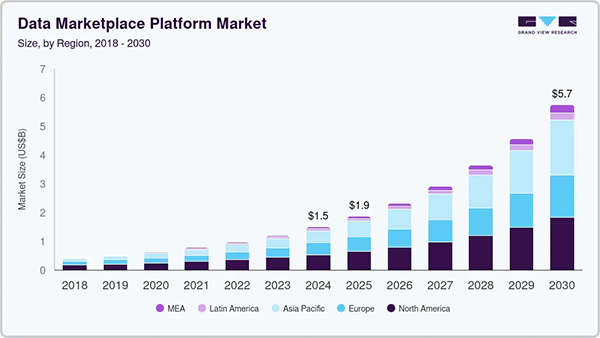
Apart from these, the data marketplace also plays a crucial role in other areas such as supply chain & logistics, technology & telecom, etc. Since almost all the industries rely on data, the data marketplace platform market has shown a tremendous growth and it is expected to go from $1.9 billion in 2025 to &5.7 billion in 2030.
How to Build or Select a Data Marketplace Platform
The data marketplace you build or choose plays a crucial role in your business and affects its security, governance, monetization potential, and long-term scalability. This is why the platform you choose to trust should be compatible with your systems and combine usability and compliance.
For this, first, you must define your purpose. Ask yourself what exactly you need, how much you are willing to spend on it, what features are a must to function properly, and other privacy requirements.
Prioritize features that ensure quality data, easy discovery, security compliance, simple transactions, and easy integration and scale with your existing tools.
The Future of Data Marketplaces: AI, Automation, and Data Recovery Integration
Data marketplaces are already transforming organizational workflows, changing them for the better. For the next generation, we can expect:
- AI-powered data matching that automatically suggests data sets and highlights hidden insights.
- Self-healing data pipelines that detect failures and reroute data on their own before it turns into a bigger issue.
- Better technologies to protect client credentials.
- Blockchain-enabled smart contracts that automate the licensing and payment process.
These and more such advancements paint a future of a data marketplace that looks promising and bright.
At the end, we can say that as data becomes the backbone of digital transformation, data marketplaces will evolve into essential hubs that power personalization, automation and decision intelligence.
Frequently Asked Questions
What are data marketplaces?
What are the examples of data marketplaces?
Some of the common examples of data marketplaces are Snowflake Marketplace, AWS Data Exchange and Oracle Data Marketplace.
What are the key uses of data marketplaces?
The key uses of data marketplace include monetization, data sourcing, collaboration, governance & security, and self-service access.
Explain the types of data marketplaces.
Data marketplaces are mainly of two types: Internal, for sharing data between departments within an organization, and External, which allows secure dataset exchanges.
A hybrid option is also there, which combines both external and internal systems.
Related Posts

8 Best AI Presentation Makers for Business-Ready Slides
Making a presentation doesn’t just mean designing slides. It’s about defining a clear structure, using defined logic, useful visuals, and…

Queue Management Software Troubleshooting Guide: 8 Common Faults and Fixes
The long wait times and ineffective management of customer queues can have a significant impact on customer satisfaction and business…

How to Use Similarweb Website Traffic Data for Competitor Research
Competitor research without traffic data is guesswork. You can guess who your rivals are, guess how big they are, guess…
Choosing the Right Hosting Model for Scalable Digital Platforms
The performance of digital business is directly related to website speed, uptime, and scalability. Slow page performance has a negative…

How Data-Driven Performance Tools Are Transforming Employee Recognition in Tech Companies
“People work for money but go the extra mile for recognition, praise, and rewards.” — Dale Carnegie (Writer & Teacher)…

Why Businesses Struggle to Collect Reliable Data from the Web
Almost every company that depends on data runs into the same problem: although they can find the data they need,…

Why Financial Data Recovery Matters for Businesses
Financial data supports every part of a business, directly affecting cash flow, payroll, tax reports, audits, customer billing, and daily…

CMMC Compliance Is Coming for Manufacturers. Here Is What You Need to Do
“Cybersecurity is much more than a matter of IT.” — Stephane Nappo (Cybersecurity Professional) For manufacturers working within the defense…

How Data-Based Tools Influence Learning Performance
Learning has transformed in the modern age with the integration of new technologies to help students and professionals prosper in…