
Governance, Architecture, Management, and Culture.
Data Loss vs. Data Strategy: Why One Conversation Matters More Than the Other
 Kartik Wadhwa
Updated on: Mar 28, 2026

In the corporate conversation around information, most of the firms are scared of losing data. That’s understandable, as most of us like to play defensively. And losing data can actually cost your business gravely.
But in their fears around information, they’re ignoring a much more important conversation: Data Strategy. Do you know that two-thirds of firms don’t have a data framework in place (Source)?
By partnering with data strategy services, businesses aren’t just securing their data; they’re leveraging it to drive future growth.
In this article, I’ll explain why you should focus on your data framework as much as you worry about data loss, maybe even more. The following sections cover the cost of data loss, data lakes and their relevance, and how to build a successful data strategy.
KEY TAKEAWAYS
- Focus on building a robust data strategy more than worrying about just data loss.
- Yes, data loss is costly, but you can’t win in the business world with a defensive approach.
- A data lake is a repository that stores all your business information and helps you build a functional data framework.
Why Data Loss Is So Costly
Data loss directly dents your finances as it takes a fortune to recover from a single data breach. The average data breach cost is $4.88 million.
Suddenly, “don’t ever lose data” starts to sound pretty realistic, right?
But here’s the thing about those numbers. They don’t account for much more than the immediate financial hit to the business.
They don’t measure:
- Reputation damage
- Lost customers
- Compliance penalties
- Months (or years!) of recovery
- Lost productivity
- Stress.
When data is lost, ALL of that suffers.
IBM revealed that 93% of companies that experience a disruption from their data center (lasting more than 10 days) filed for bankruptcy within a year. Not suffered. Not had a rough go. Filed for bankruptcy.
Protecting data matters. Of course. But also realize that the conversation doesn’t end there.
And most businesses do end it there.
The Problem: Businesses Are Asking the Wrong Question
The usual reaction of a business to a cyberattack is:
- Install new security software.
- Schedule a training on phishing.
And it’s sufficient if the goal was just “don’t get hacked.” But here’s the critical question that most businesses DON’T ask:
“What data should we actually have? Where is it now? Who needs it? And how is it informing decisions?”
If those questions aren’t being asked, the business is just building a larger target.
This is a reactive approach, and IT professionals know it. Most breaches are caused by human error. So security software gets improved, and employees get educated. But what about the data environment? What if it’s welcoming human error with open arms?
Data should be protected. Nobody likes headaches. But if data isn’t structured, governed, and actually useful, it’s just throwing money away on an expensive Band-Aid.
What Is a Data Lake Anyway?
There’s a new buzzword around information in the corporate circles: Data Lake.
Don’t know what it is?
Well, a data lake is a framework that ensures no information can ever be lost again. No costly “why wasn’t this backed up?” moments. Ever.
A data lake is a central repository of information that stores information in its native format.
Essentially, structured data, unstructured data, and semi-structured data all live in one accessible location until it’s time to parse them out for analysis.
It allows companies to throw everything into one big lake… then go fishing when the time comes.
This isn’t the future. It’s here. The global data lake market is expected to reach $51.78 billion by 2030.
Growth is happening because companies understand that valuable insights aren’t hidden in the new AI they are yet to purchase. It’s in their data. And making sure that data is easily accessible is critical.
Here’s the thing about a data lake, though: Businesses are often sold the value of “everything, all in one place.”
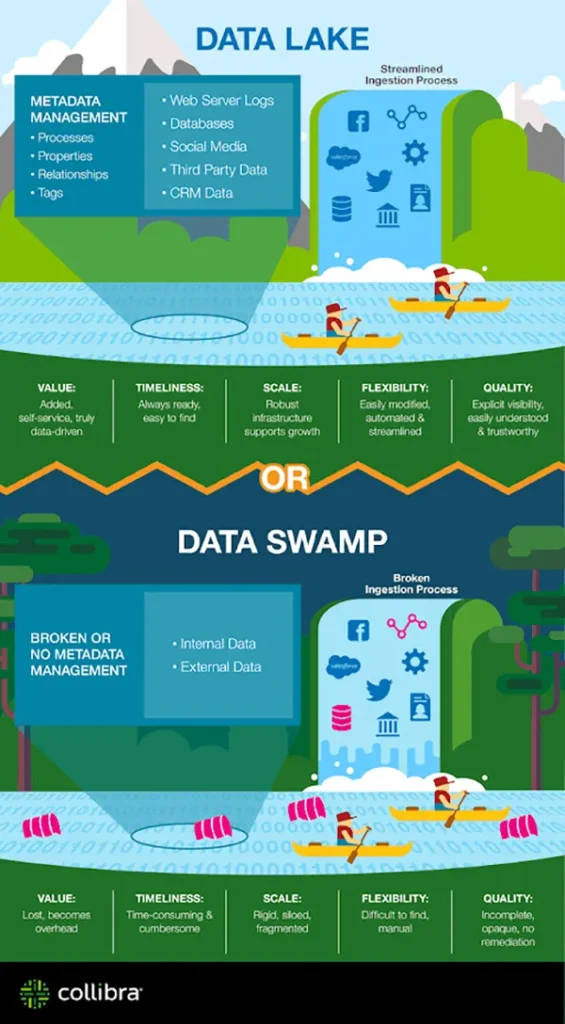
But what happens if there’s no context? No governance? Nothing to make that data readily accessible or useful? A data swamp gets built. Data lakes consulting doesn’t let that happen.
The following infographic makes you understand the difference between a data lake and a data swamp in a clearer way:
The Role of Data Lakes Consulting
As far as data is concerned, It’s great to avoid loss. But what do you plan to do with that information? Is it just there for the sake of it? Didn’t you start your data collection with a purpose?
Yes, a proper data strategy can make you use that information properly. And it’s data lakes that help you build that strategy from the infrastructure level up.
Quality data lakes services do more than just store data. The right partner helps architect a system that captures data, organizes it, and surfaces the right information at the right time so it can literally drive better decisions. They also ensure the lake isn’t slowly turning into a swamp.
Quality data lakes engagements will:
- Help identify where data exists (and where it’s going missing)
- Design the lake architecture that works for unique business needs
- Put governance practices and procedures into place so data doesn’t become corrupt
- Connect the lake to analytics and reporting tools teams are already using today
But above all else? They build the plan for why information is being collected in the first place.
Without that foundation, a lake WILL become a data swamp.
All the technology in the world can be bought to build a dream home. But without an architect to draw up the plans… that house won’t last long.
How to Build a Successful Data Strategy
Data lakes are important. But they’re just one cog in the wheel.
A holistic data framework involves everything about data: how it’s collected, stored, governed, and used.
Putting a strategy in place will answer three questions.
- What data does the business have?
Sounds simple, but unless a proper audit has been completed, most businesses likely have no clear answer.
- What data does the business actually need?
Just because data CAN be collected doesn’t mean it SHOULD be. Data strategy helps identify what to track and, just as importantly, what to cut out.
- How does data impact decisions?
All of this is pointless if information isn’t attached to business outcomes. A strategy needs to close that loop.
Who spent more time on data governance than AI and data quality initiatives combined in 2024? Data leaders.
They know building out strong governance practices isn’t about compliance. It’s about creating a structure that makes information useful enough to act on.
Governance starts with defining who has access to what. How long is data retained, and where it flows. Every part of the data lifecycle needs to be explained, planned for, and deployed.
Wrap Up
So, from now on, stop asking “how do we keep from losing data?” and instead ask: “How do we make our data worth protecting?”
Flip the conversation. Instead of focusing on what there is to lose… think about how to build something worth protecting.
Two-thirds of organisations suffered significant data loss in the last year. Those who were scrambling to recover losses are likely still feeling the ripple effects. Those who had a strategy? They were ready.
It’s not about the tools or technology. They matter, of course. But the winners are businesses with a plan.
A plan that starts at the infrastructure level and filters down to every team. Every process. Every decision.
Do you have a plan to make your data worth protecting?
Frequently Asked Questions
What are the 4 pillars of data strategy?
Why is information more important than data?
Because it is processed, structured, and contextualized.
What are the 4 big data strategies?
Descriptive, Diagnostic, Predictive, and Prescriptive.
Related Posts

How to Open Control Panel in Windows? (All Methods Explained)
The control panel in Windows is a collection of tiny programs. It is used to configure the various aspects of…

How to Delete Apps on Mac? Safe and Quick Ways to Uninstall Apps
How do you remove applications from a Mac? Most Mac users think there is just one way to delete apps.…
Why Proxy Servers Are Popular
Many tech platforms, ad networks, SaaS tools, and online stores in the world have critical traffic and infrastructure that require…

How to Turn Off Touchscreen on Chromebook? Step-by-Step Guide
Touchscreen on a Chromebook sounds great until it starts getting in the way. Accidental taps while typing, smudges, and random…

How to See Blocked Messages on iPhone? (What Actually Works)
Ever blocked someone on your iPhone and later found yourself wondering if you can see blocked texts on iPhone? It…
The 5 Architecture Decisions That Haunt SaaS Founders Two Years Later
Architecture decisions are fundamental to ensuring steady growth in any business or technical step, especially when the topic is laying…

Database Scaling: How to Manage 10,000+ Political Volunteers
Every small business or growing team needs to deal with a common issue—the database that was working perfectly for the…

What Structured Cabling Systems Include and Why Businesses Still Need Them
Nowadays, IT conversations jump straight to cloud apps, wireless coverage, and cybersecurity tools. While these are visible and easy to…

Top 10 Web Development Companies to Partner with in 2026
In today’s fast-growing digital world, every business needs a strong online presence to stay competitive. A well-designed website not only…