
A Practical Guide to Designing Secure and Scalable Enterprise Networks
 Kartik Wadhwa
- Start With a Threat Model Before You Draw The Network
- Design Scalability with Repeatable Building Blocks
- Use Zero Trust Principles Through Segmentation
- Assume Credentials Will Fail and Design for That Reality
- Build Resilience Into The Hardware Layer Without Overbuying
- Operationalize Security With Monitoring and Change Control
- Conclusion
Enterprise networks used to be designed around a building. Now they’re designed around a business that rarely stays in one place. Users work from anywhere, apps run across hybrid environments, and the “edge” is often a laptop on a home Wi-Fi network. That shift makes network design decisions harder and mistakes more expensive.
Security pressure is also rising because the easiest attack paths scale nicely. Credential-based access is still a repeat offender in modern breaches, which is why “trusted internal network” thinking keeps hurting teams. According to Verizon’s 2024 Data Breach Investigations Report, stolen credentials and web application attacks remain the most common breach patterns.
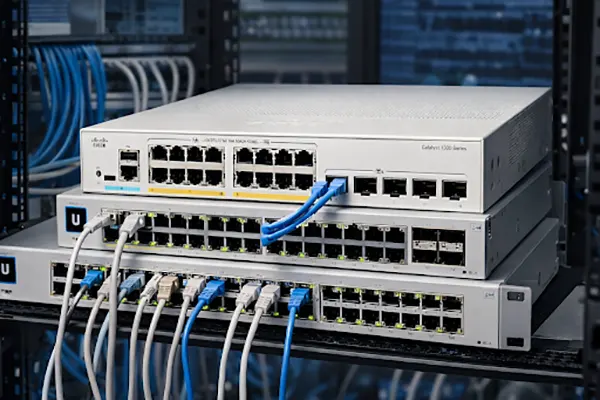
A practical way to respond is to design networks with repeatable building blocks, strong segmentation, and predictable capacity headroom. Procurement choices can support that approach, too. Teams looking to expand coverage or standardize across sites often evaluate used Ubiquiti equipment as a cost-effective way to scale without turning every upgrade into a budget crisis.
Start With a Threat Model Before You Draw The Network
Most network projects start with a diagram and end with security controls sprinkled on top. Flip that. Start by defining what you’re protecting, how it can fail, and what “good enough” risk looks like for your business.
Keep it simple. Identify your critical systems (identity, finance apps, customer data, production operations), where they live, and who needs access to them. Then list the most likely failure modes: compromised credentials, exposed admin interfaces, misconfigurations, and unpatched edge devices.
Once you do that, “secure and scalable” becomes a set of design decisions. You’re building for containment and recovery, not just prevention. That mindset is what keeps one compromised device from becoming a company-wide incident.
Design Scalability with Repeatable Building Blocks
Scalable networks are boring in the best way. They use a standard pattern that can be copied across floors, buildings, and branch offices. That’s how you grow without turning every site into a custom project.
Define your unit of growth. It might be a branch office of 40 users, a warehouse zone, or a floor in a campus building. For that unit, document expected device counts, traffic types (voice, video, SaaS, ERP), and the minimum acceptable performance.
Then standardize around it. Standard switch models, consistent VLAN patterns, predictable IP addressing, and a repeatable wireless layout reduce design debt. Consistency matters more than novelty, and standardized equipment is easier to operate well.
Build Capacity Headroom Into the Design
Capacity planning isn’t guesswork if you set targets. Define acceptable utilization thresholds for uplinks and core paths, and plan for peak periods plus growth.
Headroom is what prevents “it works most of the time” networks. It also buys you time during failures, because a network running hot has no margin when a link or device drops.
Use Zero Trust Principles Through Segmentation
Zero trust is often misunderstood as a product. It’s more useful as a principle: don’t trust traffic solely because it’s “inside.” NIST describes zero trust as shifting defenses away from static perimeters and toward users, assets, and resources.
In practice, segmentation is your fastest win. Separate users, IoT, guest access, servers, and management traffic so a compromise in one area doesn’t unlock the rest of the environment.
A clean segmentation baseline looks like this:
- User Networks: group by role or risk (staff, contractors, privileged users).
- IoT Networks: cameras, printers, access control, and anything that should never talk to finance systems.
- Server Networks: restrict access using allow-lists and explicit policies.
- Guest Networks: full isolation from corporate resources.
- Management Networks: reachable only via approved admin paths.
This doesn’t require perfection on day one. It requires intent and steady tightening over time.
Lock Down the Management Plane
A surprising number of serious incidents worsen because the management plane is accessible from everywhere. Treat device administration as a protected resource.
Put management interfaces on a separate segment, restrict access to known admin devices, and enforce strong authentication. Avoid exposing administrative panels to the public internet, even temporarily.
If remote management is required, use secure access with logging and strict permissions.
Assume Credentials Will Fail and Design for That Reality
Credentials are a weak link because humans are humans. Phishing, password reuse, and credential theft aren’t edge cases. They’re common enough that your network should assume they will happen.
Verizon’s DBIRonsistently shows the same lesson: stolen credentials keep enabling breaches at scale.
Design responses that reduce the blast radius of a stolen login:
- Require MFA for remote access and privileged actions.
- Limit lateral movement with segmentation and least-privilege policies.
- Monitor for abnormal behavior, such as new device access, privilege escalation, or unusual geographic logins.
- Reduce standing admin access by using just-in-time elevation where possible.
This is also a scalability move. Security that depends on manual exceptions and one-off rules doesn’t scale. Standard policies do.
Build Resilience Into The Hardware Layer Without Overbuying
Scalability isn’t only “more users.” It’s also “more reliable under stress.” That means redundancy where it matters: uplinks, critical switching, authentication dependencies, and WAN paths for distributed environments.
A practical approach is to categorize what must stay up:
- Must Not Fail: core switching/routing, identity services, critical wireless coverage.
- Can Degrade: guest Wi-Fi, noncritical IoT, best-effort bandwidth.
- Can Recover Later: labs, test networks, low-priority segments.
Then invest accordingly. Many networks fail theatrically because the core is a single point of failure, while edge features get all the attention.
Cost discipline helps here, too. IBM’s 2024 Cost of a Data Breach report highlights how expensive incidents can be when you include disruption, response, and recovery. The point isn’t to panic-buy hardware. The point is to spend on resilience patterns that reduce the likelihood and impact of common failures.
Managing Used Ubiquiti Equipment Within a Controlled Standard
If you choose refurbished or used Ubiquiti equipment as part of your scaling strategy, treat it as an engineering decision with operational controls in place. Standardize models per site, keep spares, document configurations, and test failover behavior.
What creates risk isn’t the procurement approach. It’s unmanaged variation: random models, inconsistent firmware practices, and undocumented changes. Predictability is what makes both security and scalability achievable.
Operationalize Security With Monitoring and Change Control
A network design isn’t complete until it’s observable. Centralized logging, alerting, and performance baselines help you detect both security issues and reliability problems early.
Start with a few high-signal events: authentication anomalies, configuration changes, device reboots, uplink flaps, and new devices joining sensitive segments. Then add depth over time. Visibility is a compounding asset.
Change control is equally important. Most outages are self-inflicted, and many security weaknesses come from configuration drift. Use a simple discipline: document intent, make changes in defined windows, validate outcomes, and keep rollback plans. This is how you scale without losing stability.
Conclusion
Secure and scalable networks are built through fundamentals that hold up under pressure. Start with a threat model so your design choices reflect real risks. Use repeatable building blocks so growth doesn’t create chaos. Segment aggressively so incidents stay contained. Assume credentials will fail and reduce the damage they can do. Finally, operationalize everything with monitoring and change control so security and uptime don’t depend on luck.
The goal isn’t perfection. It’s a network that fails gracefully, recovers quickly, and keeps the business moving when the real world does what it always does: surprise you.
Growth is an important factor that determines the success rate of any business. When we witness new operations, partnerships and…

“Digital currency is here to stay, and it’s only a matter of how long before governments embrace it.” — Brad…

Data growth has significantly accelerated beyond what most compliance teams can manage, with personal records, financial details, contracts, and emails…

The way marketing teams and businesses approach their potential clients to boost their sales has completely transformed in the last…

Thinking, how can I delete iCloud or Apple account? It is not just about removing an account; it is about…

In the market we have today, companies are always trying to find ways to work better and get results. The…

Attractive web pages form the roots of any appealing website. For instance, imagine looking for content on Google, and you…

Every business needs to ensure smooth operations for a successful business. But despite trying hard to avoid barriers, technical issues…

You don’t notice user profiles until one starts causing problems. A profile gets corrupted, a login error pops up, or…