Messaging apps have become an integral part for most smartphone users today. They feel instant, effortless, and personal. But what people often miss is that behind every message is a flow of sensitive data that needs serious protection.
Messaging apps deal with data that is fully confidential to users: whether personal or shared messages, files, or access passwords.
Since millions of users are using these platforms daily, including apps like Nicegram, security is no longer a feature, but a core responsibility. So, how do modern messaging apps keep user data safe in real time? Read on to find out!
Key Takeaways
The data of users in the messaging applications is highly sensitive and should be secured at all times.
End-to-end encryption is a strategy that only targeted recipients are able to comprehend messages.
Multi-factor authentication reduces the risk of unauthorized access to a significant degree.
Beyond transmission, data is secured by using encrypted backups and safe storage.
Strong security practices create a lasting trust in the user.
Why Data Security is Critical in Messaging Platforms
Messaging apps are not merely chat applications; they are ecosystems. People share their personal details, business communications, media files and documents, sensitive logging or financial information, and so on.
If the credentials leak, the consequences can extend much further than an inconvenience. The nature of the instantaneous exchange of messages is that security systems are required to operate in real time, without necessarily impacting the user experience.
FUN FACT Some secure messaging systems use something called “forward secrecy,” which means even if a hacker somehow gets your encryption key today, they still can’t read your past messages. Each message session uses a new key, so your old coverstations stay safea and locked in the past.
Common Security Risks in Messaging Applications
The first step to avoid any kind of digital risk is to know them.
Unauthorized Access and Data Breaches
If attackers gain access to user accounts, they can read messages, impersonate users, or extract sensitive data. This can happen due to weak passwords, reused login credentials, or a lack of proper authentication controls.
Malware, Phishing, and Message Interception
Messaging platforms often become a common target for phishing links and malicious files. Attackers can gain access to a user and infect their computer by getting users to click unscrupulous links or downloading infected attachments without even knowing it. This gives them a chance to steal data, install malware, or intercept communications. With improper protection, user information can be destroyed with the press of a button.
Implementing End-to-End Encryption for Secure Communication
End-to-end encryption (E2EE) is one of the most efficient methods of safeguarding messaging information. With E2EE:
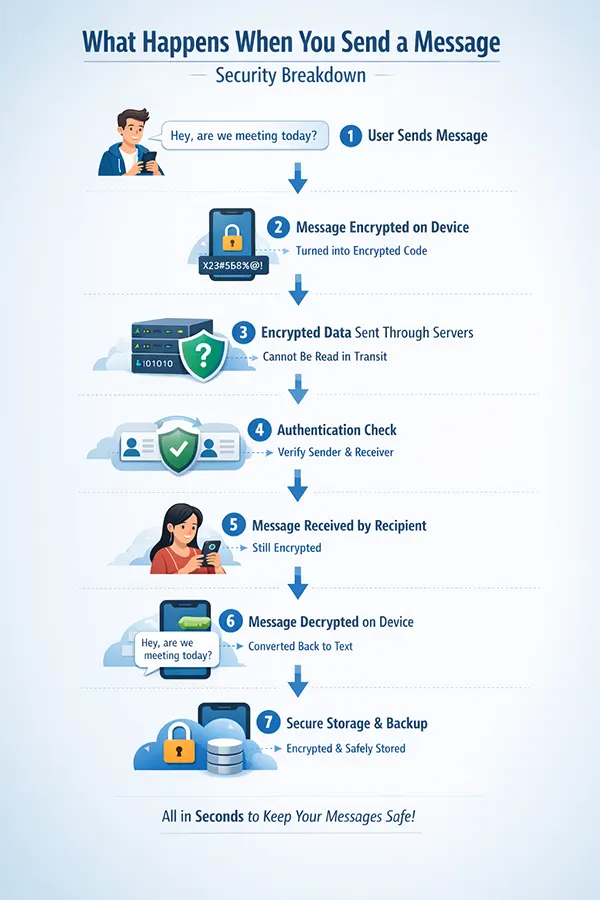
The encryption of messages occurs in the device of the sender
They are only decipherable by their recipient
The content cannot even be read by the messaging platform itself
This makes sure that in case data is intercepted during transmission, it is not readable and thus safe. Encryption basically transforms messages into an encrypted form envelope; only a special key (possessed by the communication receiver) can unlock this envelope.
Authentication Methods to Protect User Accounts
Authentication is essential to avoid unwarranted access by means of strong authentication.
Multi-Factor Authentication
Multi-factor authentication (MFA) is an additional way to enhance the security of the user by asking them to confirm their identity with a password, one-time code, and biometrics (fingerprint or face recognition). Although a password may be stolen, MFA makes it much more difficult for attackers to approach.
Secure Login Protocols
The modern messaging applications also have secure login features that secure user sessions. These may include:
Encrypted logging requests
Token-based authentication
Expiring of sessions automatically
These systems enable users to access only accounts that have been verified, and sessions are also secure.
Role of Secure Data Storage and Backup Systems
Security is not a one-time event after a message has been sent out. The information should also be safeguarded during storage. Messaging systems employ secure storage methods like encrypted databases, access control policies, and safe cloud infrastructure.
Second, backup systems are also important. It ensures that data can be stored in case of messages being lost, there is a way systems can recover from cyber attacks, and important conversations are not lost by the users.
Nevertheless, the backups also have to be encrypted, otherwise this can be a vulnerability of the system.
INTRIGUING INSIGHTS Learn how a message reaches a recipient after you press the “send” button.
Final Thoughts
Instant messaging has been incorporated into our communication fabric, both in our personal and business interactions. Most conveniently comes responsibility.
To ensure the safety of user data, it is necessary to combine:
String encryption
Reliable authentication
Secure storage practices
Constant supervision and feedback
In the case of messaging platforms, there is no such thing as security that can be added at a later stage, but rather must be integrated into all levels of the system. We live in a world where messages can be passed around in an instant, and therefore, trust can be passed the same way, and all it takes is one slip to break it.
Frequently Asked Questions
What do end-to-end encryption and messaging apps mean?
It is a security measure in which messages are coded in the computer of the person sending, and only the receiver can decode them.
What is the significance of multi-factor authentication?
It provides an additional level of security, and it is quite difficult, even with the compromised passwords, to access accounts.
Does the messaging app understand encrypted messaging?
Actual end-to-end encryption systems have the advantage that even the application provider cannot read the messages.
What is the greatest security threat with messaging applications?
One of the most frequent risks is unauthorized access into the system by using weak credentials or through phishing attacks.

 Kartik Wadhwa