


Modern systems can reach speech recognition accuracy of 96% and call resolution accuracy of about 78% in cases of proper training. However, when it comes to reality, open calls are often resolved successfully only some months after system adjustments have been made.
How Accurate Are AI Calling Agents in Real Customer Conversations?
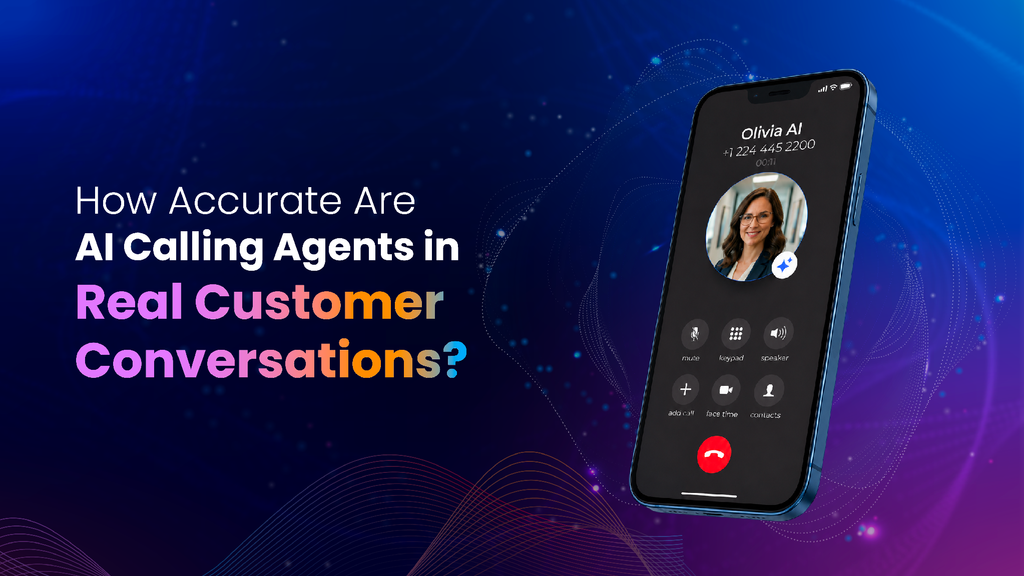
We all have experience with customer conversations that usually say, “Press 1 for sales, press 2 for support,” right? Today, AI voice agents are changing the pattern into more natural conversation, with speech recognition accuracy reaching around 95% in some systems.
But there are some issues, like understanding every word is not the same as understanding the customer. A caller might say something unusual, mumble, or describe their problems without the main keywords. Also, it’s not always necessary for AI to sound perfectly human don’t misunderstand the intent, take the wrong action, or fail to solve the issue. So, how accurate is an AI call center agent in real customer conversations? The answer lies in what we mean by “accurate” in the first place.
What “Accuracy” Means for an AI Calling Agent
Call centers act as strategic growth engines. And things have spiced up with the introduction of AI voice agents in the area. But their accuracy is constantly the point of discussion. The word “accuracy” is quite usually taken to mean different things in different contexts; in this case, however, it has four distinct meanings. It might be possible for a voice AI to score high on one aspect while failing to achieve the same high level in another.
- Voice recognition accuracy: The first layer shows the ability of the voice AI system to transcribe messages accurately. This means the AI can write down the customer’s words down to the letter, which is why this criterion can be termed the most important. Due to the development of voice AI technology and a steady shift towards human-like performance in noise-free environments, it becomes easier for voice AI systems to meet this need nowadays.
- Semantic accuracy: Layer two refers to the capability of the AI system to understand the message sent by the customer. One example that shows this aspect of operation is sending a cancellation signal when saying the words, “I think I no longer need that.” Although there are no keywords here, the AI is still able to understand the meaning of this phrase.
- Intent and containment accuracy: Did the AI understand the reason for the phone call, and was it able to resolve the problem without a human being involved? Reports indicate that about 91% of AI telephonic conversations can lead to resolutions without assistance from a human being in real implementations, even though the rate of resolving actual customer support issues is lower.
- Outcome accuracy: Did the appointment get booked in the right calendar, did the refund get transferred properly, did the CRM system get updated? Here is the phase where customers don’t see anything but feel the result when the process fails.
Even if the agent did exceptionally well at the first two stages, he may lose consumer trust at the fourth stage, because a successfully conducted conversation with the wrong outcome still leads to a poor experience.
SURPRISING STAT
Yahoo Finance says Enterprise Voicing AI now has 97% accuracy in real-world function calling.
Why Governance Is the Other Half of the Accuracy Question
Here’s the area that is ignored in many “voice AI accuracy” articles. An agent is one that speaks the correct language but is not monitored with respect to its operations. However, each AI agent has access to very sensitive data such as names, account numbers, order details, and even payment and health data. The absence of protocols for accessing this information makes a corporation vulnerable to a breach despite its use of a correct AI assistant in customer service settings.
According to IBM research, breaches involving “shadow AI” (AI systems operating with no oversight) are costing organizations on average an additional $670,000, and incidents involving shadow AI are more likely to expose vulnerable personal information than other breaches. In fact, only a third of companies conduct regular audits to detect unauthorized AI. This difference between the swiftness of company adaptation of conversational AI and its slow governance development is one of the most expensive gaps in corporate security.
In the context of a calling agent, proper governance means maintaining records of every call, allowing access to call records and transcripts for just the required people, ensuring a specific policy for escalation of sensitive requests for assistance, having systems in place for auditing at the CRM level, and documenting precisely what AI is allowed to do or say. This is the layer that converts the concept of “having impressive accuracy” into the meaning of “safe to use”.
Where Purpose-Built Systems Fit In
Purpose-built platforms like Olivia AI by Pete & Gabi are developed to close this gap. AI voice agents are trying to solve it by implementing natural, full-on-conversation management (from greeting to solution, with no restrictive scripting), as well as the essential CRM integration, call logging, and predefined protocols for passing the call to a human representative that governance frameworks need. In this case, tools of this type combine into a single call both accuracy and oversight: while the AI processes the potential customer’s inquiry or qualifies the lead, the system records all the necessary information on the call.
Turning This Into a Decision
AI calling agents have become incredibly accurate, to the point where many people cannot discern if they are speaking to a human. Nonetheless, accuracy is not something that can be expressed through a single number; in fact, there is much more to the story here. The most promising results come from businesses that analyze their accuracy not only in terms of the transcription but also in terms of intention and outcome, while putting in place all necessary controls to ensure that precise chats don’t create yet another governance gap as described by IBM.
Frequently Asked Questions
How accurate are AI calling agents in real customer conversations today?
Can customers tell they’re talking to an AI instead of a human?
According to the statistics, around 50% of people can’t tell the difference between an AI-controlled system and a normal human being during the first conversation with the caller. However, the majority of consumers are willing to have the opportunity to talk to a human being in cases when a complex problem is to be resolved.
Can customers tell they’re talking to an AI instead of a human?
Speech accuracy evaluates whether the AI has correctly understood the words spoken, while outcome accuracy calculates whether the necessary task has been accomplished.
Why does AI governance matter for calling agents specifically?
Agents have sensitive private information during all calls. If the information does not have formal governance or access control, it becomes a liability no matter how accurate the AI is.
Do AI calling agents substitute human agents entirely?
Certainly not. The best technologies are ones where AI is doing a lot of well-defined work and is passing off the more complicated and/or sensitive exchanges to humans, as customers are still quite fond of that possibility.
How is call resolution accuracy expected to change in the next few years?
Reports estimate that there are indeed high expectations; it has been noted that AI might resolve around 80% of typical service requests by the end of the decade, with improvements in technology and more data collected from real conversations.
Related Posts
Search Console Forgets Everything After 16 Months: How to Back Up Your SEO Data
After completing the period of 16 months, all the data and access are deleted from Google Search Console’s database. After…
Why Digital Transformation Projects Stall: A Resourcing Playbook for Project Managers
Digital transformation projects are on the rise at this time. From government-backed initiatives to enterprise cloud adoption and AI integration.…
How Email Hosting Providers Store and Protect Business Data
Where does your business email go when you click the send button? The impression is that the email just goes…
Best CI/CD Platforms for Coding Agents and AI-Native Development
CI/CD has changed its job because coding agents now write a growing share of the changes that reach a repository.…

Mavlers Agency on Why Global Agencies Are Turning to Offshore SEO Teams
An offshore SEO team in India is becoming more and more an option for great profit for global agencies; it’s…
How to Change Signature in Outlook: A Complete Guide
How do you change signature in Outlook? It sounds simple until you realize that the steps vary across Windows, Mac,…
Best 7 AI Development Companies for Data AI Solutions for Your Project: Guide for…
Buying model work before the data work is the most expensive order to do it in. The pilot shows well,…
Top Software Development Companies Backed by GoodFirms Reviews
In September 2026, GoodFirms listed 853 software development companies in California. The group had a median hourly rate of $37,…

What Is a Blockchain Explorer? How to Track Crypto Transactions
A blockchain explorer is a searchable interface for viewing data recorded on a public blockchain. You can look up a…