


Absolutely not. A working restore still leaves you for payments and salary distribution among employees when the business is closed.
Business Continuity Beyond Backups: Why Data Resilience Needs a Broader Strategy
Table of Contents
- What a Backup Actually Gives You Back
- The Thing That Takes You Down Is Usually Not Your Data
- Nobody Can Find the Study
- Three Months of Cash Is the Real Recovery Window
- The Part That Isn't Data at All
- Who Is Allowed to Declare a Disaster?
- A Written Plan and a Rehearsed One Are Different Documents
- Wrapping Up
- Frequently Asked Questions

This does not mean that if your backup is working, then your business is also running smoothly.
Major issues arise when you continue working despite the data being secured and no one knows who takes the next step. When the system shuts down, most of the time is wasted on calling for help or even waiting for anyone’s response to handle the situation.
Backup secures the data but does not tell staff where to proceed, who to take responsibility, and which services to be taken initially. These conditions start the continuity plan and happen when incidents are actually detected.
This guide tells you what problems you face and how the business runs smoothly with the continuity plan.
Quick Glance (If You’re in a Hurry):
Ranked the conditions that can hamper your business from shutting down. First, no power; then, procedures not followed by someone who is responsible; after arranging cash to recover, a responsive person to make decisions. Losing data comes at five, and this is the situation where backups integrate.
What a Backup Actually Gives You Back
This issue arises when you understand the last backup is several days old, and the data is lost up to now after restoring.
This is only what backup does, not power regeneration, a downed phone starting up, or regaining the responsibility to higher authority for backup.
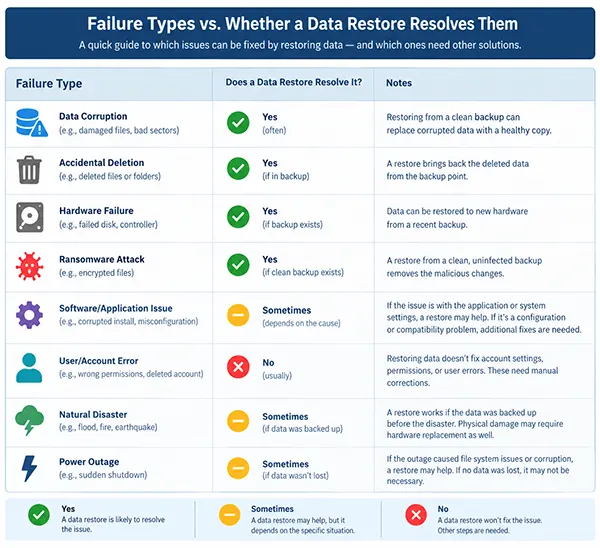
| What stops the business | Does a restore fix it? | What actually fixes it |
| Power loss at the site | No | A fuel contract and a transfer switch somebody has tested |
| Nobody followed the runbook | No | A rehearsal that actually cuts the power |
| Corrupted or deleted data | Yes | The backup, working as designed |
| No cash to cover the closed week | No | A credit line arranged before the event |
| No one reachable with authority | No | A named deputy who is awake |
Only one row says yes.
The Thing That Takes You Down Is Usually Not Your Data
The outage numbers are telling roughly the same story in past years. Power still causes more serious disturbance than most data-related problems.
The Uptime Institute report in 2026 stated that 45% of incidents are from power shutdowns, which is higher than the previous year (around 54%). Then, networking issues come; data-related problems come after.
Only this difference matters: the backup schedule is a must, but system protection level also plays an important role when all systems run without disruption.
For financial companies, a practical digital infrastructure also tells the same story. A resilient system is compulsory for a perfect system, not just backups.
Nobody Can Find the Study
Around 40% of businesses permanently shut down. This data is represented in every continuity plan reported that is credited to FEMA.
Despite this, researchers failed to find the actual study of FEMA. Continuity expert Geary Sikich followed that claim in 1950, in a British fire research study who compiled the manufacturers that were burned during incidents. When some incident repeats, unverified statistics for decades that suspicion is good.
Three Months of Cash Is the Real Recovery Window
Recovery target looks precise in paper: four hours, thirty minutes, whatever contracts claimed. But this number does not tell that disruption leads to delays in payments during business runoff. Most businesses have less than three months of emergency cash to operate. Recovery speed matters, but optimum cash is also a factor.
Keeping operations stable under pressure means fixing the recovery plan if data loss occurs, and also confirms how long the payroll survived.
The Part That Isn’t Data at All
Continuity planning focuses on business so well that physical aspects are ignored. A storm, system collapse, damaged machinery, or unreachable places are issues that cannot be covered by backups’ whole premise.

The climate change issue or supplier-related patterns also matter. Some companies also depend on physical reserves like backup fuel, other storage servers, or assets that don’t require system resilience. Monex offers historic U.S. bullion options, which is the best option that we can study.
Fun Fact:
America shut down 90% silver dimes and quarters in 1965. Before that, this was also valid, as its face value was printed. Due to the silver content, their market value also changed. One dime is equivalent to 10 cents still now, or the price fluctuation of silver determines their actual value.
Who Is Allowed to Declare a Disaster?
After failure, the cost gradually increased. For recovery costs, someone has to be ready to take on this responsibility without any delay or excuses in meetings.
This doesn’t solve issues that come from job changes, responsibility shifts, or the position of approval authority, as the continuity plan is empty.

This actually hits at midnight when the duty phone rings, which is noticed in office time. That person’s name, or responsibility clearance, is worth more than forty pages of organization charts that nobody uses under pressure.
A Written Plan and a Rehearsed One Are Different Documents
A continuity plan is worth it when people face decisions that are made under pressure. Procedure involves:
- Stop the power supply when customers use the service on a normal working day.
- The failover procedure is followed by the person who is on duty.
- Watch the time taken to retrieve the needed credentials.
- Restore the primary site.
- Write down what the procedure is in the plan or what is followed.
This was also found by Upstime Institute: good management that follows the procedure and configuration reduces the outage by 87%, but mismanagement or disobedience of follow-up mistakes accounts for 59%. This clearly results in the fact that if no one follows the plan, then it’s useless to make such instructions.
For regulated industries, the absolute requirement for disaster recovery protocols is a detailed procedure. This preparation doesn’t replicate proficiency but is important for someone to execute under critical conditions.
Wrapping Up
In a continuity review, most time is consumed in discussing storage and backup procedures. The question is to consider who is in charge during a disaster, or who can reach the person at midnight if it occurs.
If someone doesn’t respond within a minute, then it’s not the problem of the backup schedule. It’s an authority issue that is not covered by the storage data that you collected so far.
Frequently Asked Questions
Isn’t a good backup enough for a small business?
How often should a continuity plan be tested?
Test it enough that the person on duty can practice thoroughly so that yearly testing can overcome staff replacement issues.
What is the difference between disaster recovery and business continuity?
Disaster recovery restores the system after a failure, while business continuity keeps operations running without any gaps.
Should a continuity plan cover physical assets?
Yes, stocks, buildings, materials, or suppliers can face issues that backups cannot recover from because insurance claims take time to settle.
Related Posts
Sorry, No post were found