


GraphQL allows the frontend to request only the specific fields needed in a single network request, whereas REST returns fixed, complete payloads that often require multiple round-trip calls.
Why GraphQL Is Becoming Essential for Modern Magento Frontends
Table of Contents
- Introduction: What Is GraphQL and Why Does It Matter for Magento?
- The Limitations of REST API in Traditional Magento Development
- Key Benefits of GraphQL for Magento Store Performance
- Getting the Most Out of GraphQL on the Front End
- GraphQL and Headless Magento (PWA Studio) Integration
- How GraphQL Improves Magento Store Scalability and Flexibility
- GraphQL vs REST in Magento: A Quick Comparison
- Final Thoughts: Is GraphQL the Future of Magento Development?
- Frequently Asked Questions
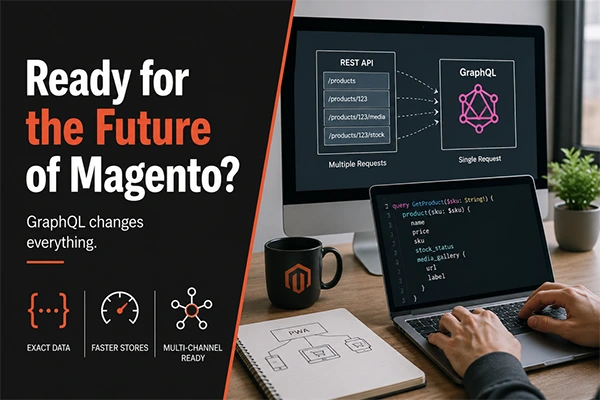
Introduction: What Is GraphQL and Why Does It Matter for Magento?
User experience, as well as speed, are the main determinants of conversion rates and search engine rankings in today’s e-commerce. Facebook open-sourced GraphQL in 2015, and just three years later, in 2018, handed stewardship over to the vendor-neutral GraphQL Foundation, whose members include AWS, Intuit, and IBM.
Taking into account the fact that online shops are being more developed in terms of the amount of catalog and technology, the classic REST APIs seem to be unable to satisfy the requirements of today’s front-end. Due to GraphQL technology, the possibility of gaining precise data from numerous resources has appeared.
The Limitations of REST API in Traditional Magento Development
Before GraphQL, Magento stores relied primarily on REST endpoints to communicate between the back end and front end. While REST has served e-commerce platforms for years, it comes with structural drawbacks that become more apparent as stores grow in complexity.
Common REST limitations include:
- Overfetching: An API call returns far more data than a page actually needs. A product listing page, for example, might only require a name, price, and thumbnail image, yet a REST call could return dozens of unnecessary fields.
- Underfetching: A single call doesn’t return enough data, forcing developers to make multiple separate requests to gather everything required for one view.
- Multiple round trips: Gathering complete data for a page often means several back-and-forth calls between client and server, which increases load times and places extra strain on infrastructure.
- Added development overhead: Developers often end up writing extra code just to filter or combine REST responses, which adds development time and technical debt to a project.
For stores handling large catalogs or high traffic volumes, these inefficiencies translate into slower page rendering and a clunkier shopping experience overall. Addressing these structural issues often requires specialized skills, which is why some businesses choose to hire Magento developer early, before a REST-based architecture becomes too costly to unwind. Catching these limitations sooner rather than later also makes any future move to GraphQL considerably less disruptive.
Key Benefits of GraphQL for Magento Store Performance
GraphQL addresses many of the pain points associated with REST by giving developers precise control over data requests. Every query returns exactly what’s needed, down to the specific fields a page requires. Nothing more gets pulled from the server, and nothing less either. This precision translates into measurable improvements across several areas of store performance, from the moment a page starts loading to how the back end handles traffic spikes. The gains show up in speed, efficiency, and resource use alike, making the difference noticeable to both developers and shoppers.
Faster Page Load Speed and Improved Core Web Vitals
Page speed has a direct relationship with search rankings and customer retention. GraphQL supports faster load times by allowing a single request to pull exactly the data a page needs, cutting down on wasted bandwidth and processing time. This matters for Core Web Vitals metrics such as Largest Contentful Paint and Cumulative Layout Shift, both of which factor into how search engines evaluate page quality.
Faster loading pages also reduce bounce rates. Shoppers who encounter delays, even brief ones, are more likely to abandon a session before completing a purchase. By trimming unnecessary data transfer, GraphQL helps Magento stores deliver quicker first impressions, particularly on mobile devices where bandwidth and processing power are often more limited than on desktop.
Reduced Server Load with Single-Request Data Fetching
Beyond the front end, GraphQL also benefits back-end infrastructure. Because a single query can retrieve data that would otherwise require several REST calls, servers handle fewer requests overall. This reduces the processing burden during high-traffic periods such as seasonal sales or promotional campaigns.
Lower server load also means better resource allocation. Hosting costs can be managed more effectively when infrastructure isn’t being taxed by redundant calls. For merchants running lean operations or scaling quickly, this efficiency gain often translates into tangible savings alongside the performance benefits.
Getting the Most Out of GraphQL on the Front End
The performance gains GraphQL offers only show up in practice if the front end is built to take advantage of them. Structuring queries efficiently, avoiding over-nested requests, and handling caching at the component level all require someone comfortable working directly with the data layer that powers the storefront. This is different from general Magento back-end work, and it’s a large part of why businesses looking to build fast, responsive storefronts often choose to hire front end programmer who can work directly with GraphQL queries rather than relying on default REST-based patterns.
A developer with this kind of experience can fine-tune how components request and render data, catching inefficiencies that might otherwise go unnoticed until a store is already under heavy traffic. For teams investing in headless or PWA-based storefronts, this front-end expertise often ends up being just as important to overall performance as the back-end architecture itself.
GraphQL and Headless Magento (PWA Studio) Integration
GraphQL plays a central role in Magento’s headless commerce strategy, particularly through PWA Studio, Adobe’s toolkit for building progressive web applications on top of Magento. In a headless setup, the front end and back end operate independently, connected through an API layer. GraphQL serves as that connective layer, handling the data exchange between the Magento back end and whatever front-end framework a business chooses to use.
This separation gives development teams freedom to build custom, app-like shopping experiences without being tied to Magento’s default theming system. Businesses can create storefronts using React or other modern frameworks while still relying on Magento for catalog management, order processing, and admin functions.
Because GraphQL was designed with this kind of flexible data fetching in mind, it fits naturally into headless architectures. Teams working on PWA Studio projects often need someone who understands both the Magento back end and GraphQL’s query structure, which is why many businesses choose to hire GraphQL developer talent specifically for headless implementation work. The pairing of GraphQL and PWA Studio has become one of the more common technical combinations in modern Magento builds, particularly for brands prioritizing mobile performance and app-like browsing experiences.
How GraphQL Improves Magento Store Scalability and Flexibility
As businesses expand into new channels, their data needs grow more complex. GraphQL’s structure supports this kind of expansion more gracefully than REST in several practical ways.
- Omnichannel support: A single GraphQL API can serve data to a website, mobile app, and even in-store kiosks without requiring separate endpoints for each channel.
- Third-party integrations: GraphQL’s schema-based approach makes it easier to connect with external services such as CRMs, marketing platforms, or custom analytics tools, since data requirements can be adjusted without restructuring the entire API.
- Mobile app development: Because GraphQL minimizes data transfer, it works well for mobile environments where connectivity may be inconsistent or slower.
This flexibility becomes particularly valuable for merchants managing growth across multiple markets or sales channels. Rather than maintaining separate API structures for each new integration, teams can extend a single GraphQL schema, keeping development more manageable as the business scales.
GraphQL vs REST in Magento: A Quick Comparison
The differences between these two approaches become clearer when compared directly.
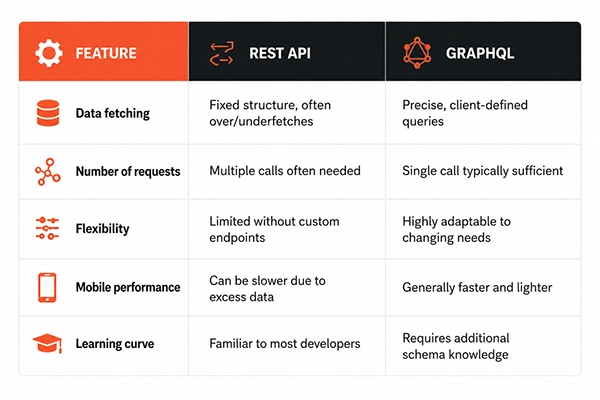
Both approaches have their place, and REST still works well for simpler implementations. However, for stores with complex data requirements or headless architecture, GraphQL generally offers a more efficient path forward.
Best Practices for Implementing GraphQL in Magento 2
Implementing GraphQL effectively requires more than simply switching APIs. A smoother rollout starts with auditing existing REST dependencies to identify what needs to be rebuilt and where the current architecture will need to change. From there, queries should be structured carefully, since overly complex nested requests can slow response times rather than improve them.
Caching also deserves particular attention. Traditional REST caching methods don’t always translate directly to GraphQL, so teams need strategies built specifically around how GraphQL handles requests. Thorough testing across devices and browsers rounds out the process, especially when the implementation supports a headless front end where consistency matters across multiple platforms.
Final Thoughts: Is GraphQL the Future of Magento Development?
GraphQL has moved from a niche technical option to a standard part of modern Magento development, particularly for businesses building headless or app-like shopping experiences. Its ability to reduce data transfer, cut down on server strain, and support flexible, multi-channel architectures addresses many of the limitations that REST-based systems struggle with.
While REST remains a reasonable choice for simpler stores, GraphQL’s advantages become harder to ignore as complexity increases. For merchants planning long-term growth, particularly those considering headless commerce or expanding into new sales channels, GraphQL represents a practical, well-supported direction for Magento’s continued development.
Frequently Asked Questions
1. What is the primary difference between GraphQL and REST in Magento?
2. Does using GraphQL improve Magento page speed and Core Web Vitals?
Yes. By reducing payload sizes and eliminating redundant server requests, GraphQL significantly reduces load times, improving Largest Contentful Paint (LCP) and decreasing bounce rates.
3. Is GraphQL required to build a headless Magento store?
While headless stores can technically use REST, GraphQL is the recommended standard because it integrates natively with modern frameworks like Adobe PWA Studio and simplifies data management.
Related Posts
Using HeyGen AI for Sales and Customer Onboarding
It’s best to use HeyGen AI to create videos for you that answer a particular question or pain point. You…

Search Console Forgets Everything After 16 Months: How to Back Up Your SEO Data
After completing the period of 16 months, all the data and access are deleted from Google Search Console’s database. After…
Why Digital Transformation Projects Stall: A Resourcing Playbook for Project Managers
Digital transformation projects are on the rise at this time. From government-backed initiatives to enterprise cloud adoption and AI integration.…
How Email Hosting Providers Store and Protect Business Data
Where does your business email go when you click the send button? The impression is that the email just goes…
Best CI/CD Platforms for Coding Agents and AI-Native Development
CI/CD has changed its job because coding agents now write a growing share of the changes that reach a repository.…

Mavlers Agency on Why Global Agencies Are Turning to Offshore SEO Teams
An offshore SEO team in India is becoming more and more an option for great profit for global agencies; it’s…
How to Change Signature in Outlook: A Complete Guide
How do you change signature in Outlook? It sounds simple until you realize that the steps vary across Windows, Mac,…

Best 7 AI Development Companies for Data AI Solutions for Your Project: Guide for…
Buying model work before the data work is the most expensive order to do it in. The pilot shows well,…

Top Software Development Companies Backed by GoodFirms Reviews
In September 2026, GoodFirms listed 853 software development companies in California. The group had a median hourly rate of $37,…