


Scala has a smaller overall developer base due to its steep learning curve and emphasis on advanced functional programming paradigms. Because it is heavily utilized in high-scale infrastructure and data engineering, most senior developers are already employed in critical roles and do not browse public job boards.
How Scala Recruitment Helps Companies Hire Senior Developers Overseas
Table of Contents
- Introduction
- What Makes Scala Recruitment Different from General Software Hiring
- Key Benefits of Working with a Specialized Scala Recruitment Agency
- How Specialized Recruiters Evaluate Senior Scala Engineering Skills
- The Business Impact of Faster Senior Engineering Hires
- Why Companies Look Overseas for Senior Scala Talent
- Comparing Senior Scala Developer Costs by Region
- In-House Hiring vs Specialized Scala Recruitment: A Quick Comparison
- Best Practices for Partnering with a Scala Recruitment Agency
- Conclusion
- Frequently Asked Questions

Introduction
In 2026, the creation of resilient and highly concurrent backend systems strongly depends on the use of specific functional programming technology stacks. Although the use of distributed technologies is growing globally in industries such as fintech, big data, and cloud-native technologies, the market is still limited with experienced Scala developers.
As a standalone language in 2004, this scenario forces engineering leaders and hiring managers to look for international specialized recruiting services as one of the most effective tools for finding highly skilled developers.
What Makes Scala Recruitment Different from General Software Hiring
General technical recruiters often rely on keyword matching and broad screening questions that work reasonably well for more common languages. Scala requires a different approach. Its functional programming foundation, combined with object-oriented features, makes it structurally different from languages most recruiters are used to assessing.
A recruiter without Scala-specific knowledge may struggle to evaluate candidates accurately. Key gaps typically show up in these areas:
- Distinguishing depth of experience: Telling the difference between a candidate with surface-level exposure to Scala and one with genuine command of the language.
- Understanding core concepts: Recognizing whether a candidate truly grasps immutability, pattern matching, and monadic error handling, rather than just recognizing the terms.
- Evaluating ecosystem familiarity: Assessing knowledge of the frameworks and tools senior engineers are expected to know, not just the language syntax itself.
These distinctions matter significantly at the senior level, where the difference between a competent hire and an exceptional one often comes down to how well someone understands these underlying principles. Without this context, technical screening tends to miss important signals, resulting in candidates who look qualified on paper but fall short during actual project work.
Key Benefits of Working with a Specialized Scala Recruitment Agency
Partnering with recruiters who focus specifically on Scala talent changes the hiring equation in meaningful ways. The process moves faster from the very first search. Candidates arrive already better matched to the role’s technical demands. Screening becomes more accurate and considerably less time-consuming for hiring managers. Fewer mismatched hires make it through to final interview stages. These benefits show up across several practical areas of the hiring process.
Access to a Pre-Vetted Network of Senior Scala Engineers
Specialized agencies maintain ongoing relationships with Scala developers, often built over years of consistent placement work. This means candidates are not being sourced cold for every new role. Instead, recruiters draw from an existing network of professionals whose skills, work history, and availability are already understood.
This kind of access shortens the sourcing phase considerably. Rather than starting from scratch with each search, a specialized Scala recruitment company can often present qualified candidates within days rather than weeks. For companies under pressure to fill a role quickly, this head start makes a measurable difference in overall hiring timelines.
Faster Screening Through Technical and Domain Expertise
Screening candidates accurately requires recruiters who understand what they are evaluating. Specialized recruiters ask more precise technical questions, recognize meaningful answers, and can identify red flags that a generalist might overlook entirely.
This accuracy reduces the number of unqualified candidates who make it to later interview stages. Hiring managers spend less time reviewing resumes that don’t match actual project needs, and technical interviews become more productive since the initial filtering has already done meaningful work. The result is a shorter, more focused hiring process overall.
How Specialized Recruiters Evaluate Senior Scala Engineering Skills
Assessing senior-level Scala talent goes beyond basic syntax knowledge. Specialized recruiters typically evaluate candidates across several technical dimensions that matter for real-world project success:
- Functional programming proficiency: Understanding of higher-order functions, recursion, and type safety, all of which shape how a Scala codebase is structured and maintained over time.
- Distributed systems experience: Practical background building or maintaining systems that need to handle concurrency and scale reliably.
- Tooling knowledge: Familiarity with Akka for building concurrent and distributed applications, Play Framework for web development, and sbt for build management.
Tooling knowledge, in particular, often signals practical, hands-on experience rather than theoretical familiarity. Recruiters who understand these tools can ask targeted questions that reveal how a candidate has actually applied them in production environments, rather than relying on self-reported skill levels alone.
The Business Impact of Faster Senior Engineering Hires
The speed of a hiring process carries consequences well beyond the recruitment function itself. Every week a senior engineering role remains open represents lost project momentum, delayed deliverables, and added strain on existing team members who often absorb the workload gap.
Faster time-to-hire directly supports project timelines. When companies can hire senior developers without prolonged vacancies, development schedules stay closer to their original targets, and dependent teams avoid the ripple effects of delayed backend work. This matters particularly for Scala roles tied to core infrastructure, where a single senior engineer’s absence can slow multiple downstream projects simultaneously.
There is also a cost dimension worth considering. Extended vacancies often mean paying for contractor coverage, overtime for existing staff, or accepting slower output from an understaffed team. Reducing the time a senior role sits open helps limit these indirect costs, which tend to accumulate quickly even when they aren’t immediately visible on a hiring budget line.
Why Companies Look Overseas for Senior Scala Talent
Given how narrow the domestic senior Scala pool already is, many companies extend their search beyond their home country almost by necessity. In fact, there are a lot of reasons why companies want to hire overseas web developer for their project, and cost is only the most obvious one. Hiring overseas isn’t just a cost-cutting move – it changes the shape of the entire search in ways that matter for teams struggling to fill these roles at all. The advantages are:
- A larger, more accessible talent pool. Opening a search internationally multiplies the number of qualified candidates a company can realistically reach. Regions like Eastern Europe and parts of Asia have built up sizable communities of experienced Scala engineers, often shaped by years of outsourced development work for Western clients, giving companies access to depth that simply isn’t available in a single domestic market.
- Lower overall cost without sacrificing seniority. Compensation expectations for equally experienced Scala engineers vary significantly by region. This lets companies bring on genuinely senior talent – not a junior substitute – at a materially lower cost than hiring the same experience level domestically.
- Faster hiring in a tight market. When the domestic pool is already saturated with competing offers from well-funded companies, widening the geographic search reduces competition for the same handful of candidates and shortens time-to-hire.
- Around-the-clock development coverage. Teams distributed across time zones can extend the effective working day, which is particularly useful for infrastructure and data-engineering work that benefits from continuous monitoring or staged handoffs between regions.
- Team resilience and continuity. Building engineering capacity in more than one region reduces a company’s exposure to local hiring slowdowns, wage inflation, or talent shortages in any single market.
Of course, overseas hiring introduces its own considerations – time zone overlap, communication norms, legal and payroll complexity, and the need for a recruiter who can accurately assess technical skill across a different professional culture. This is exactly where a specialized Scala recruitment partner earns its value, since vetting engineering talent well is harder, not easier, across borders.
Comparing Senior Scala Developer Costs by Region
Salary expectations for senior Scala engineers differ substantially depending on where a company hires. The table below offers an approximate comparison of typical annual base salaries for a senior-level Scala developer (5+ years of experience) by region, based on current market data.
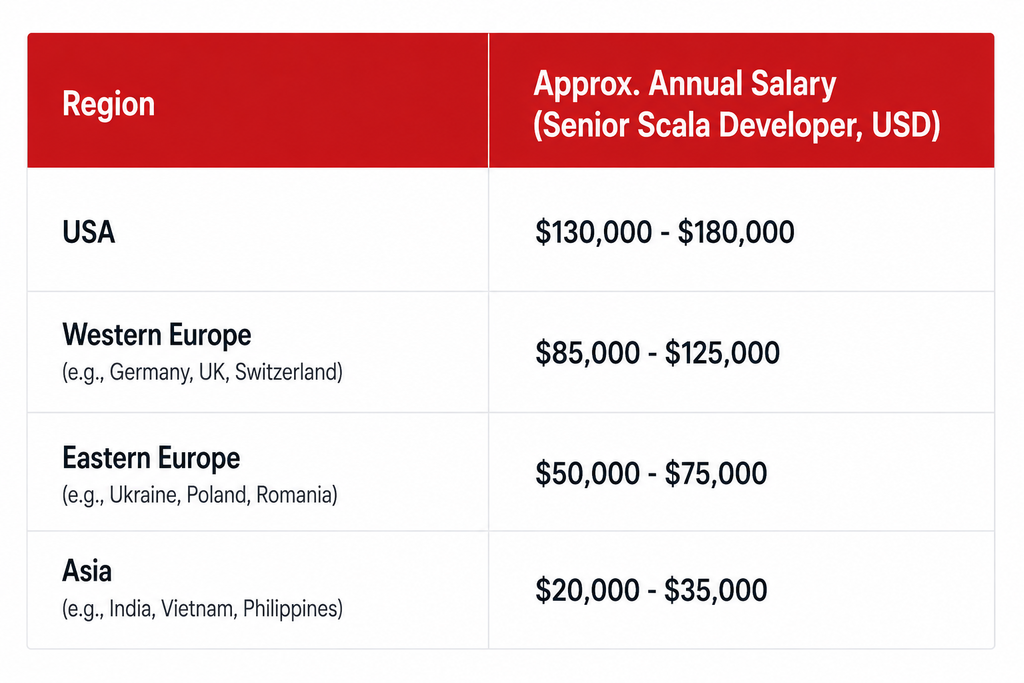
Figures are approximate market averages and will vary by city, company size, specific tech stack, and individual experience. They are intended to illustrate relative cost differences between regions rather than serve as fixed benchmarks.
As the table shows, the cost gap isn’t marginal — it’s large enough to change hiring strategy outright. A company priced out of hiring a senior engineer domestically may find the same experience level comfortably within budget in Ukraine or India, which is a major reason overseas hiring has become a standard part of Scala recruitment strategy rather than a fallback option.
In-House Hiring vs Specialized Scala Recruitment: A Quick Comparison
The differences between these two approaches become clear when placed side by side.
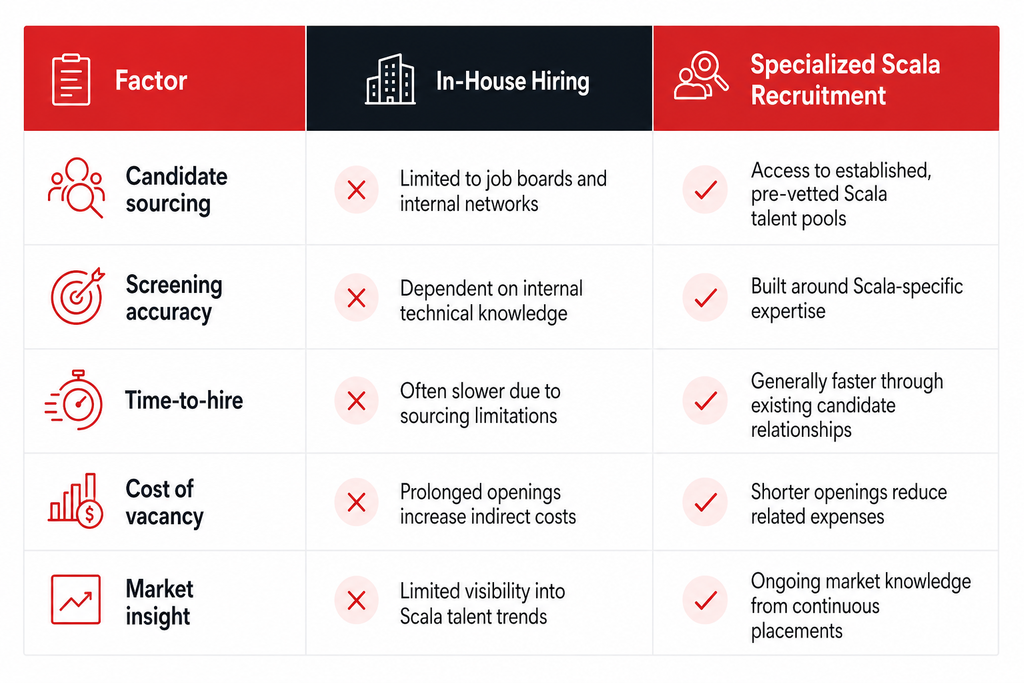
Both approaches can work depending on company size and internal resources, but specialized recruitment tends to close roles faster, particularly for senior positions where the candidate pool is already narrow.
Best Practices for Partnering with a Scala Recruitment Agency
Getting the most out of a recruitment partnership starts with clear communication about role requirements, including the specific frameworks, project context, and seniority level expected. Vague job descriptions tend to produce mismatched candidates regardless of how skilled the recruiter is.
It also helps to involve technical stakeholders early in the process, even briefly, so recruiters understand the nuances of the role beyond a written job posting. Setting realistic timelines matters too, since rushing a senior search can undermine the quality benefits that specialized recruitment typically provides. Finally, maintaining open feedback loops after candidate submissions allows recruiters to refine their search quickly rather than repeating the same mismatched profiles.
Conclusion
Hiring senior Scala engineers through conventional channels often takes longer and carries a higher risk of mismatched hires, largely due to the specialized knowledge required to evaluate candidates accurately. Working with recruiters who understand the language, its ecosystem, and the developers within it changes that equation considerably.
For companies facing time pressure or struggling to find qualified senior candidates, specialized Scala recruitment offers a practical path forward. The combination of established talent networks and accurate technical screening tends to produce faster, more reliable hiring outcomes, particularly for roles where the cost of a prolonged vacancy or a poor hire carries real business consequences.
Frequently Asked Questions
Why is senior Scala talent significantly harder to find than Java or Python developers?
What core technical competencies indicate a genuine senior Scala engineer?
A senior Scala engineer demonstrates deep command of functional programming concepts (immutability, typeclasses, monads), concurrency models, distributed computing architectures, and hands-on production experience with frameworks like Akka/Pekko, ZIO, Cats, or Apache Spark.
How does hiring overseas Scala engineers benefit domestic product teams?
Overseas hiring expands the accessible talent pool into regions with established Scala communities, significantly lowers average compensation overhead without sacrificing seniority, and provides extended timezone coverage for round-the-clock development and operations.
Related Posts
Best 7 AI Development Companies for Data AI Solutions for Your Project: Guide for…
Buying model work before the data work is the most expensive order to do it in. The pilot shows well,…

Top Software Development Companies Backed by GoodFirms Reviews
In September 2026, GoodFirms listed 853 software development companies in California. The group had a median hourly rate of $37,…

What Is a Blockchain Explorer? How to Track Crypto Transactions
A blockchain explorer is a searchable interface for viewing data recorded on a public blockchain. You can look up a…
How AI Is Changing the Way Businesses Configure and Manage CRM Systems
With the growth and expansion of business operations, CRM management gets complex. New things, workflows, integrations, and custom rules often…

AI Photo Editors for Modern Image Editing in 2026 for Social Media and E-commerce
Due to advanced neural rendering models, the landscape of digital photography, graphic layout, and commercial design has changed fundamentally. Now…

Top 6 Automated Calling Software Options for Businesses
In this digital era, businesses are cutting their staff and relying more on automated systems. One great example of this…

Data Visualization Team: What It Takes to Build One That Delivers
Data visualization is no longer just about normal charts. In this modern era, they make no sense. Dashboards that are…

What Google Trusts More Than Your Own Copy
SEO is not just limited to optimising your website pages and adding relevant keywords in the content. Here is much…

Top 3 Data Analytics Courses That Match What Employers Are Hiring For
The data analytics courses are made for employers who want practical job skills, including SQL, data preparation, a digital competence…