
AI-driven personalization helps businesses deliver more relevant content, product recommendations, and user experiences based on visitor behavior, location, device type, and previous interactions.
Web Development Trends Businesses Should Watch
 Written by Saipansab Nadaf

Companies in California operate in some of the most competitive markets in the country. SaaS, legal, real estate, health, e-commerce: every type of business runs on digital acquisition, and every one of them depends on a website that can perform under that pressure.
With over 39 million people and 1,500 specialized web design and development agencies, it’s hard to ignore how quickly California shapes new web development trends across design, technology, user experience, and digital business growth.
To help your California brand stay competitive, we’ve rounded up below some of the most trendy web development solutions you should be aware of.
KEY TAKEAWAYS
- AI-driven personalization is becoming a standard feature, helping businesses deliver more relevant content based on user behavior, location, device, and traffic source.
- Headless CMS and composable architecture enable businesses to manage content more efficiently across websites, mobile apps, voice platforms, and emerging AI interfaces.
- Edge computing improves website speed and performance by processing requests closer to users, leading to better user experiences and stronger Core Web Vitals scores.
- Progressive Web Apps (PWAs) are gaining traction in both B2B and B2C sectors by offering fast, app-like experiences without requiring users to download native applications.
What’s factually changed in web development in 2026
As an industry standard, you should redesign your website every 2 to 3 years. For the Californian market, this is even more important since it’s a very tough market.
1. AI-driven personalization
Today, more than 90% of websites in the United States are already personalized for artificial intelligence. As for web development in California, personalizing for AI is also one of the current trends in the local market. Since customers now expect quicker and more relevant online experiences.
With AI personalization, local businesses can optimize website content based on:
- User behavior
- Location
- Device type
- Traffic source
- And previous interactions
In the case of AI personalization, visitors from Los Angeles might see different messaging than someone in San Diego or San Francisco. Eventually, the goal is to keep the experience highly helpful without feeling intrusive. Eventually, the final goal here is to enhance the customer journey.
2. Edge computing and distributed delivery
Traditional hosting architectures route every request through a centralized origin server. Today, edge computing moves that execution to the server node closest to the user. And this, in turn, cuts latency at the infrastructure level (rather than patching it with CDNs alone).
For California companies serving Los Angeles, the Bay Area, and San Diego, edge delivery can reduce load times from around 2.8 seconds to under 1.2 seconds (based on some studies) without even making any coding changes.
As a consequence, that moves the Core Web Vitals score even higher. Thus, platforms like Vercel, Cloudflare Workers, and Netlify Edge Functions have made this easier to access. However, most teams haven’t yet implemented it because it requires rethinking the deployment layer. It’s not just front-end code, and it tends to push it down the priority list.
3. Headless CMS and composable architecture
Monolithic CMS platforms were designed when websites were the main front-end channel.
Today, brands need to push content to:
- Websites
- Mobile apps
- Voice interfaces
- And AI-powered interfaces (that pull structured data)
Currently, headless architecture keeps the content layer separate from the presentation layer. This way, they don’t need developers for every update.
Moreover, it’s quite efficient in terms of complexity and implementation cost. The long-term benefits (e.g., quicker publishing, fewer developer delays, and clearer API-driven data) often make the investment worthwhile for any business with multiple content channels. But here, a common pitfall is evaluating headless by comparing it to the current setup, rather than to where content needs will be in three years.
3. Core Web Vitals as a baseline, not a goal
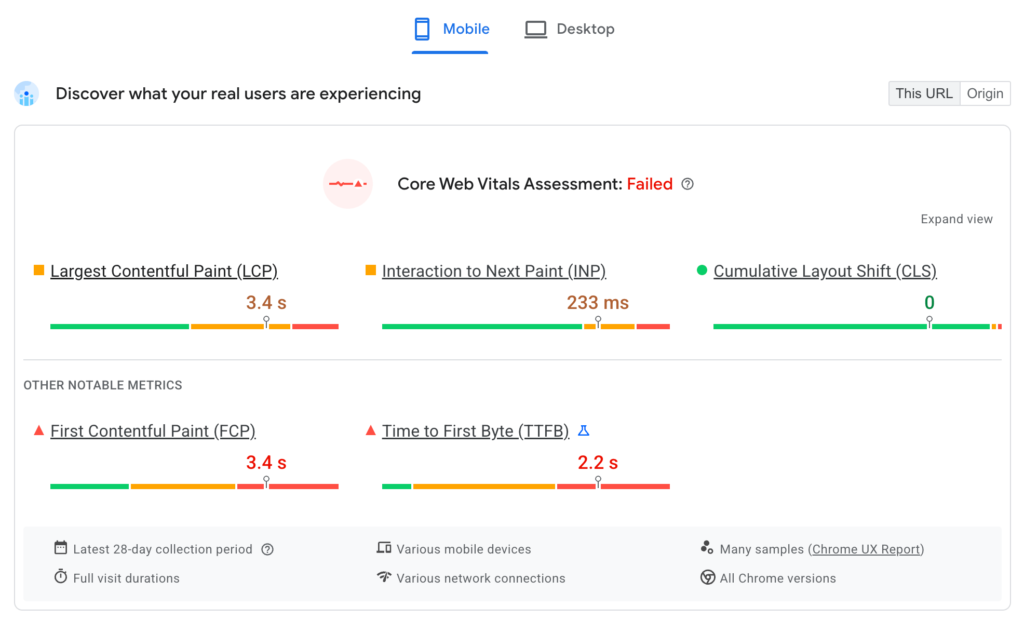
Google’s Core Web Vitals have been a constant ranking signal since 2001.
Nevertheless, there are some business owners who think it’s just a metric and not a ranking signal.
If not optimized enough, website pages can spread among five to fifteen positions in organic results. And besides, if competitors have a higher score, they will possibly get higher rankings and positions on Google as well.
4. Progressive Web Apps are becoming popular in the B2B sector
Another web development trend, Progressive Web Apps (PWAs), has existed for years but became quite popular in 2026.
Above all, PWA offers users an app-like experience in the browser. For instance, it includes push notifications and fast loading even on slow connections (which is quite important today).
For California brands with field teams, remote workers, or customers in areas with spotty connectivity, it can be an advantage.
How CA businesses can build a web development roadmap that works in 2026 and beyond
A web development roadmap starts with prioritization, not with redesigning everything at once, though many business owners believe in this. For California local companies, modernization should be a strategy based on:
- Deep analysis
- Business strategy
- Customer needs
- And finally, industry trends
So, first and foremost, before adding new features or changing the design, run a full technical audit covering Core Web Vitals, crawlability, site architecture, internal linking, structured data, hosting, and CMS limitations.
Main takeaways
Web development is constantly developing, and California brands should follow the trends, for certain.
However, it does not mean they should blindly follow those trends, but rather pay attention to what local customers want. It’s, in fact, a quite complex system that can impact all acquisition channels.
The final goal here should be rebuilding a website to reflect customers’ behavior and streamline the conversion process.
Conclusion
Web development continues to evolve very fast, and businesses need to keep up with all the trends. Technologies like AI personalization, faster website delivery, headless CMS, and Progressive Web Apps can help improve user experience, website performance, and conversions.
However, not every trend will be the right fit for your business. The key is to focus on what the customers need and what supports your business growth or goals. By making smart updates and improving your website over time, you can create a better online experience that attracts more customers.
Frequently Asked Questions
Why is AI-driven personalization important for websites in 2026?
What is a headless CMS, and why are businesses adopting it?
A headless CMS allows content to be managed separately from the website design, making it easier to publish across multiple digital channels.
How does edge computing benefit website performance?
Edge computing reduces loading times by processing requests closer to users, resulting in faster and smoother website experiences.
Are progressive web apps (PWAs) suitable for businesses?
Yes, PWAs provide app-like functionality, faster performance, and offline access without requiring the installation of an app.
Related Posts
Using HeyGen AI for Sales and Customer Onboarding
It’s best to use HeyGen AI to create videos for you that answer a particular question or pain point. You…

Search Console Forgets Everything After 16 Months: How to Back Up Your SEO Data
After completing the period of 16 months, all the data and access are deleted from Google Search Console’s database. After…
Why Digital Transformation Projects Stall: A Resourcing Playbook for Project Managers
Digital transformation projects are on the rise at this time. From government-backed initiatives to enterprise cloud adoption and AI integration.…
How Email Hosting Providers Store and Protect Business Data
Where does your business email go when you click the send button? The impression is that the email just goes…
Best CI/CD Platforms for Coding Agents and AI-Native Development
CI/CD has changed its job because coding agents now write a growing share of the changes that reach a repository.…

Mavlers Agency on Why Global Agencies Are Turning to Offshore SEO Teams
An offshore SEO team in India is becoming more and more an option for great profit for global agencies; it’s…

How to Change Signature in Outlook: A Complete Guide
How do you change signature in Outlook? It sounds simple until you realize that the steps vary across Windows, Mac,…

Best 7 AI Development Companies for Data AI Solutions for Your Project: Guide for…
Buying model work before the data work is the most expensive order to do it in. The pilot shows well,…

Top Software Development Companies Backed by GoodFirms Reviews
In September 2026, GoodFirms listed 853 software development companies in California. The group had a median hourly rate of $37,…