
Yes, it is possible now. Most mobile survey apps offer offline functionality, storing data locally and automatically syncing it once the connection is re-established.
Mobile Survey Apps: How Pocket-Sized Research Is Changing the Game for Consumer Insights
 Mahima Dave
Updated on: Dec 09, 2025
Table of Contents
- How We Got Here: The Survey Evolution Nobody Talks About
- The Tech Stack Behind Your Opinion
- What Makes People Actually Complete Surveys?
- Real-World Uses That Actually Matter
- The Privacy Elephant in the Room
- Where Things Get Sci-Fi
- Making Surveys Work in the Real World
- What’s Coming Next
- Final Take
- Frequently Asked Questions
The definition of a survey was once limited to roaming around with a clipboard in hand and asking certain questions to people. But it had many drawbacks: manual efforts, limited participants, and many more. But today, things have changed, and mobile survey apps have quietly revolutionized how companies figure out what we actually want, tapping into the phones that billions of us now use every day.
According to reports, these apps drive engagement with over 90% of in-app prompts, receiving responses. This shows how these platforms capture a much larger audience, allowing businesses to gain better and more useful insights.
Let’s dive deeper into the subject and learn how these apps use location tracking, instant notifications, and even video responses to gather insight that desktop surveys could never touch.
Key Takeaways
- People answer surveys more when they’re on their phones, quick taps beat long emails.
- Timing matters more than effort: catch users while they’re waiting, scrolling, or commuting.
- Short surveys are more effective as people drop off with every extra minute.
- AI filters fake responses while apps send data straight to businesses.
- Smart apps learn trends without knowing who said what.
How We Got Here: The Survey Evolution Nobody Talks About
Looking back in time, it did not take us long to move past the conventional ways that involved papers to a much smarter, pixelized way. The first thing to move out of the picture was the physical forms, which cut the costs by 62% for companies and enabled them to read hundreds instead of dozens.
Next in line was responsive design, which also felt like a huge transformation at the time. Then, mobile apps made their way, making things more interesting and taking the response rates 28% higher.
In comparison, the email surveys limped along at 8.4%. Wondering why there was such a huge difference? Well, it’s just simple maths. Everyone checks their phone multiple times a day, creating dozens of opportunities for quick surveys; on the other hand, no one wants to make an extra effort for a physical or desktop survey.
HISTORIC FUN FACT
Surveying is one of the world’s oldest professions, utilized by ancient Egyptians to re-establish property boundaries after the Nile flooded.
The Tech Stack Behind Your Opinion
Most modern survey platforms are quite easy to navigate, but what goes on behind the scenes is equally complex. These involve cloud systems that process millions and millions of responses at once. On top of that, the AI models are also capable of catching fake responses at 94% accuracy.
Generally, these apps are connected directly to company databases through APIs, pushing the data straight into CRM systems, eliminating several steps from the traditional processes, which saves both effort and time.
And PWAs (Progressive Web Apps) take it all a step ahead. It allows users to work offline, send push notifications, and access your camera when needed.
What Makes People Actually Complete Surveys?
According to surveys, people often abandon the survey midway; the abandonment rates can vary from 10 to over 80% depending on the survey’s length, complexity, and subject matter. So what exactly does encourage them to stick around? Some common elements are:
- Timing: People often remember not-so-prioritized tasks when they have nothing better to do: It can be during commutes or while waiting for an appointment.
- Apps Used: Different apps attract different crowds. If we compare between pawns app vs eureka surveys, users are often drawn to one side based on payment methods, how often surveys pop up, and minimum cashout amounts. Everyone has varied preferences.
- Gamification: Add progress bars, achievement badges, and level-up systems to make the whole experience more engaging for the audience rather than making it feel like an arduous task that anyhoe needs to be completed.
These factors might seem small, but have proven to boost the survey completion rates to significant degrees.
Real-World Uses That Actually Matter
These apps are extremely helpful in the real world and are often used by organizations in several ways.
Retail chains send employees to survey apps and check their competitor prices to understand the consumer expectations, and tailor their systems accordingly to make a name in the market.
Some healthcare institutions require patients to fill out surveys right after their appointments. As Harvard Business Review found, Immediate feedback is 52% more accurate than waiting even a day, since fresh memories result in honest answers.
Even banks use micro surveys: transferred money? Rate the experience. Deposited a check? You might find a small survey to fill in to tell them how you felt and what all can be done to improve the experience in the future.
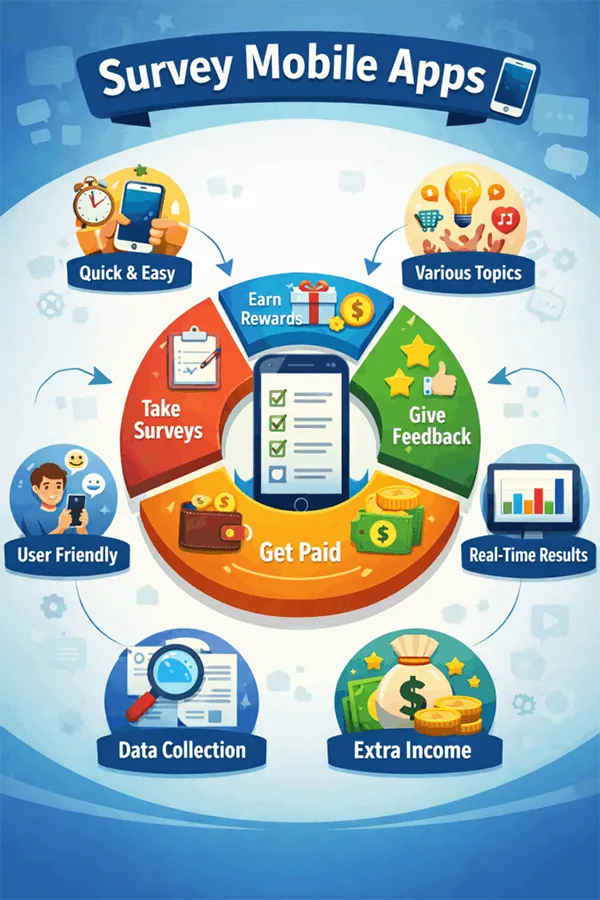
The infographic below provides more information on how these mobile survey apps work. Take a look!
The Privacy Elephant in the Room
Now comes the crucial part: Privacy. No one wishes to compromise with that, and survey apps very obviously collect customer data. This is why mobile apps are required to comply with dozens of regulations, such as GDPR, CCPA, etc.
Then comes encryption, another non-negotiable. Everything gets scrambled during transmission and storage, with end-to-end protection meaning even the survey company can’t peek at individual responses without permission.
Smart platforms do not require personal information to use data. They keep both these factors separate and analyze trends without knowing who said what. This approach helps balance useful insights with actual privacy.
Where Things Get Sci-Fi
MIT’s research shows that people give better responses when not under any kind of pressure and when talking versus typing. Talking makes them drom the guard and be more honest. Therefore, modern systems now adjust questions based on the previous answer and create custom survey paths for each person.
Natural Language Processing (NSP) enables companies to collect open-ended answers, finding patterns in thousands of text answers that the traditional, manual ways might skim through.
Making Surveys Work in the Real World
Well, people might download apps, but they are of no use if they do not actively engage with them. That is why companies need a clear goal, defined audiences, and rewards people actually want.
Gartner’s data shows some strategies that boosted responses by 63%, these are:
- Keeping the surveys short in length kills completion rates; every minute costs them 8% of the respondents.
- 8-12 questions are considered optimal to get the information required; any longer can result in people ghosting.
- Using multiple channels invites a larger audience.
These practices actually make surveys work in the real-world.
What’s Coming Next
The way businesses conduct surveys has transformed completely and already solves several problems. Still, a few issues stay consistent. However, in the future, we can tackle those as well with emerging technologies. Blockchain might actually solve the fake response problem. Immutable records, automatic payments through smart contracts, verified participants. We’ve got the technology; just adoption is next.
Final Take
Surveys have always been a useful weapon for companies to understand consumer behavior and their expectations. Hence, these aren’t going anywhere. Though their ways are changing. We have moved past the manual clipboard ways to pixels. In the future, we can expect it to be more efficient and user-friendly.
Frequently Asked Questions
Can I collect data on a mobile survey app without an internet connection?
What are in-app surveys, and are they really effective?
In-app surveys are short questionnaires embedded directly within a mobile app that help get immediate and honest responses and prove to be extremely useful, resulting in higher engagement.
Can I customize the survey design?
Yes, most tools now offer customization of branding, colors, and question types.
How do I prevent duplicate or fake responses?
Duplicate and fake responses are a major concern that can be handled by techniques like device fingerprinting, OTP (One-time passwords) verification, GPS logging, and session timeouts.
Related Posts
How Poor Contract Visibility Leads to Revenue Leakage in Growing Companies
Growth is an important factor that determines the success rate of any business. When we witness new operations, partnerships and…
Managing Bitcoin Operations? Here’s How Salesforce Automation Helps
“Digital currency is here to stay, and it’s only a matter of how long before governments embrace it.” — Brad…
Why Modern Organizations Depend on Data Privacy Software
Data growth has significantly accelerated beyond what most compliance teams can manage, with personal records, financial details, contracts, and emails…
Converting Chats Into Leads While Maintaining Professionalism
The way marketing teams and businesses approach their potential clients to boost their sales has completely transformed in the last…
How to Delete iCloud Account? Complete Guide for 2026
Thinking, how can I delete iCloud or Apple account? It is not just about removing an account; it is about…

How Different Industries Use Specialized Software to Stay Competitive
In the market we have today, companies are always trying to find ways to work better and get results. The…
What Key Adjustments Enhance Visual Appeal Across Web Pages
Attractive web pages form the roots of any appealing website. For instance, imagine looking for content on Google, and you…
When is it Time to Consider IT Support Services for Your Business?
Every business needs to ensure smooth operations for a successful business. But despite trying hard to avoid barriers, technical issues…

How to Delete User Profile in Windows 10: Step-by-Step Guide
You don’t notice user profiles until one starts causing problems. A profile gets corrupted, a login error pops up, or…