
Not really. The traditional CCTV records footage for later review. Whereas live video surveillance lets you see what’s happening in real time and act immediately if something is out of routine.
How Does a Live Video Surveillance System Complies Real-Time Monitoring
 Upasna Deewan
Updated on: Dec 16, 2025
Table of Contents
Security no longer starts after things have taken a wrong turn; it starts the moment something happens. Because let’s be honest, there is no use in locking the stable door after the horse has bolted. Live video surveillance stands at the forefront of this shift, powered by real-time monitoring demand and advanced technologies like AI and cloud integration.
As per the reports, over 60% of surveillance systems now integrate functions such as threat detection through real-time video monitoring and behavior analysis, enhancing both security and operational insights.
Let’s go into the depths of this topic and understand how these systems work and the role of real-time monitoring and AI in it.
Key Takeaways
- Live video surveillance is about acting in the moment, not reviewing damage later.
- Cameras alone aren’t enough; networks, software, and analytics make real-time monitoring possible.
- Smart alerts mean you don’t have to stare at screens all day.
- AI helps spot what humans might miss, especially in busy or low–visibility environments.
- Strong security and privacy controls are just as important as video quality.
What is Live Video Surveillance?
Traditionally, video surveillance meant watching the recorded content moments after it was recorded. But as the name suggests, live video surveillance captures, transmits, and displays video footage in real time. Which means the operators do not need to wait for hours to watch the recordings, instead they can watch things unfold as they happen and take some action at the exact moments if things go south.
This technology is widely used in offices, retail stores, warehouses, public spaces, healthcare facilities, and residential communities to enhance social awareness and enable immediate action. And as an outcome, 93% of frontline workers reported feeling safer when doing their jobs.
Core Components of Real-Time or Live Video Surveillance
Real-time video surveillance relies on various components to function properly and provide footage in real time. The core components for this include:
Cameras and Video Capture Devices
Cameras are the most important element for video surveillance. They form the foundation of such systems. Hence, operators should invest in them, go for modern IP cameras that support features like night vision, wide dynamic range, and pan-tilt-zoom functionality to get the most out of these systems. These devices also convert visual input into digital data that can be transmitted instantly for live viewing.
Network Infrastructure and Connectivity
Live video surveillance is all about providing video streams in real time, and this is why reliable network connectivity is important. Systems operate with high-speed wired and wireless networks to ensure the recordings are transmitted with minimal delay, as bandwidth capacity, network stability, and low latency directly impact video quality and the effectiveness of the whole system.
Video Management Systems (VMS)
A video management system serves as the control of live video surveillance and collects video feeds from cameras, displays them on monitoring dashboards, manages user access, and integrates features like alerts, playback, and analytics. It allows operators to navigate multiple live feeds and respond to events efficiently.
Storage and Streaming Architecture
These systems generate a significant amount of video data, which needs to be stored with care, even if live monitoring focuses on real-time viewing. Hybrid architectures allow systems to stream videos live and simultaneously record footage to local servers or cloud storage, fulfilling both purposes: immediacy and long-term access.
FUN FACT A single HD camera can generate thousands of images per minute, all analyzed in real-time by modern systems.
How Real-Time Monitoring Works in Live Video Surveillance
We’ve learned what live surveillance actually is and what its core components are. But now the question arises, how do these components work together to achieve a continuous flow of data and intelligent processing? Well, here’s how it happens:
Continuous Video Streaming and Processing
As the camera captures the images, they are continuously transmitted through VMS. The advanced compression techniques work their way to reduce bandwidth usage while maintaining clarity, allowing operators to view clear feeds without any lag.
Motion Detection and Event Triggers
Motion detection and event triggers are especially designed to sense any unusual movement and predefined events, such as entry into a restricted zone. If these sensors are triggered, the systems highlight the event instantly and alert the operators to take the required action.
Real-Time Alerts and Notifications
Live monitoring is of no use if the action is not taken in real time, and this is where instant alerts and notifications help. Whenever the system detects an anomaly these directly send alert to the responsible teams, enabling them to check what happened and take action accordingly.
Role of AI and Analytics in Live Video Surveillance
AI and video analytics are two important components of the whole system. They take the overall efficiency and reliability of the systems to another level as they are capable of recognizing faces, detecting objects, counting people, and identifying suspicious behaviour in real time.
They provide useful insights, taking away the manual effort of analyzing the footage piece by piece. By analyzing patterns, AI surveillance systems help organizations shift from passive observation to proactive threat prevention.
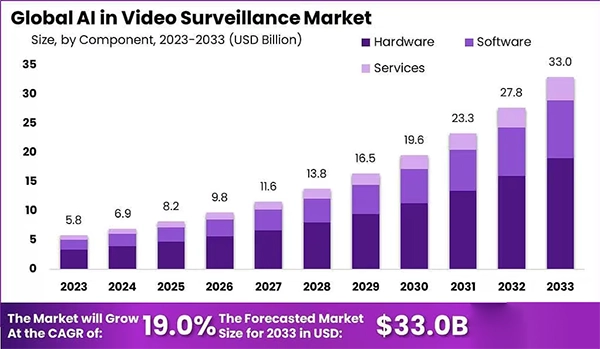
Since AI is extremely helpful in video surveillance, its market is on the rise. It is expected to reach $33 billion by 2033 from $8.2 billion in 2025, growing at a CAGR of 19%.
Data Security and Privacy in Live Video Monitoring
Surveillance systems continuously generate video data, and this brings another responsibility with it: protecting the data. To ensure security and compliance data, modern systems incorporate role-based access, audit logs, and secure storage, which only allow authorized users to view live feeds, protecting the data from falling into the wrong hands.
By balancing effective monitoring with privacy considerations, teams can build trust and make sure that surveillance practices remain ethical and compliant.
Final Thoughts
Live video surveillance is all about providing instant video recording that helps teams detect any unusual moments and prevent unfortunate events before they happen. The system complies with real-time monitoring by combining high-quality cameras, robust networks, intelligent software, and advanced analytics.
Together, these make instant visibility, rapid response, and smart decision-making. As the technology evolves further, it will continue to move beyond basic security and create powerful tools for operational awareness, safety, and efficiency across industries.
Frequently Asked Questions
Is live video surveillance the same as CCTV?
Do I need someone watching screens all day?
No, modern systems have taken the responsibility into their own hands. They rely on motion detection and AI alerts, saving the human effort of watching the screens all day.
Does live monitoring slow down my internet?
Live monitoring may slow down the internet, but if good systems are in place, this is not something you need to worry about. Modern systems compress video smartly and adapt to available bandwidth so your network doesn’t crawl.
What happens if the internet goes down?
Most systems keep recording locally and sync footage once the connection is restored, so you don’t lose critical moments.
Related Posts
Simple Ways to Clean Audio Data for Better Model Performance
Most of the machine learning teams do not struggle because their processing systems are not capable—they struggle because their audio…

How to Check for Malware on Mac in 2026?
Can Mac computers get viruses? Macs are not as safe as people think. Yes, macOS has built-in tools like XProtect…
10 Best Lightroom Preset Alternatives in 2026
“Photography is the story I fail to put into words.” — Destin Sparks (Landscape Photographer) For years, Lightroom presets have…
Elementor Hosting vs SiteGround: Which is Faster in 2026?
A website’s performance is mainly determined by its Speed. Even a slight delay can reduce conversions by a significant margin.…

10 Best Visual UGC Platforms for eCommerce Brands in 2026
“People influence people. Nothing influences people more than a recommendation from a trusted friend.” — Mark Zuckerberg (Meta CEO) That…

The Data Models Powering the Next Creative Revolution in Video Generation
Artificial intelligence has evolved from a mere tool to the cornerstone of advancements in the new era. Over the years,…

Solar Software Companies: How Platforms Improve Cross Team Collaboration
“If everyone is moving forward together, then success takes care of itself.” — Henry Ford (Industrialist & Business Magnate) Handoffs…
What Healthcare Leaders Expect From Digital Tools
Healthcare executives are under pressure to protect patient safety, clinician time, and data privacy while modernizing the delivery of care.…

How to Reset Android Phone When Locked? (Safe Factory Reset Methods)
Locked out of your Android phone or stuck on the screen? It happens more than you think. A forgotten PIN,…