
B2B salespeople handle entire sales cycles, from identifying prospects to closing the deals.
Why National B2B Salesperson Day Should Make You Rethink Your Salesforce Workflows
 Mahima Dave
Updated on: Feb 20, 2026
Table of Contents
- The Hidden Cost of Broken Email and CRM Workflows
- Email Deliverability: The Silent Deal Killer
- Salesforce Automation That Actually Moves the Needle
- Scalable Cloud Infrastructure for Growing Sales Teams
- Beyond the Inbox: Multi-Channel Sales Communication
- How to Mark National B2B Salesperson Day in Your Organization
- The Bottom Line
- Frequently Asked Questions

“Stop selling. Start helping.” — Zig Ziglar (Author)
And the personnel who sell the hardest to clients and help the organization the most are usually ignored: B2B salespeople. Though they are not actively ignored, it has mostly to do with them working invisibly.
To counter the exact problem, National B2B Salesperson Day is celebrated every year. It puts a well-deserved spotlight on the professionals who navigate the longest, most complex sales cycles in business. These are the people who slog for months to fix multi-stakeholder deals. The everyday tools by their side they rely on are a technology stack.
On this recognition day, the pertinent questions are: is your email and CRM infrastructure actually easing and accelerating the work of your sales team, or is it just slowing them down?
In this article, we will focus on exactly that. The following sections also offer some other measures to help your salespeople with their workflows.
KEY TAKEAWAYS!
- Salespeople play one of the most important roles in a B2B business.
- They rely on their tools for day-to-day work, which should be regularly reviewed.
- A poor tech stack can drastically dent the performance of salespeople.
- Focus on cloud infrastructure and Salesforce automation to improve their workflow.
The Hidden Cost of Broken Email and CRM Workflows
B2B salespeople begin and end their workdays with just two things: their email inbox and their CRM. Outlook, Gmail, Salesforce, HubSpot, and various other tools form the operational backbone of every deal under negotiation. When these systems work well together, sales reps move fast and close more. When they do not, the consequences are surprisingly severe.

Studies consistently show that sales professionals spend roughly 28% of their time on administrative tasks, with email management and CRM data entry consuming the largest share. That means for every eight-hour workday, more than two hours are lost to tasks that do not directly generate revenue. Across a team of ten reps, that adds up to over 100 hours per week of productivity that is being consumed by system friction rather than selling activity.
The problem gets worse at scale. As organizations grow, the volume of email data, contact records, and CRM entries expands exponentially. Without the right infrastructure in place, critical prospect emails get buried, follow-up tasks fall through the cracks, and valuable relationship data becomes fragmented across disconnected systems.
Email Deliverability: The Silent Deal Killer
The rarely discussed hazard that is eroding your B2B sales is email deliverability. Up to 70% of inbound leads who fill out a contact form never actually connect with a sales rep. While there are many reasons for this, one of the most overlooked is that outbound sales emails are landing in spam folders, being throttled by email providers, or simply never reaching the prospect’s primary inbox.
For teams relying heavily on Outlook or cloud-based email platforms for sales outreach, understanding and optimizing deliverability is no longer optional. This includes properly configuring SPF, DKIM, and DMARC authentication records; maintaining clean sender reputations; managing email volume to avoid triggering spam filters; and segmenting outreach lists to improve engagement rates. If you’re ignoring these technical fundamentals, your pitches are essentially going into the black hole. And then you wonder why prospects are not responding.
Salesforce Automation That Actually Moves the Needle
The majorly used CRM platform in B2B sales is Salesforce. But the gap in how it’s actually used and how it should be used is enormous. Once properly configured, the platform’s automation capabilities can eliminate the majority of manual repetitive work, boosting sales productivity by a considerable margin.

Here are the highest ROI automations for B2B salespeople:
- Auto-Logging Email Activity: Integrate your Outlook/Gmail with Salesforce. This automatically captures every email, reply, and attachment activity as well as the corresponding contact and opportunity. Complete communication history is always accessible. The tedious task of data entry is also eliminated.
- Lead Assignment and Routing Rules. Configuring Salesforce to automatically assign incoming leads to the right rep based on territory, industry, deal size, or round-robin distribution. This removes the delay between lead capture and first contact, which is one of the most critical factors in conversion rates.
- Automated Follow-Up Sequences. Using Salesforce Flow or integrated tools to trigger follow-up emails, task reminders, and escalation alerts based on prospect behavior. If a lead opens a proposal email three times without responding, the system can automatically prompt the rep to call or send a personalized follow-up.
- Pipeline Stage Automation. Setting up rules that automatically move opportunities between pipeline stages based on completed actions. When a prospective client signs an NDA, the deal moves to “Evaluation.” When the contract is sent, it moves to “Negotiation.” This keeps the pipeline accurate in real time without relying on reps to manually update records.
- AI-Powered Lead Scoring: Salesforce Einstein and similar AI layers can analyze historical deal data to score and rank leads by conversion probability. This allows sales managers to direct their team’s attention toward the prospects with the highest likelihood of closing, rather than spreading effort evenly across the entire funnel.
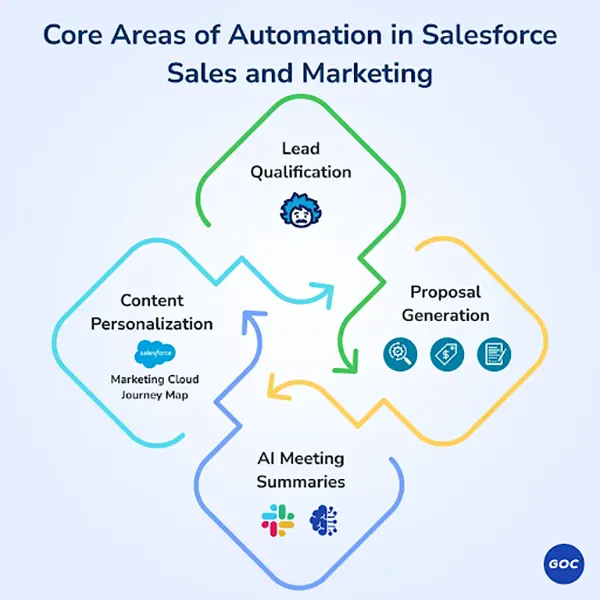
The following infographic summarizes the core areas of Salesforce automation:
Scalable Cloud Infrastructure for Growing Sales Teams
The infrastructure needs to catch up with the continuously scaling B2B sales firms. Cloud-based solutions are coming in handy for this. Just ensure during their development that scaling and growth are built into the design.
Email archiving and data recovery become critical concerns as communication volume grows. A single lost email thread can mean the difference between closing a six-figure deal and losing it entirely. Cloud-based email management solutions that include robust backup, search, and recovery capabilities are not just IT considerations. They are direct revenue protection for the sales function.
Similarly, CRM data integrity at scale requires careful attention to deduplication, data hygiene, and integration architecture. When multiple systems feed into Salesforce (marketing automation platforms, web forms, third-party data providers, email sync tools, etc.), the risk of duplicate records, conflicting data, and broken automations arises. Investing in data quality tools and establishing governance processes early prevents the kind of CRM chaos that cripples sales productivity down the line.
Beyond the Inbox: Multi-Channel Sales Communication
Emails are the primary communication channel in the B2B business workflows. However, firms are experimenting with a multi-channel approach as well. Presently, many of them have already adopted some other channels besides email.
While email remains the primary communication channel for B2B sales, the most effective teams are supplementing their inbox outreach with coordinated multi-channel strategies. SMS follow-ups after email sends, personalized video messages embedded in outreach sequences, and direct calendar booking links that eliminate the back-and-forth of scheduling are all becoming standard practice for high-performing sales organizations.
The key is integration. Each of these channels needs to feed data back into the CRM so that the full picture of prospect engagement is visible in one place. A sales rep should be able to open a Salesforce record and see every email, text, video, and meeting scheduled without flipping between five different tools.
How to Mark National B2B Salesperson Day in Your Organization
January 16th is the National B2B Salesperson Day and the perfect occasion for assessment of sales-supporting technology stack performance. Some concrete steps you can take are:
- Run an email deliverability audit. Check your SPF, DKIM, and DMARC records. Test your sender reputation. Identify whether sales emails are reaching primary inboxes or getting filtered to spam.
- Measure CRM adoption and data quality. How many of your sales activities are being logged automatically versus manually? Where are the gaps? Poor integrations lead to duplicate records and incomplete data.
- Implement one automation this quarter: What’s the most time-consuming manual task in your sales workflow? Go ahead and automate it. One well-designed Salesforce Flow can save hours.
- Review data backup and recovery plan: Critical email data and CRM records should be regularly backed up. They should be quickly recoverable as well. Otherwise, one mistake by a newbie can erase months of relationships.
- Recognize your sales team publicly. Share a post using #B2BSalespersonDay on LinkedIn and social media. Acknowledge the people who drive revenue for your organization and the tools that help them do it.
The Bottom Line
As they say, you are only as good as the weapon in your hand. Fits perfectly on the B2B salespeople. A brilliant closer with a broken CRM, poor email deliverability, and no automation support is fighting with one hand tied behind their back. National B2B Salesperson Day is a call to action, not just to appreciate these professionals, but to invest in the email infrastructure, CRM automation, and cloud-based tools that allow them to perform at their best.
On the coming January 16th, make sure your tech stack is ready to support the people who keep your revenue growing.
Frequently Asked Questions
What does a B2B salesperson do on a day-to-day basis?
What are the 7 steps of the selling process?
The 7 steps in a selling process are prospecting, preparation, approach, presentation, handling objections, closing, and follow-up.
How to be a good B2B sales rep?
Rather than relentlessly pitching products always, sometimes try genuinely helping clients and alleviating their pain points.
Related Posts
How to Transfer Contacts from Android to iPhone: 4 Easy Methods
Switching from Android to iPhone should not feel like rebuilding your life from scratch. Restoring contacts on iPhone should be…
White Label Ad Server vs Development From Scratch: What to Choose
Even though the DSP segment is the largest market within AdTech at the moment, an ad server remains a crucial…
How Data Infrastructure Powers Next-Gen Mobile Recognition Apps
Modern digital applications have evolved with time, offering various functionalities to users that weren’t possible or even imaginable before. But…
How Poor Contract Visibility Leads to Revenue Leakage in Growing Companies
Growth is an important factor that determines the success rate of any business. When we witness new operations, partnerships and…

Managing Bitcoin Operations? Here’s How Salesforce Automation Helps
“Digital currency is here to stay, and it’s only a matter of how long before governments embrace it.” — Brad…

Why Modern Organizations Depend on Data Privacy Software
Data growth has significantly accelerated beyond what most compliance teams can manage, with personal records, financial details, contracts, and emails…

Converting Chats Into Leads While Maintaining Professionalism
The way marketing teams and businesses approach their potential clients to boost their sales has completely transformed in the last…
How to Delete iCloud Account? Complete Guide for 2026
Thinking, how can I delete iCloud or Apple account? It is not just about removing an account; it is about…

How Different Industries Use Specialized Software to Stay Competitive
In the market we have today, companies are always trying to find ways to work better and get results. The…