IT downtime can cause a major setback for organisations that ensure productivity and growth working day and night.
The losses are recorded to be over $5,600 per minute, and in the worst cases, it rises to up to 1 million.
And if your systems or software are attacked by hijackers or ransomware, the monthly productivity goes down the drain.
To make sure recovery in such cases is made as soon as possible, going for the right IT company that ensures reliability and improved protection of your data is very important.
Read this article to know the top 7 masters in this field for improved business growth and better security.
Key Takeaways
Tailwind Voice & Data: The master of software security ruling over 40,000 enterprises across all of North America.
Cisco is the backbone of enterprise networking worldwide, and its AI-driven automation tools have cemented its status as an infrastructure essential in 2026.
HPE: the hub for industries with heavy data workloads, including manufacturing, healthcare, and financial services, etc.
Choosing the right enterprise partner as per your company’s requirements to facilitate security for your industry.
Enterprise IT operations center with monitoring screens displaying network uptime dashboards
Founded in 2005, Tailwind Voice & Data has built a reputation as the best enterprise IT company for multi-location businesses that depend on always-on connectivity.
The industries served include :
Healthcare
financial services
Retail
Restaurants
and manufacturing.
Tailwind supports over 40,000 enterprise locations across North America, offering a single point of contact and one consolidated invoice — a major operational advantage for businesses managing dozens or hundreds of sites.
Their services span:
broadband aggregation
business fiber
carrier management
telecom expense management (TEM)
structured cabling
NOCaaS (Network Operations Center as a Service)
WiFi deployment and demarc extensions.
With a carrier-agnostic approach and 20+ years of experience, Tailwind is particularly strong for enterprises that need centralized network management without the complexity of juggling multiple vendor relationships.
2. IBM
IBM remains one of the most trusted names in enterprise IT,
The reasons include :
a portfolio spanning hybrid cloud infrastructure
AI-powered automation
and enterprise-grade security.
Watson AI and Kubernetes-based services suit compliance-heavy environments subject to SOX, HIPAA, or PCI-DSS requirements.
IBM’s robust disaster recovery and data protection give enterprises a reliable safety net against data loss.
3. Cisco
Cisco is the backbone of enterprise networking worldwide, and its AI-driven automation tools have cemented its status as an infrastructure essential in 2026.
Cisco’s portfolio covers:
secure networking
data center solutions
edge computing
and unified security management via a single dashboard.
For distributed enterprises requiring reliable connectivity across many locations, Cisco delivers proven performance and a vast ecosystem of certified partners.
Its strength lies where network reliability and security convergence are non-negotiable.
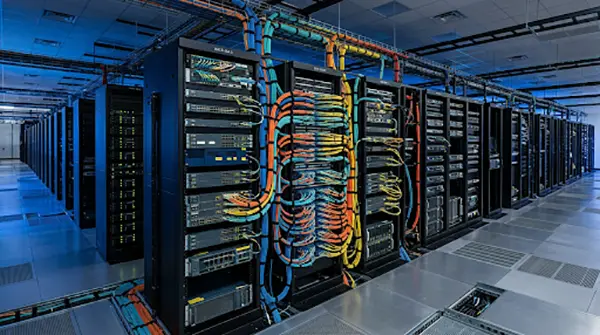
Data center server racks with enterprise networking equipment and fiber optic cable connections
4. Dell Technologies
Dell Technologies delivers end-to-end enterprise infrastructure, from servers and storage arrays to converged systems and data protection appliances.
Dell’s PowerProtect portfolio is a standout for businesses focused on data recovery — offering near-zero recovery point objectives and integration with leading DRaaS providers.
It is especially well-suited to hybrid environments requiring tight coordination between on-premises hardware and cloud-based recovery, with a comprehensive ecosystem that simplifies lifecycle management.
This is what makes it standout of its competitors.
5. Microsoft
Microsoft’s enterprise IT ecosystem — anchored by Azure, Microsoft 365, and Intune — is the default environment for large organizations operating in the Windows ecosystem.
Attributes such as :
Azure Arc hybrid capabilities
Entra ID identity management
and built-in compliance tooling make Microsoft a logical choice for businesses prioritizing data governance.
Azure also leads in disaster recovery as a service, with geo-redundant storage and automated failover.
For organizations scaling their digital operations or SaaS SEO capabilities alongside IT infrastructure, Microsoft’s integrated tooling covers endpoint management to cloud security posture.
6. Palo Alto Networks
When cybersecurity is the enterprise’s primary concern, Palo Alto Networks delivers a full-stack platform covering network, endpoint, and cloud workloads.
Its Prisma Cloud and Cortex XDR platforms protect more than 85 Fortune 500 companies, proving their worth all across the market.
This matters especially in 2026, as ransomware attacks increasingly target backup and recovery systems specifically.
For data-sensitive enterprises, a security-first partner like Palo Alto Networks is a baseline requirement for operational resilience, not a luxury.
7. HPE (Hewlett Packard Enterprise)
HPE’s GreenLake platform transforms how enterprises consume IT through a pay-as-you-use model that combines cloud agility with on-premises control.
HPE supports :
Edge
Cloud
and on-premises workloads under a unified management layer — an excellent fit for diverse and evolving infrastructure needs.
Industries with heavy data workloads, including :
Manufacturing
healthcare
and financial services, benefit from HPE’s scalable storage.
Enterprises with mature automation experience 40–50% less downtime, and HPE’s automation-forward approach makes that outcome achievable at any scale.
Choosing the Right Enterprise IT Partner
Selecting an enterprise IT company is a strategic business decision with long-term implications for uptime, security, and recovery capability.
Therefore, consider your industry’s compliance requirements,
whether you manage one or multiple sites,
How much weight do you place on data recovery?
cybersecurity
and connectivity to make the right decision.
The Bottom Line
In the digital era, losing time on downtime can cause serious losses in business, further increasing the scope for your competitors.
Therefore, it is important to have the best facilities for protecting your data and ensuring better security as per your company’s requirements, so that in case downtime hits, the recovery can be faster.
Frequently Asked Questions
What are the five types of privacy?
The five types of privacy include: intellectual, informational, bodily, communication, and territorial. It means different things to different people.
What are 6 legal bases?
Article 6of the General Data Protection Regulation sets out what potential legal bases are: consent, contract, legal obligation, public tasks, or legitimate interests, Vital Interests.
What are the four levels of data?
There are four basic levels of data on the ground level. These include: nominal, ordinal, interval, and ratio.
What are five different data types?
Some common data types include: integers, floating point numbers, strings, booleans, arrays, and objects.
Accurate attendance tracking plays a critical role in workforce management. Authentication-based employee time clock systems help organizations verify employee identity…


 Upasna Deewan