
It refers to emails, phone numbers and profiles that don’t clearly show the real person behind them.
What Anonymous Contact Data Reveals About Online Risk
 Mahima Dave
Updated on: Jan 31, 2026
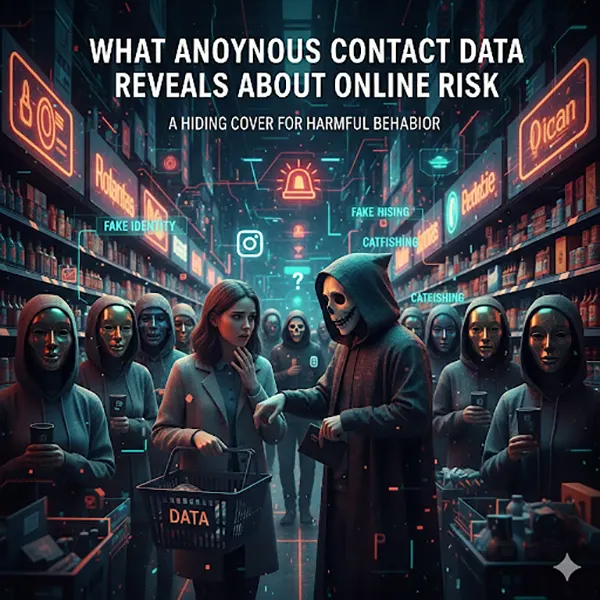
Imagine walking into a crowded supermarket where everyone is wearing a mask and a costume. You might have come with the intention to buy clothes but can’t predict whether others have come to do the same or pickpocket wallets. This is how anonymous contact data works on the internet.
The purpose behind identity shielding was to hide users’ information and protect their privacy, but anonymous users misuse it to control and abuse people. In fact, a research study in 2013 shared that 86% of internet users have taken steps to hide their online identity, in one way or another. While many believe that full anonymity isn’t possible online due to cookies and footprints. (Source – Pew Research Centre)
Read more to unpack what exactly anonymous contact data reveals – its associated risks and practical ways to spot an anonymous scammer.
The Dynamics Behind Anonymous Online Interactions
A user can either provide their correct information on the internet, hide it or disguise it and pretend to be someone else – often termed as total anonymity or partial anonymity. This allows anonymous users to exploit others.
For instance, Instagram allows users to create a profile either based on their true identity – age, name, location and more or one with fake data. Now, this allows shy people to talk with strangers and make new friends. While helping anonymous users to misuse it.
The psychology behind this is simple – when we feel unseen, we behave more unpredictably, increasing risk. With this advantage, some might crack a joke they normally wouldn’t and – unfortunately – some may abuse others they wouldn’t do face-to-face.
Risks Associated With Anonymous Interactions
Not every user has the intention to make bad use of it – it’s more like a power that can be used for both enjoyment and harming people. Things worsen when these tools are misused in the environments where people expect safety and trust.
Here are the three major dangers linked with anonymous contact data—
Fake Identities and False Information
A common tactic is to create a fake identity – often with an anonymous email, photo or phone number – to fool people by pretending to be someone else.
Scammers often use popular photos to build attractive profiles and engaging backstories to lure users – a tactic known as catfishing. Once you are comfortable with them, they will ask for money and other favors.
While understanding it just seems like a moment of embarrassment, but after connecting for a long time, it more feels like a loss of trust, privacy and relationships.
Privacy and Data Misuse
One of the most common ways is that anonymous users build trust and then ask for personal details such as photos, names and addresses. Later, use the collected information to create a new account or profile using your information. And commit fraudulent activities such as asking for money.
These anonymous accounts are also the main source of fake news – manipulating public opinions and sometimes elections too.
Scams and Fraud Risks
Anonymous channels are often responsible for scams. Whether it’s a fake investment scheme, relationship scene or phishing scam. A popular pattern is to send a message from a popular brand or government authority email with a too good to be true offer – think ‘you won a lottery of 1 crore!’ – encouraging you to click on the link or share personal information.
Another common and well-known scam is where an anonymous sender claims to have a personal video and demands money. They often disappear or come again with more demands.
How to Spot an Anonymous Scammer

Spotting anonymous scammers is not about being overhyped about scams – it’s about being observant to avoid them. Here are some of the most common red flags mentioned –
- Suspicious email domains – If the ending part of the sender’s email is looking odd or unfamiliar (random merging of characters), it’s a warning sign.
- Mismatch of information – If the owner of the profile is claiming one thing but behaving in a different way or representing something else with their activity, it’s suspicious. Be a step ahead with Scannero’s “Who Called Me?” and find out the real details of the caller.
- Asking for urgent action – Scammers often ask to react as early as possible – ‘act now’ – to skip forgetting or research.
- Too attractive profiles – If someone is too perfect to consider (good looks, perfect backstory, flawless grammar) treat it as a red flag.
Consider it like dating in real life. If someone is asking to get personal too fast or refuses to meet in public settings, it raises questions.
Conclusion
Anonymous contact data is not harmful by default, but it does increase online risk when used improperly. While anonymity helps users to protect privacy and encourages open communication – but is also helps users with bad intentions to hide their identity and carry out scams.
In today’s digital landscape, anonymity should be treated as a risk signal – not an automatic threat. Awareness, observance and verification are the shields to stay safe online.
Frequently Asked Questions
What is anonymous contact data?
Why do scammers rely on anonymous contacts?
Because it helps them to hide their real personality and disappear whenever needed.
Is anonymous contact data always risky?
No, not always. It’s often used for the privacy concerns – but when intentions go wrong, it becomes risky.
Related Posts
8 Best AI Presentation Makers for Business-Ready Slides
Making a presentation doesn’t just mean designing slides. It’s about defining a clear structure, using defined logic, useful visuals, and…

Queue Management Software Troubleshooting Guide: 8 Common Faults and Fixes
The long wait times and ineffective management of customer queues can have a significant impact on customer satisfaction and business…
How to Use Similarweb Website Traffic Data for Competitor Research
Competitor research without traffic data is guesswork. You can guess who your rivals are, guess how big they are, guess…

Choosing the Right Hosting Model for Scalable Digital Platforms
The performance of digital business is directly related to website speed, uptime, and scalability. Slow page performance has a negative…

How Data-Driven Performance Tools Are Transforming Employee Recognition in Tech Companies
“People work for money but go the extra mile for recognition, praise, and rewards.” — Dale Carnegie (Writer & Teacher)…
Why Businesses Struggle to Collect Reliable Data from the Web
Almost every company that depends on data runs into the same problem: although they can find the data they need,…
Why Financial Data Recovery Matters for Businesses
Financial data supports every part of a business, directly affecting cash flow, payroll, tax reports, audits, customer billing, and daily…
CMMC Compliance Is Coming for Manufacturers. Here Is What You Need to Do
“Cybersecurity is much more than a matter of IT.” — Stephane Nappo (Cybersecurity Professional) For manufacturers working within the defense…

How Data-Based Tools Influence Learning Performance
Learning has transformed in the modern age with the integration of new technologies to help students and professionals prosper in…