
Audit readiness and data integrity. Without these, even the most advanced analytics will fail during regulatory scrutiny.
5 Best ESG Reporting and Disclosure Platforms for Enterprise in 2026
 Reviewed By Brijesh Kumar Singh
  Saipansab Nadaf
Updated on: Apr 22, 2026

“There is no business to be done on a dead planet.” — David Brower (Environmentalist)
That line hits harder in 2026 than ever before. What used to be voluntary sustainability storytelling is now a regulated, audited, and investor-scrutinized discipline.
With mandates like the Corporate Sustainability Reporting Directive, SEC Climate Disclosure Rules, and California SB 253, ESG reporting has shifted from “nice-to-have” to legally enforceable infrastructure. Add investor pressure and Scope 3 complexity into the mix, and suddenly your ESG platform transforms from just a tool to a risk control system.
The platforms below are evaluated on what actually matters to enterprise teams: deep carbon accounting, multi-framework reporting, audit readiness, supplier data collection, and the ability to scale across entities without chaos.
KEY TAKEAWAYS
- ESG reporting has evolved into a regulated, audit-heavy function, not just a communications exercise.
- A single, unified data model is critical to avoid duplication across frameworks.
- Scope 3 and supply chain data are now the hardest and most important pieces to manage.
- The right platform depends on your complexity: carbon, governance, or investor reporting.
1. Sweep
Best for: Enterprise carbon management, multi-framework ESG reporting, and supply chain transparency
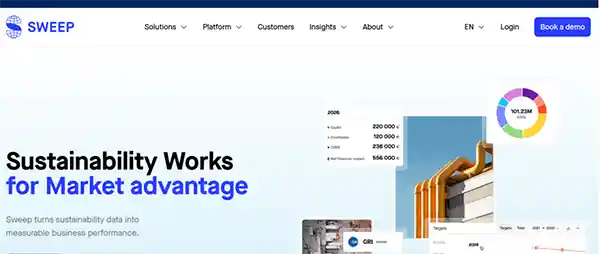
Sweep is one of the best ESG reporting and disclosure platforms that delivers a tightly integrated environment where emissions tracking, disclosure, and decarbonization strategy happen in one place rather than across fragmented tools.
The platform is structured around three core pillars: Track, Disclose, and Act, giving sustainability teams a single governed environment to measure emissions, report across frameworks, and drive decarbonization strategy simultaneously.
On the carbon accounting side, Sweep covers Scope 1 to 3 emissions in alignment with the GHG Protocol. AI-powered hotspot identification triggers where the largest reduction opportunities exist across the value chain.
Real-time dashboards give teams continuous visibility into emissions performance across business units, geographies, and reporting entities, making it possible to identify data gaps before they affect disclosure quality rather than discovering them during the audit process.
Multi-framework reporting is one of Sweep’s most significant operational advantages for enterprise organizations.
A single dataset can be mapped simultaneously to CSRD, SFDR, CDP, GRI, ISSB, TCFD, and California’s SB 253, eliminating the duplication of effort that comes from managing separate data models for each regulatory requirement.
Supply chain collaboration is deeply embedded in the platform through supplier portals, role-based access controls, and approval workflows that extend data collection beyond internal teams to value chain partners.
This is particularly relevant for organizations under CSRD scope, where Scope 3 completeness and supplier engagement are increasingly scrutinized during external assurance reviews.
Sweep is a certified B Corp and has been recognized by both Verdantix and the IDC MarketScape as a leading enterprise sustainability software provider.
The platform is used by enterprise and mid-market organizations across manufacturing, financial services, technology, and retail sectors globally.
Key frameworks supported: CSRD, SFDR, CDP, GRI, ISSB, TCFD, SB 253.
Ideal for: Large enterprises, financial institutions, and global companies with complex supply chains and multi-framework compliance obligations
SECTOR GROWTH
The global ESG software market size was estimated at USD 1.24 billion in 2025 and is projected to reach USD 5.19 billion by 2033, growing at a CAGR of 20.1%.
2. KEY ESG
Best for: ESG data management for enterprises and investment firms
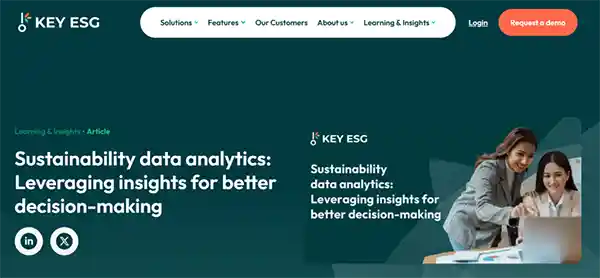
KEY ESG is built with a clear bias toward accuracy and usability, especially for firms juggling portfolio-level reporting.
The platform is built around a single data model that supports CSRD, IFRS S1 and S2, SFDR, TCFD, CDP, GRI, Invest Europe, EDCI, and California climate laws without requiring separate configurations for each framework.
Carbon accounting across all 15 Scope 3 categories is central to the platform, backed by more than 70,000 emission factors from DEFRA, the US EPA, and Climatiq, giving organizations the calculation depth needed to produce defensible, audit-ready emissions data.
Automated data collection requests, in-platform review and sign-off workflows, and a comprehensive audit trail keep the reporting process organized and assurance-ready from the point of data entry rather than as a post-process cleanup.
The Fund Manager Platform is one of KEY ESG’s most distinct offerings in the market.
Private equity firms can send automated data collection requests to all portfolio companies, aggregate results at the fund level, and apply built-in ESG data analytics to translate raw sustainability data into strategic insights, reporting to LPs against EDCI, SFDR, and other investor-facing frameworks from a centralized dashboard that allows analysis by fund, asset type, and individual portfolio company.
For operating companies, the Company Platform provides a step-by-step guided data collection experience that is deliberately designed to be accessible to non-specialist business users across finance, HR, procurement, and operations, not just sustainability teams.
This cross-functional usability is consistently cited in customer reviews as one of the platform’s strongest differentiators.
KEY ESG is a certified AWS software partner. It continuously updates the framework library as regulations evolve. A dedicated team of ESG specialists maintains alignment with the latest CSRD, SFDR, and other regulatory developments.
Key frameworks supported: CSRD, IFRS S1/S2, SFDR, TCFD, CDP, GRI, EDCI, Invest Europe, California Climate Laws.
Ideal for: Enterprise companies, private equity fund managers, and investment firms managing multi-entity ESG data and investor-grade reporting
3. Workiva
Best for: Listed enterprises integrating ESG with financial reporting
Workiva’s biggest advantage is not flashy features but structural reliability. Its core strength lies in a connected reporting architecture that links live data from ERP, CRM, and spreadsheet sources directly into reporting documents, eliminating manual data copying and the version control errors that come with it.
The platform’s ESG capabilities extend naturally from its established financial reporting foundation.
Organizations that already use Workiva for SEC filings and SOX compliance can extend the same governance infrastructure, audit trails, and workflow management to sustainability disclosures, making it a particularly practical choice for listed companies where ESG data needs to meet the same rigor as financial reporting.
Framework coverage spans CSRD, GRI, TCFD, ISSB, CDP, and SEC climate disclosure requirements, with pre-built templates and intelligent mapping tools that automatically format data to each framework’s specifications.
Workiva AI supports peer benchmarking, narrative drafting aligned to ESRS standards, and workflow automation across the reporting cycle.
The platform has been named a Leader in the IDC MarketScape for ESG Reporting and Compliance Management Applications.
Its primary audience remains large, listed enterprises, and teams without existing Workiva infrastructure should factor implementation complexity and custom enterprise pricing into their evaluation.
Key frameworks supported: CSRD, GRI, TCFD, ISSB, SEC climate rule, CDP, SASB.
Ideal for: Listed companies and large enterprises already using Workiva for financial reporting who need ESG disclosures integrated within the same audit-ready environment
4. Watershed
Best for: Large enterprises focused on decarbonization and Scope 3
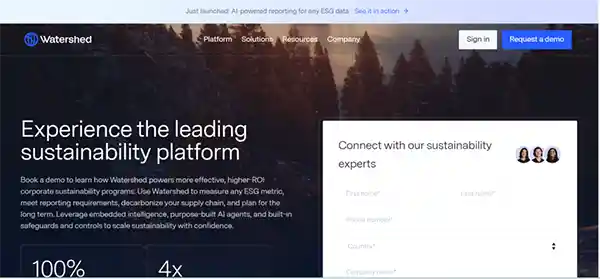
Watershed leans heavily into carbon intelligence, turning emissions data into something actionable instead of just reportable.
The platform was named a Leader in the 2026 Verdantix Green Quadrant for Enterprise Carbon Management Software.
At the measurement layer, Watershed provides access to a library of more than 500,000 emissions factors, automated data ingestion with built-in OCR, anomaly detection, and data standardization across Scope 1, 2, and 3.
AI-powered product carbon footprinting allows enterprises to decompose their supply chain emissions at the material and process level, which is particularly valuable for organizations where upstream purchasing emissions represent the majority of their total carbon footprint.
Reporting is supported across major frameworks through AI-assisted drafting, peer benchmarking, and full data lineage, enabling sustainability teams to accelerate disclosure preparation without sacrificing the accuracy and explainability required by external assurance.
Watershed also operates a structured carbon procurement program, enabling companies to purchase vetted carbon removal and avoidance credits through an aggregated RFP process that connects corporate buyers with high-quality climate projects.
Watershed is used by clients including Visa, Walmart, FedEx, Etsy, BlackRock, and other Fortune 500 organizations, with the platform managing more than 1 gigatonne of carbon dioxide equivalent across its portfolio.
Its primary orientation is climate program execution, and organizations seeking deeper governance, social metrics, or investor-reporting workflows alongside carbon may need to supplement with additional tools.
Key frameworks supported: GHG Protocol, CSRD, TCFD, ISSB, CDP, SEC climate rule, GRI. Ideal for: Large enterprises and financial institutions with mature sustainability teams and a primary focus on carbon management, Scope 3 supplier engagement, and decarbonization strategy.
5. Diligent
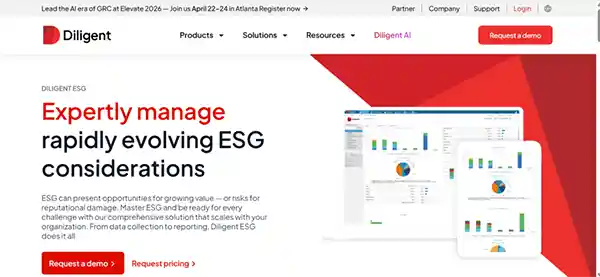
Best for: ESG integrated with governance, risk, and compliance
Diligent approaches ESG from a governance-first angle, embedding sustainability into board-level workflows rather than treating it as a separate function.
The platform serves a broad range of industries, including financial services, healthcare, energy, technology, retail, and government.
The ESG module within the Diligent One Platform provides centralized data collection, framework mapping, and disclosure reporting with built-in audit trail functionality and benchmarking tools that allow organizations to compare their ESG performance against peers.
Its integration with Diligent’s board management suite means that ESG data can flow directly into board presentations, governance reports, and stakeholder communications without manual extraction or reformatting.
Framework support covers GRI, SASB, TCFD, CSRD, and SEC climate disclosure requirements, with pre-built templates that reduce the customization burden for teams under time pressure from mandatory reporting deadlines.
The platform’s governance-native approach means ESG data is treated with the same oversight, version control, and accountability as other board-level information.
Diligent is better suited to organizations where governance, risk, and ESG convergence is the primary driver than to those whose dominant need is deep operational carbon accounting or supply chain Scope 3 management.
For sustainability teams whose requirements extend primarily to investor-grade emissions calculation or advanced supplier engagement workflows, a dedicated carbon accounting platform may offer greater depth in those areas.
Key frameworks supported: GRI, SASB, TCFD, CSRD, SEC climate rule.
Ideal for: Mid-market and listed enterprises that need ESG reporting integrated within an existing governance, risk, and compliance framework, particularly where board-level ESG oversight is a priority
How to Choose the Right Platform
The right choice depends less on features and more on where your complexity lives.
Enterprises with dominant Scope 3 and supply chain complexity should prioritize platforms with deep supplier engagement tooling and multi-entity data governance.
Investment firms and private equity fund managers will benefit most from platforms with dedicated fund-level aggregation and LP reporting capability.
Listed companies with SEC filing obligations will find value in platforms that connect sustainability disclosures directly to existing financial reporting workflows.
Regulatory coverage, audit readiness, and the ability to support multiple frameworks from a single dataset are baseline requirements that every enterprise shortlist should verify.
The platforms in this guide each meet those standards while serving meaningfully different organizational profiles, and identifying which profile matches yours most closely is the most reliable starting point for a successful evaluation.
Conclusion
ESG reporting in 2026 is no longer about producing a polished report once a year. It is about building a system that continuously captures, validates, and explains your impact.
The best platforms do not just help you comply. They help you operate with clarity, reduce risk, and make sustainability decisions that actually move the needle.
Frequently Asked Questions
What is the most important feature in an ESG platform?
Which platform is best for Scope 3 emissions?
Platforms like Watershed and Sweep stand out due to strong supplier engagement and deep emissions modeling.
Do companies need separate tools for ESG and financial reporting?
Not always. Platforms like Workiva allow both to exist in a single, connected reporting environment.
How long does ESG platform implementation take?
For enterprise setups, it can range from a few weeks to several months, depending on data complexity and integration needs.
Related Posts

8 Best AI Presentation Makers for Business-Ready Slides
Making a presentation doesn’t just mean designing slides. It’s about defining a clear structure, using defined logic, useful visuals, and…

Queue Management Software Troubleshooting Guide: 8 Common Faults and Fixes
The long wait times and ineffective management of customer queues can have a significant impact on customer satisfaction and business…
How to Use Similarweb Website Traffic Data for Competitor Research
Competitor research without traffic data is guesswork. You can guess who your rivals are, guess how big they are, guess…
Choosing the Right Hosting Model for Scalable Digital Platforms
The performance of digital business is directly related to website speed, uptime, and scalability. Slow page performance has a negative…

How Data-Driven Performance Tools Are Transforming Employee Recognition in Tech Companies
“People work for money but go the extra mile for recognition, praise, and rewards.” — Dale Carnegie (Writer & Teacher)…

Why Businesses Struggle to Collect Reliable Data from the Web
Almost every company that depends on data runs into the same problem: although they can find the data they need,…
Why Financial Data Recovery Matters for Businesses
Financial data supports every part of a business, directly affecting cash flow, payroll, tax reports, audits, customer billing, and daily…

CMMC Compliance Is Coming for Manufacturers. Here Is What You Need to Do
“Cybersecurity is much more than a matter of IT.” — Stephane Nappo (Cybersecurity Professional) For manufacturers working within the defense…

How Data-Based Tools Influence Learning Performance
Learning has transformed in the modern age with the integration of new technologies to help students and professionals prosper in…