
There may be confidential information that can be recovered from old devices.
Preventing Data Breaches During Hardware Disposal and Replacement
 Reviewed By Brijesh Kumar Singh
  Saipansab Nadaf
Updated on: Apr 20, 2026
Table of Contents
- Why Old Hardware Can Become a Major Data Security Risk
- Common Causes of Data Breaches During Device Disposal
- Best Practices for Secure Hardware Replacement and Data Protection
- The Role of Data Erasure and Recovery Prevention in Device Disposal
- How Businesses Can Build a Safe IT Asset Disposal Strategy
- Final Thoughts
- Frequently Asked Questions
Time-to-time replacement of hardware, servers, and storage is not a rare occurrence in businesses. But many organizations fail to think about one vital point when upgrading hardware: safe data disposal. Old devices may hold sensitive customer information, financial data, login credentials, and business files that can still be retrieved if data is not fully destroyed or erased.
While data breaches still cost businesses millions of dollars each year, IBM Security says that the misuse of devices is still a major threat to security.
With the increasing sophistication of cyber threats and the tightening of data privacy laws, businesses should consider hardware disposal a crucial component of their cybersecurity plan. Proper data destruction and replacement of devices ensure that risks of unauthorized access, compliance violations, and expensive data breaches are minimized.
Key Takeaways
- Sensitive data may be recoverable on old hardware
- If devices are disposed of improperly, the chance for data breaches rises
- Before hardware disposal, it is crucial to have secure erasure methods
- Physical destruction is a method of resisting the recovery of advanced data
- Optimized disposal policies enhance long-term cybersecurity protection
Why Old Hardware Can Become a Major Data Security Risk
Sometimes old hardware looks usable, but storage devices can still have recoverable information even after files have been deleted. Many companies mistakenly believe that removing sensitive data from a drive or folder is a one-time process that will erase the information. But in the real world, information can actually be recovered from devices with recovery software even if the devices are not securely destroyed.
Organizations need to be aware of the risks that lie within old hardware before they throw it away. So, how does this make old devices risky? Here is how:
- Recoverable confidential files
- Storage of login details and passwords
- Exposing customer data and employee information
- Financial record leaks
- Compliance violations
- Increased cybersecurity risks
If businesses do not dispose of their hardware properly, they risk facing legal sanctions, damage to reputation, and operational disruption. That’s why it’s crucial to secure data destruction as a part of any device replacement program.
Wondering if your data destruction is actually safe or not? Refer to the infographic below to find out.
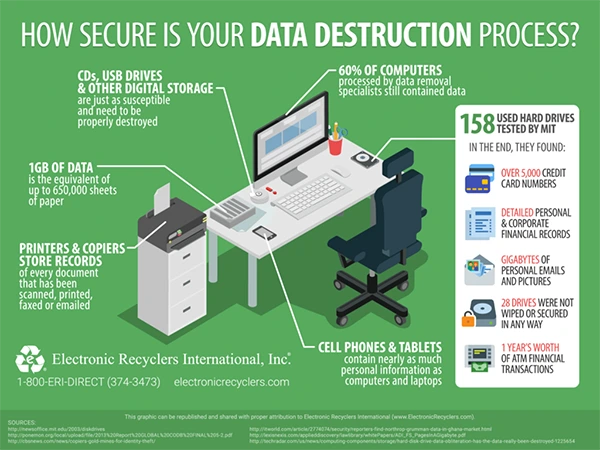
Common Causes of Data Breaches During Device Disposal
There are several common causes of data breaches during device disposal. Here are some of the typical causes of data breaches when devices are being discarded. An often overlooked cause of data breaches is when devices are being discarded.
An often overlooked cause of data breaches is a lack of proper disposal practices for old IT equipment. Unauthorized data access can occur even in the case of minor errors during disposal/replacement. Common disposal mistakes are:
- Using a disc-throwing device instead of wiping the data
- The absence of secure erasure of used hardware
- Improper recycling practices
- No record of disposal
- Inadequate access controls when replacing a device
- Failing to physically destroy damaged drives
Many organizations do not realize that files can be retrieved from used and carelessly disposed of storage media. Retired equipment can be a serious data exposure problem if not managed properly.
Best Practices for Secure Hardware Replacement and Data Protection
Companies always need to stick to the standard security protocols when replacing or discarding IT equipment. Proactive measures can minimise accidental disclosure of data and non-compliance. Essential security practices are:
- Develop a disposal policy that is recorded
- Before using sensitive devices, encrypt them
- Back up important files prior to disposal
- Limit access while replacing devices
- Check for complete data removal
- Keep disposal records and audit log
- For waste disposal, use certified disposal methods
Organizations should work with trusted vendors that provide certified data destruction services and compliance documentation. Specialized devices like hard drive shredders are also employed to physically secure hard drives and other storage media to make it more difficult to retrieve information. Digital erasure in combination with physical destruction gives better protection of very sensitive information.
The Role of Data Erasure and Recovery Prevention in Device Disposal
Removing files or formatting drives will NOT stop data recovery. If the proper erasure techniques are not employed, then deleted information can be recovered by modern recovery software. Secure methods permanently overwrite data so that it is practically impossible to recover.
Effective data erasure methods include multi-pass overwriting, cryptographic erasure, degaussing, physical destruction, and certified wiping software.
Physical destruction is an extra layer of security for highly sensitive data. A Hard Drive Shredder can be utilized by businesses to destroy drives that are beyond recovery. It’s particularly crucial for businesses that deal with financial data, healthcare details, legal documents, or government information.
When implemented correctly, proper procedures for ensuring and destruction can incur business meet privacy regulations and minimize future security risks.
DO YOU KNOW?
Data often stays physically on hard drives (even after the files are deleted) until the data is overwritten or destroyed.
How Businesses Can Build a Safe IT Asset Disposal Strategy
A secure IT asset disposal strategy can assist organizations in the safe and consistent management of their assets. Rather than disposing of things once in a while, businesses must take into account long-term processes. The key elements of a disposal strategy are asset inventory tracking, device lifecycle management, secure backup procedures, certified destruction processes, and vendor risk assessments
The staff should be trained on disposal policies; they must understand secure disposal procedures, data handling responsibilities, device return policies, and retired hardware security risks. This becomes a non-negotiable as frequent training decreases human error and increases overall awareness of cybersecurity. It also is important for businesses to update disposal rules periodically to meet changing security threats and regulations.
Final Thoughts
In the era of business digitization, the need to manage hardware and digital infrastructure is growing, and secure device disposal is becoming an important component of cybersecurity and compliance management. Unsecured or poorly disposed storage devices may be vulnerable to security threats that could compromise sensitive customer, employee, and financial information.
With proper measures like secure data destruction practices, certified erasure methods, and structured disposal policies, organizations can minimize the risk of data breaches during hardware replacement. When linked with physical destruction methods, digital wiping helps achieve higher resistance to unauthorized recovery attempts.
Securing the disposal of hardware is not just about protecting sensitive data; it’s about fostering customer confidence, ensuring compliance with regulations, and building trust in the long run.
Frequently Asked Questions
Why is using old hardware a security risk?
Would disposing of a computer be complete without the removal of files?
No, it is possible to recover deleted files without secure file erasure tools.
What is data destruction?
It’s where data stored is permanently erased or destroyed so that it can no longer be recovered.
What is the reason behind businesses having hard drive shredders?
They physically destroy storage so that sensitive data can’t be retrieved.
Related Posts

8 Best AI Presentation Makers for Business-Ready Slides
Making a presentation doesn’t just mean designing slides. It’s about defining a clear structure, using defined logic, useful visuals, and…

Queue Management Software Troubleshooting Guide: 8 Common Faults and Fixes
The long wait times and ineffective management of customer queues can have a significant impact on customer satisfaction and business…

How to Use Similarweb Website Traffic Data for Competitor Research
Competitor research without traffic data is guesswork. You can guess who your rivals are, guess how big they are, guess…

Choosing the Right Hosting Model for Scalable Digital Platforms
The performance of digital business is directly related to website speed, uptime, and scalability. Slow page performance has a negative…

How Data-Driven Performance Tools Are Transforming Employee Recognition in Tech Companies
“People work for money but go the extra mile for recognition, praise, and rewards.” — Dale Carnegie (Writer & Teacher)…

Why Businesses Struggle to Collect Reliable Data from the Web
Almost every company that depends on data runs into the same problem: although they can find the data they need,…

Why Financial Data Recovery Matters for Businesses
Financial data supports every part of a business, directly affecting cash flow, payroll, tax reports, audits, customer billing, and daily…

CMMC Compliance Is Coming for Manufacturers. Here Is What You Need to Do
“Cybersecurity is much more than a matter of IT.” — Stephane Nappo (Cybersecurity Professional) For manufacturers working within the defense…

How Data-Based Tools Influence Learning Performance
Learning has transformed in the modern age with the integration of new technologies to help students and professionals prosper in…