
How to Structure Aerospace Product Pages for Maximum Engagement
 Mahima Dave
In the aerospace sector, the quality of your product page often dictates whether you secure a lead or lose out to a competitor. Decision-makers in this industry demand more than just flashy graphics—they expect authoritative technical information, assurance of compliance, and a seamless user experience. An effective product page is more than a digital brochure: it’s a trust-building, lead-generating tool that can set your company apart. Working with an aerospace web design agency can ensure your page is crafted with sector-specific expertise and proven strategies.
Aerospace engineers, procurement teams, and executives seek detailed content that answers critical questions quickly. Strategic content structure and data-driven visuals on a product page enable these professionals to find the precise information they need. With stakes and standards so high, every element on the page must be built to instill confidence and guide the user’s journey toward conversion.
Understand Your Audience
A nuanced understanding of your audience underpins every aspect of the aerospace product page. Buyers and specifiers in the aerospace industry are highly technical; their purchasing decisions rely on specific details such as engineering tolerances, reliability records, interoperability, and regulatory compliance. Using language that matches their expertise boosts trust and authority, while including role-based navigation options—such as “Specifications for Engineers” or “Certifications for Procurement Teams”—further personalizes the user’s journey.
Craft a Compelling Headline
Headlines are the gateway to your story. Instead of simply stating the product name, transform your headline into a promise of value: “Enhance Flight Safety with Our Cutting-Edge Avionics Technology” is far more engaging than “Advanced Avionics System.” Addressing a key benefit or solving a common problem draws the reader in and sets expectations for the detailed supporting content that follows.
Provide Detailed Technical Specifications
Aerospace professionals will typically look for a block of technical specifications as their first point of reference. Present critical information—dimensions, weight, performance figures, environmental tolerances, electrical requirements, and certifications—in clearly labeled tables or bullet points for effortless scanning. Downloadable spec sheets and data tables add convenience for technical teams compiling multiple options. Use precision and consistency; any ambiguity undermines credibility and can halt the sales process.
Incorporate High-Quality Visuals
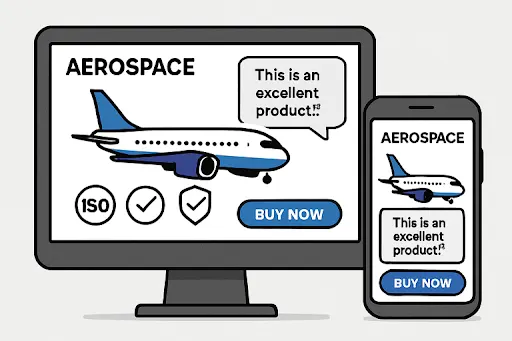
Visual assets can separate a high-performing product page from an average one. Aerospace is a visually technical field; detailed diagrams, 3D renders, exploded views, and demonstration videos help validate your written content. Each image or video should have a specific purpose—clarifying how a component fits into a system, showcasing its unique features, or illustrating the installation process. Professional photography and technical illustrations demonstrate attention to detail, a crucial signal to discerning aerospace buyers.
Highlight Certifications and Compliance
Safety and regulatory adherence are non-negotiable in the aerospace industry. Prominently display relevant compliance badges—such as those from the FAA, EASA, and established ISO certifications—in an easily seen section of the product page. Accompany each certification with a brief note describing its significance and, if possible, include links to official resources or downloadable certificates. This openness bolsters buyer confidence and streamlines procurement checks.
Include Customer Testimonials and Case Studies
Proven results and industry endorsements influence aerospace buyers. Showcasing a testimonial from a leading OEM or a case study highlighting the application of your product within a high-profile project provides social proof that builds trust. Where possible, quantify the performance improvements or operational benefits realized. Real-world validation helps move prospects from initial interest to action.
Optimize for Mobile Responsiveness
In a sector where decisions happen both in the office and on the move, your aerospace product page must be flawless on smartphones and tablets. Use responsive layouts, touch-friendly navigation, and fast loading times to cater to all users. Data from Statista shows that mobile access continues to rise, even in professional and technical fields. An optimized mobile experience reduces bounce rates and expands reach to all segments of your audience.
Implement Clear Calls-to-Action (CTAs)
To transform engagement into leads, your CTAs must be informative and highly visible. Use direct language—”Request a Quote,” “Download Specifications,” or “Speak with an Engineer”—and position buttons above the fold as well as after detailed specification sections. Experiment with design to make CTAs stand out without distracting from technical content. Track performance using analytics to refine messaging.
Delivering an aerospace product page that exceeds user expectations requires a blend of technical mastery, transparent compliance, visual clarity, and digital fluency. By implementing these best practices, you establish your company as a leader in both digital experience and aerospace solutions.
Conclusion
A high-performing aerospace product page is the result of deliberate strategy, technical precision, and a deep respect for the expectations of an exacting audience. By aligning detailed specifications with compelling visuals, clear compliance signals, and intuitive user journeys, you create an experience that not only informs but also reassures and persuades. In an industry where trust, safety, and performance are paramount, every element of the page should work together to reduce friction and reinforce credibility. When executed correctly, an aerospace product page becomes a powerful competitive asset, turning informed visitors into confident decision-makers and qualified leads.

Making a presentation doesn’t just mean designing slides. It’s about defining a clear structure, using defined logic, useful visuals, and…

The long wait times and ineffective management of customer queues can have a significant impact on customer satisfaction and business…
Competitor research without traffic data is guesswork. You can guess who your rivals are, guess how big they are, guess…

The performance of digital business is directly related to website speed, uptime, and scalability. Slow page performance has a negative…

“People work for money but go the extra mile for recognition, praise, and rewards.” — Dale Carnegie (Writer & Teacher)…

Almost every company that depends on data runs into the same problem: although they can find the data they need,…

Financial data supports every part of a business, directly affecting cash flow, payroll, tax reports, audits, customer billing, and daily…

“Cybersecurity is much more than a matter of IT.” — Stephane Nappo (Cybersecurity Professional) For manufacturers working within the defense…

Learning has transformed in the modern age with the integration of new technologies to help students and professionals prosper in…