
Timely data provides you with immediate observations on any change, allowing management of risk to occur upfront, to avert risks from escalating to failure.
How Modern Infrastructure Depends on Real-Time Data
 Mahima Dave
Updated on: Aug 28, 2025
Table of Contents
- Why Real-Time Data is Changing the Way We Build and Manage Things
- How Instant Insights Help Keep Everything Running Smoothly
- The Smart Ways Cities and Companies are Using Data Every Day
- Making Decisions Faster Without Losing the Human Touch
- Getting Infrastructure Ready for a Future That Never Waits
- Frequently Asked Questions
KEY TAKEAWAYS
- Real-time data helps engineers design stronger, more responsive infrastructure systems.
- Instant insights prevent costly failures by detecting small problems early.
- Smart cities use data for efficiency, safety, and sustainability improvements.
- Human judgment remains essential, balancing data-driven actions with ethical decisions.
There’s no denying the importance of real-time data in infrastructure. A report mentioned that data-driven infrastructure could create $1 trillion in annual savings globally through improved efficiencies and reduced failures.
The design, construction, and management of our infrastructure is changing. In transportation, energy, and urban planning, real-time data allows for better decisions, real-time decisions to avoid disruptions and make more efficient use of our resources.
So, in this article, I’ll mention how real-time data boosts infrastructure, how it is used to make decisions, and how solutions like Pacific DAS take us a step closer to a faster-smarter future.
Why Real-Time Data is Changing the Way We Build and Manage Things
The modern use of real-time data is revolutionizing the planning, design, construction, and operation of infrastructure. Engineers and designers will no longer need to rely on stale data, but on real-time information to understand the status of the systems they design.
With the use of real-time data, for example, sensors on bridges and roadways can measure stress loads in real-time so that authorities charged with that infrastructure can react before the problem becomes a costly failure.
Having a near-real-time understanding of conditions will promote smarter maintenance of infrastructure systems, which, in turn, will extend the lifespan of the system. Real-time data will allow us to make infrastructure systems much more robust, flexible, and responsive to modern demands.
How Instant Insights Help Keep Everything Running Smoothly
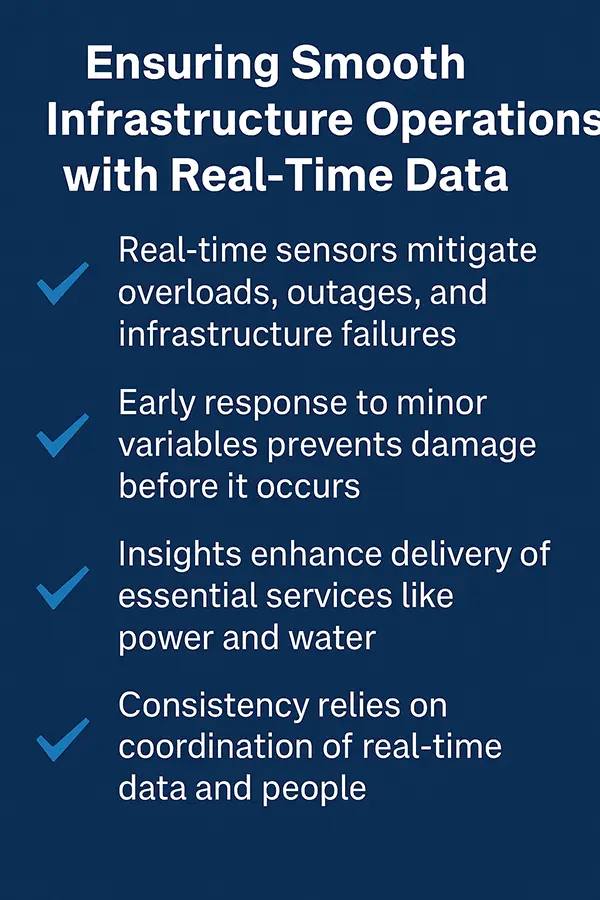
From transportation systems to energy grids, real-time awareness is an important capability for keeping essential services functioning smoothly. City traffic sensors provide cities with the ability to change traffic signals, depending on congestion, in real-time.
This constant “flow” of information can mitigate overloads, outages, or dangerous failures by tracking minor operating variables before failure, affording managers the ability to respond early instead of waiting until damage has occurred.
By working in conjunction, this allows for infrastructure that works with and for people, and ultimately provides consistent delivery of essential services that people expect every day, whether it be electricity, clean water, or an adequate transport journey. Below, you can see what things you need to do so things keep running smoothly.
The Smart Ways Cities and Companies are Using Data Every Day
Cities and businesses are starting to increasingly adopt real-time data to enhance service, efficiency, or overall well-being. Smart cities can leverage connected devices to track anything from air quality to waste collection schedules.
Companies can also utilize real-time data in logistics, allowing a logistic company to move goods faster, optimize routes, and meet consumer demands in a more timely manner. Construction companies are now starting to adopt live monitoring tools that provide transparency to allow projects to stay on schedule and within budget.
This approach supports the idea that real-time data is more than a technological enhancement; it is about creating better living and working environments. By leveraging continuous and reliable measures of information.
Making Decisions Faster Without Losing the Human Touch
Real-time data supports decision-making by providing timely information; however, humans are still central to decision-making. Automated systems may analyze material, spot patterns, and suggest actions, but ultimately, humans use judgment to make the decisions that are actionable, ethical, and aligned with community needs.
For example, predictive traffic systems may signal a need to reroute vehicles, but municipal officials will be conscious of the impact on the public. In a similar vein, real-time health data may signal a risk of deterioration.
This approach clarifies how we can build partnerships that enable humans, rather than replace humans. Transport infrastructure will respond to data promptly, but will never forget about empathy and accountability.
Getting Infrastructure Ready for a Future That Never Waits
To be ready for future infrastructure, real-time data is the solution. Predictive analytics of real-time data sources can enable a system to respond to a change before it knows there is a problem, either from a piece of equipment falling into disrepair. Or from the impacts of a hurricane on the resilience of an urban system.
As urban areas grow and demands on technology increase, it will be integral to the infrastructure to be agile. Real-time data affords us the agility to grow and change an infrastructure, as opposed to having to create an entirely new project.
In whatever form it may take in the future, whether that is an autonomous vehicle traveling on smart roads, or wind or solar energy that adjusts itself based on use. The future will depend on our engagement with the everyday in real-time. This is because of the data that lies it out for us every moment.
Frequently Asked Questions
What is the value of real-time data to infrastructure management?
What are cities and companies currently using real-time data for?
Managing traffic flows, air quality, logistics, construction progress, operational efficiency, reducing costs, and providing a healthy and smart living and working environment.
Can real-time data replace human decision-making in infrastructure?
No. Real-time data’s role is to provide meaningful information and automate aspects of its role. Human judgment is the bedrock of ethical, pragmatic, and community-minded decisions in infrastructures.
Related Posts

8 Best AI Presentation Makers for Business-Ready Slides
Making a presentation doesn’t just mean designing slides. It’s about defining a clear structure, using defined logic, useful visuals, and…

Queue Management Software Troubleshooting Guide: 8 Common Faults and Fixes
The long wait times and ineffective management of customer queues can have a significant impact on customer satisfaction and business…

How to Use Similarweb Website Traffic Data for Competitor Research
Competitor research without traffic data is guesswork. You can guess who your rivals are, guess how big they are, guess…

Choosing the Right Hosting Model for Scalable Digital Platforms
The performance of digital business is directly related to website speed, uptime, and scalability. Slow page performance has a negative…

How Data-Driven Performance Tools Are Transforming Employee Recognition in Tech Companies
“People work for money but go the extra mile for recognition, praise, and rewards.” — Dale Carnegie (Writer & Teacher)…

Why Businesses Struggle to Collect Reliable Data from the Web
Almost every company that depends on data runs into the same problem: although they can find the data they need,…
Why Financial Data Recovery Matters for Businesses
Financial data supports every part of a business, directly affecting cash flow, payroll, tax reports, audits, customer billing, and daily…

CMMC Compliance Is Coming for Manufacturers. Here Is What You Need to Do
“Cybersecurity is much more than a matter of IT.” — Stephane Nappo (Cybersecurity Professional) For manufacturers working within the defense…

How Data-Based Tools Influence Learning Performance
Learning has transformed in the modern age with the integration of new technologies to help students and professionals prosper in…