Data is not just an IT responsibility anymore; it has become a leadership priority. How? Well, every decision a company makes, be it about adopting some new tool or entering new markets, data has a significant say in it. And when leadership treats security as an afterthought, it does not just create risk, it creates blind spots.
IBM’s Cost of a Data Breach Report revealed that the global average cost of a breach is $4.45 million, and the organizations with strong security governance and leadership involvement reduce both costs and recovery time to a great degree.
To put it in simple terms, businesses don’t fail on security because of tools; rather, the misalignment at the top is the reason behind their “unsuccessful” attempts.
Key Takeaways
Data security is a leadership responsibility, not just an IT function.
Strong security culture starts with executive priorities and decisions.
Layered strategies reduce risks across systems and teams.
Data analytics enables proactive threat detection.
Continuous improvement is essential for long-term security.
The Role of Leadership in Building a Strong Data Security Culture
Effective data security begins with attitude and not technology. The leader directly influences the seriousness with which the organization treats security in the organization. When executives give more priority to speed than safety, teams do not lag. Security is, however, a normal operation when the leadership focuses on accountability and awareness.
This is why a large number of workers are turning to such programs as a master’s in IT project management, where security, risk management, and leadership are not taught individually anymore.
Effective leaders’ data should be treated as a business resource and not only a technical resource, promote security awareness among teams, proactively invest in training and tools, and ensure the inclusivity of security in strategic planning. Culture is never constructed through policies; it is constructed through a series of decisions of a leader.
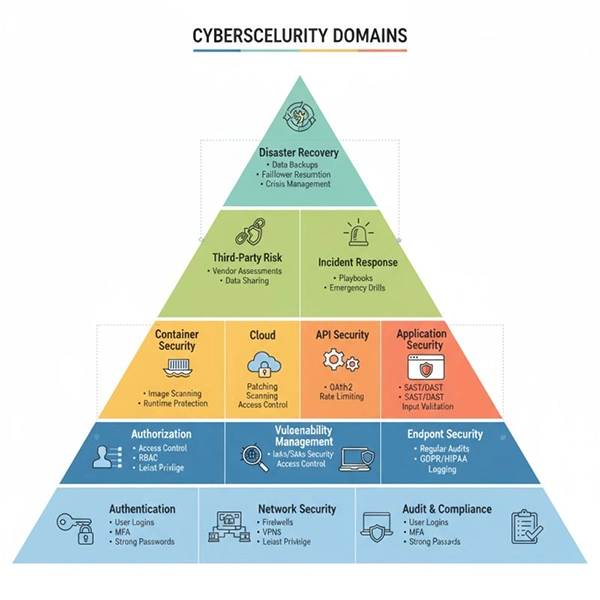
INTRIGUING INSIGHTS The infographic below illustrates the twelve critical layers of modern cyber protection. Take a look!
Key Data Security Strategies Every Organization Should Implement
Effective data security is not about a single solution, but about the concerted efforts of layers of solutions. Here are the essentials:
Access Control: Be sure that sensitive data gets into the right hands.
Encryption: Secure data in transit and at rest.
Periodic Audits: Find the weak points ahead of the attackers.
Incident Response Planning: Be prepared to take immediate action when there is a problem.
Its objective is straightforward: to minimize risk in all levels of access, storage, and sharing of data.
Leveraging Data Analytics for Proactive Security Management
The cybersecurity of modern days is proactive rather than reactive. Data analytics helps organizations to detect abnormal behavior in real time, determine trends that can signify threats, oversee the activity of the monitoring systems, and make better decisions based on facts.
Businesses can do this instead of waiting until there has been a breach before they act, and in most cases, the damage has already been done. Used in the right way, analytics enhances performance and enables teams to perform better, speed up decisions, and be less uncertain.
Common Data Security Challenges Organizations Face
In spite of the proper tools, most organizations find it difficult to cope with:
Human Errors: When employees click phishing links or handle data in a bad way.
Data Silos: Data in fragmented systems.
Visibility: Not being aware of the location of sensitive data.
Fast Digital Change: Faster adoption than securitization.
Changing Threats: Cyberattacks are getting more advanced with time.
These difficulties bring out one important point: security does not exist in a vacuum. It involves constant monitoring and changing.
Best Practices for Strengthening Enterprise Data Protection
Organizations must aim for consistency and clarity in order to create a robust data security framework. For that, some best practices are proven:
Adoption of zero-trust security
Holding frequent security training for employees
Maintaining systems and software
Saving important information on a regular basis
Real-time alerts on monitoring
Above all, align security strategies and business objectives. Adoption is so much easier when security promotes growth rather than retards it.
Conclusion
It is not only the security of the systems anymore, but also the security of the future of your business. It is not IT alone that has that responsibility; all of it starts with leadership.
When leaders are focused on security, build harmonious teams, and invest in the appropriate strategies, they make organizations that are not just safer but also confident, efficient, and resilient. In the modern world, business success does not come just in the speed of growing the business, but in preserving what you create.
Frequently Asked Questions
What is the importance of leadership in data security?
Leaders establish priorities, distribute resources, and determine the extent to which security is taken seriously within an organization.
Which is the largest data security threat to business?
Some of the most prevalent risks include human error and lack of awareness.
How is data analytics essential to enhancing security?
It assists in identifying abnormal patterns and possible threats on a real-time basis.
Is it feasible to put up robust data security measures in small businesses?
Yes. Such simple procedures as access control, backups, and training can greatly enhance security.

 Saipansab Nadaf