
The importance of data quality in AI cannot be overstated: poor data quality is one of the most common reasons AI initiatives fail.
What Happens to Enterprise Data Integrity When AI Gets Involved
 Reviewed By Brijesh Kumar Singh
  Mahima Dave
Updated on: May 05, 2026
A few years ago, the majority of businesses were still debating whether or not to use AI at all. While some quietly continued using traditional methods and soon discovered they were falling behind, others jumped on the bandwagon right away. Nowadays, practically every division in every company is deeply involved.
Using internal brand data, marketing teams are developing comprehensive marketing campaigns. Finance teams forecast more accurately than ever before by utilising historical data. In order to create even more intelligent chatbots, data science teams are refining models based on actual customer transcripts. The adoption process has been quick.
However, the obvious problem that many businesses are overlooking is that their governance procedures just haven’t kept up. Safety and data security frameworks have been neglected in the name of innovation, and those that were in place were never intended for this AI world. These autonomous systems consume data, learn from patterns, make decisions on their own, and act accordingly.
All of this occurs in ways that the original regulations could not have predicted, creating a new level of risk that requires quick attention. AI data security is becoming a major concern for businesses handling sensitive data as the use of AI in enterprise settings picks up speed.
Key Takeaways
- Understanding how training data impacts AI data security.
- Explaining why shadow AI creates AI data security risks
- Analyzing how prompt injection threatens AI data security
- Realising why AI Data Security Is Becoming a Critical Enterprise Priority
How Training Data Impacts AI Data Security
AI models learn from data. They are all aware of that. The consequences of inaccurate data—whether intentional or accidental—are something that fewer people understand.
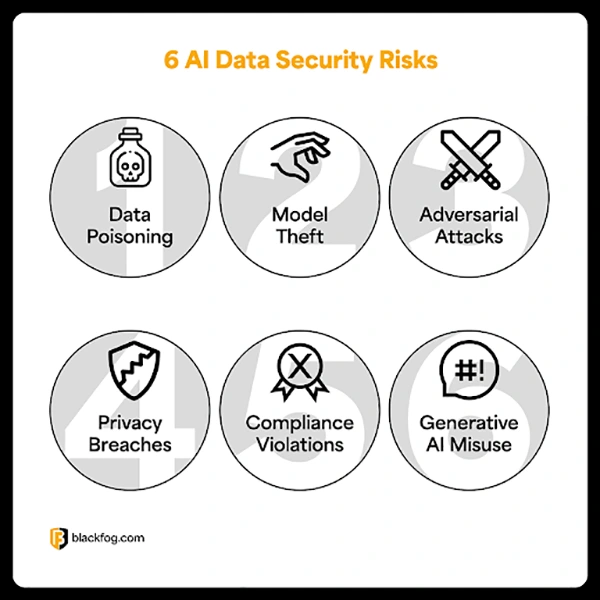
This is referred to as “data poisoning” in the security industry. If an attacker gains access to a training dataset, they can manipulate it covertly and change the behaviour of the AI model without raising any red flags. Researchers from Anthropic and the UK AI Safety Institute demonstrated that inserting just 250 malicious documents into a training dataset could lead to the creation of a backdoor in the AI model. It doesn’t matter how large the dataset is. If 250 documents contain a backdoor, the AI model will have a backdoor too, compromising the whole system.
For the enterprise teams that are building or fine-tuning the models using their proprietary data, this finding should land pretty hard.
Some of the most sensitive data you have is fed into these models; if that data is compromised at any point during the process, the AI model will reflect and magnify the compromise. This is one of the core challenges AI data security frameworks are designed to address.
Some of the major AI data security risks are as follows :
Why Shadow AI Creates AI Data Security Risks
Shadow AI is a problem that lurks in the background of most businesses, even with AI tools that are locked down and properly governed.
Without the company’s consent, employees use external AI tools. Without anyone in IT being aware of it, they run queries against proprietary data, upload internal documents to free-tier platforms, and paste client data into chat interfaces.
A financial analyst who shares their quarterly results with an external AI tool (such as an LLM) to generate a quick report has just exported confidential data and imported unverified analysis from the same tool.
That’s two problems for the price of one. The primary issue isn’t that workers are handling their data carelessly. Most just want to finish the task more quickly. The lack of visibility into the data that is leaving the company is the issue.
AI data security frameworks exist specifically to close this gap, giving enterprises the ability to enforce policies across both sanctioned and unsanctioned AI usage. Without this level of oversight, shadow AI creates a compliance risk that compounds over time.
How Prompt Injection Threatens AI Data Security
AI models can make mistakes in areas other than training and fine-tuning. When the models are actively processing requests, another danger appears. We refer to this danger as prompt injection.
When someone creates particular inputs into an AI model in a way that enables it to circumvent its inherent safety limitations, this is known as prompt injection. Prompt injection can be done for a variety of reasons, but typically it’s done to get around content restrictions, extract sensitive data that the model was trained on, or trick the model into doing things it shouldn’t.
A successful prompt injection attack can reveal data that access controls were meant to protect for enterprise applications where AI agents interact with internal systems and customer data.
The challenge is that although AI models are capable of processing natural language, it is fundamentally more difficult to distinguish between a malicious request that has been deceptively disguised and a legitimate request.
Runtime monitoring, input validation, and guardrails will help. But none of them will be a silver bullet, which is exactly why they need to work together. AI data security controls must account for these runtime risks, not just training vulnerabilities.
What This Means for Data Governance
Adoption of AI does not eliminate current governance structures. It makes them stretch. Regulatory compliance, encryption, and access control are still important concepts. The number of locations where data flows, how it is used, and the emergence of new attack surfaces are all altered.
The majority of the fixes are not drastic, which is good news. They are extensions of the skills that security teams already possess, applied to a more expansive and dynamic range of situations. Poisoning risk is decreased by checking training datasets for accuracy and completeness before they are used with a model.
Implementing strong safeguards around how business software handles sensitive information limits exposure during both AI and non-AI workflows. Monitoring employee use of generative AI tools, including the unauthorized ones, closes the shadow AI gap before it turns into a compliance headache. Additionally, establishing a clear internal policy about what data can and cannot be used in AI systems provides teams with a framework for quicker decision-making when new tools become available.
Why AI Data Security Is Becoming a Critical Enterprise Priority
Integrating conventional data governance techniques into AI workflows is necessary for effective AI data security.
Organizations that approach AI as a data governance challenge rather than just a technological one will be the ones that successfully navigate this. The models are going to continue improving.
Whether the data they depend on deserves the trust placed in it is a different question entirely, and one worth answering sooner rather than later.
Conclusion
Data integrity not only faces risks when AI enters enterprise systems, but it also gains additional security.
The true difficulty is in how carefully companies handle governance, oversight, and data quality. Depending on the inputs and controls used, AI can increase both accuracy and errors.
Ultimately, integrity is not lost to AI; rather, it is altered by the way humans decide to direct it.
Frequently Asked Questions
Why is data integrity important in AI?
Is IT how to ensure AI systems comply with enterprise data privacy standards?
Key strategies include minimising data collection, implementing robust data governance policies, and deploying privacy-enhancing technologies throughout the AI lifecycle, from data ingestion and model training to deployment and inference.
What are the four pillars of data integrity?
It’s important first to understand the four core pillars it’s built on: data integration, quality, location intelligence, and enrichment.
What are the five importance of integrity?
It builds trust and respect, fuels professional success, promotes moral responsibility, sets inspiring examples, and enhances self-respect.
Related Posts

8 Best AI Presentation Makers for Business-Ready Slides
Making a presentation doesn’t just mean designing slides. It’s about defining a clear structure, using defined logic, useful visuals, and…

Queue Management Software Troubleshooting Guide: 8 Common Faults and Fixes
The long wait times and ineffective management of customer queues can have a significant impact on customer satisfaction and business…

How to Use Similarweb Website Traffic Data for Competitor Research
Competitor research without traffic data is guesswork. You can guess who your rivals are, guess how big they are, guess…

Choosing the Right Hosting Model for Scalable Digital Platforms
The performance of digital business is directly related to website speed, uptime, and scalability. Slow page performance has a negative…

How Data-Driven Performance Tools Are Transforming Employee Recognition in Tech Companies
“People work for money but go the extra mile for recognition, praise, and rewards.” — Dale Carnegie (Writer & Teacher)…

Why Businesses Struggle to Collect Reliable Data from the Web
Almost every company that depends on data runs into the same problem: although they can find the data they need,…

Why Financial Data Recovery Matters for Businesses
Financial data supports every part of a business, directly affecting cash flow, payroll, tax reports, audits, customer billing, and daily…

CMMC Compliance Is Coming for Manufacturers. Here Is What You Need to Do
“Cybersecurity is much more than a matter of IT.” — Stephane Nappo (Cybersecurity Professional) For manufacturers working within the defense…

How Data-Based Tools Influence Learning Performance
Learning has transformed in the modern age with the integration of new technologies to help students and professionals prosper in…