
No, they are still in use. Because many readers have their personal choice not to use digital media for learning or reading.
Evolution of Online Libraries in the Big Data Era: The library Shift
 Reviewed By Brijesh Kumar Singh
  Kartik Wadhwa
Updated on: Apr 14, 2026
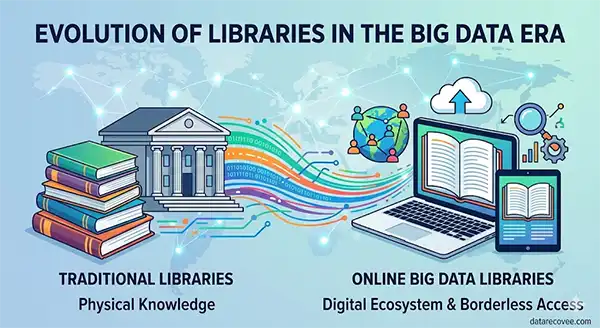
For decades, libraries have been a major source of knowledge – a simple and effective way to get access to a wide range of books. But the availability of books, journals and archives based on locality and membership has always been a major issue.
In today’s digital age, knowledge is no longer bound up with fixed timings and compact spaces. Online libraries have made knowledge like an open source API for everyone.
All became possible with Big Data – smart knowledge ecosystems served with personalized behavior with real-time access.
Sounds convenient and effective, right? Keep reading to discover the Zlibary shift and take advantage of evolved online libraries in today’s big data era.
Key takeaways
- Online libraries are highly in use, as they allow users to learn from anywhere in the world.
- Big Data helps platforms to manage a wide range of files and provide all content at once.
- Advanced analytic features help platforms to understand the user needs and provide relatable and personalized content.
The Rise of Online Libraries and Open Access Culture
The rise of the internet has already shared the idea that information can now be easily available to everyone. From then on, academic institutions started sharing journals and research papers online. This advancement crossed the boundaries of traditional publishing.
As a result, online libraries were introduced to serve the better and broader demand for information. Students, learners and other professionals stopped looking for physical collections and paid subscriptions. Instead, they selected platforms where knowledge was freely available and could be read from anywhere in the world.
Furthermore, open access culture played a central role in the change. Universities, organizations, and communities truly believed that education should be easily available for everyone. Over time, digital libraries became the major source for students, learners, and even random readers.
As a result, this became the starting point of new expectations that knowledge should be at the fingertips of every individual, irrespective of their profession.
How Big Data Transformed Digital Libraries
With the popularity of sharing knowledge through online platforms, managing countless files has become an issue. And this is exactly where Big Data brought considerable transformations to the online libraries.
Below are the major changes that were brought through Big Data:
Intelligent Search and Data-Driven Discovery
Traditional libraries were dependent on manual classification. To get a desired resource, one needed precise knowledge or exact title words. But with Big Data’s advanced search features, one can use relevant words and other contexts to get relevant results. This saves much time and effort for finding a relevant book or journal.
Personalized Content Recommendations
Modern data analytics features help platforms to better understand the context, reading preferences and other choices of the readers. After this, it provides other relevant results to the user that are more relevant for them to read.
This also saves time for readers to easily get the personalized content without further search. For instance, a reader looking for cybersecurity things will automatically get related journals and research papers for it.
Scalable Storage and Instant Access
The major issues for the digital platforms were to store a huge amount of knowledge data and share it with various users at once. This easily got stored with Big Data. Distributed databases allowed platforms to provide millions of books to users.
As a result, knowledge is available for every demand and without any wait. This way, ideas spread without any borders.
Interesting Fact
According to UNESCO, more than 60% of the global population now has internet access, which means that they can easily get access to digital libraries. (Source: UNESCO)
The Shift Toward Borderless Knowledge Access
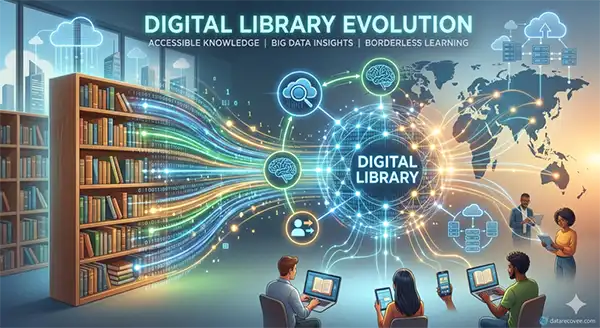
One of the most effective benefits of digital libraries is the access to knowledge without any borders. One can start learning or reading their favorite content from any location in the world. They just need to have internet connectivity or they can use downloaded content.
One student can take advantage of the curriculum of various institutes. This not only evolved the user expectations but also changed the perspective to consider knowledge as a universal right rather than something exclusive.
This way, the idea of a physical library went global and switched to a constantly accessible digital environment.
Balancing Access and Ethics in the Digital Knowledge Era
While digital access has brought various advantages in gaining knowledge, it has also brought some complex ethical debates. Issues related to copyright, property rights and fair compensation prices are the main problems in online libraries.
On one side is the wish to provide every available content to every individual and on the other side is the real-life need for publishing environments that support creators and researchers.
According to the industry experts, the future of digital libraries will probably depend on relying on a solution that balances required access and ethical responsibility.
Above this, many students experience loss of data from using unauthorized platforms. To avoid this, learn how to prevent data loss during online learning.
Conclusion: Redefining Libraries in a Data-Driven World
Modern libraries have transformed from those shelves to digital content. This became possible with Big Data, which makes platforms possible to work as a smart system to suggest and deliver knowledge.
This shift made the knowledge access faster, easier and global. Along with this transformation, the ethical reminds us that the progress needs to be structured with the writer’s growth.
In the end, the digital libraries will keep evolving and the main motive to make knowledge meaningful and usable will be served.
Frequently Asked Questions
Are traditional libraries completely removed from use?
How did Big Data make this possible?
Big Data allows platforms to provide huge amounts of content to users at once and on a single platform. Also, it provides personalized recommendations and more.
Are these digital contents freely available?
Yes, most of the content is freely available on the digital platforms, but some exclusive content still needs a premium account.
Related Posts
8 Best AI Presentation Makers for Business-Ready Slides
Making a presentation doesn’t just mean designing slides. It’s about defining a clear structure, using defined logic, useful visuals, and…
Queue Management Software Troubleshooting Guide: 8 Common Faults and Fixes
The long wait times and ineffective management of customer queues can have a significant impact on customer satisfaction and business…
How to Use Similarweb Website Traffic Data for Competitor Research
Competitor research without traffic data is guesswork. You can guess who your rivals are, guess how big they are, guess…
Choosing the Right Hosting Model for Scalable Digital Platforms
The performance of digital business is directly related to website speed, uptime, and scalability. Slow page performance has a negative…
How Data-Driven Performance Tools Are Transforming Employee Recognition in Tech Companies
“People work for money but go the extra mile for recognition, praise, and rewards.” — Dale Carnegie (Writer & Teacher)…

Why Businesses Struggle to Collect Reliable Data from the Web
Almost every company that depends on data runs into the same problem: although they can find the data they need,…

Why Financial Data Recovery Matters for Businesses
Financial data supports every part of a business, directly affecting cash flow, payroll, tax reports, audits, customer billing, and daily…

CMMC Compliance Is Coming for Manufacturers. Here Is What You Need to Do
“Cybersecurity is much more than a matter of IT.” — Stephane Nappo (Cybersecurity Professional) For manufacturers working within the defense…

How Data-Based Tools Influence Learning Performance
Learning has transformed in the modern age with the integration of new technologies to help students and professionals prosper in…