


Yes. Data science builds the environment for data recovery to handle datasets fluently. Much of this data is useful for recognizing patterns and statistical investigation that supports recovery.
Data Science and Data Recovery: Career Opportunities in a Growing Field

Data is becoming important in day-to-day life; in every career opportunity, you’ll find that data is important information for an organization to deal with. If data is corrupted and the storage system fails to recover data, then it creates a mess for professionals.
Then comes a data science or data recovery specialist who only deals with data. Differences on work of data science is to extract information from data, while data recovery finds lost or corrupted data from a drive or system.
This pattern is seen everywhere and is useful for every professional for upscaling their businesses. Here you will learn the skills for better advancement in the careers that are in demand.
Let’s explore the technical careers further.
Why Data Science Fits Data Recovery
The process you digest in data recovery that it emerges from a data science field. Basically, data recovery helps data science to maximize its potential for business growth.
Most professionals focus on recovering data that is misplaced or misguided in storage devices. The work of recovery experts focuses on file directories, storage databases, logs, and metadata for corrupted information.
But data science works differently, and it generally focuses on visible data, recovered data, or hidden data to extract meaningful insight through collecting, cleaning, structuring, modeling, and visualization. It plays a major part in building systems and structuring architectures where data can flow easily.
Both professions are lengthy and time consuming works and can not replace even having some similarities. If you want to get detailed system knowledge, then data recovery and file management guidance will help you to understand better.
Career Paths Around Digital Data
The skills never stop you from fixing your head into one path. This creates a broader prospect to explore and work with data. Several domains you can find and suits with your technical knowledge.
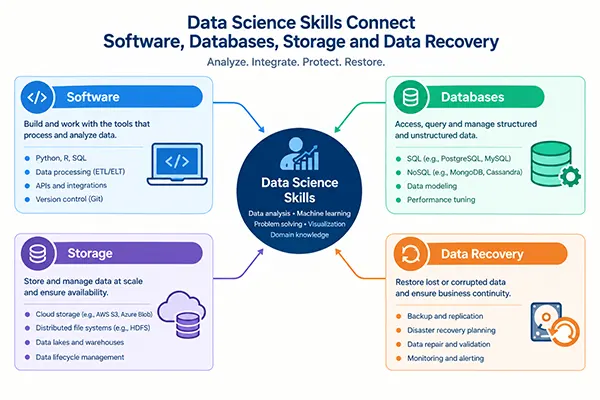
If you have professional skills in statistics, machine learning, programming, or cloud computing, you can build a career path towards data analytics, data engineering, business analyst, reporting specialist, recovery software, and cybersecurity expert. All of these involve data management and business queries.
These backgrounds vary depending on coding languages, and this should be in your hands. Model the data with a security access system, creating careers. All existing systems deviate towards data management. Digital data is becoming useful and exploitable.
The crux of finding is to observe the data periodically and see what it can do for you to enhance career paths.
What Formal Training Can Add
There are several upgrading skills platform in the digital environment. But you may prefer to get a professional degree where you can gain technical knowledge and experience with real-world data.
To learn these skills, refer to Schiller International University’s Masters in Data Science degree helps you to learn data handling applied in domains where techniques matter the most. Data modeling with Python, machine learning, data structuring, SQL database management, Data visualization, statistical analysis, and Advanced R language are taught in their program with 30 American credits.
These skills add to your professional career in data management, which is useful in cloud databases, network structures, and all data domains.
Study with the skills added to your behaviour in data into meaningful insights to produce technical foundation to solve difficult queries in modelling. Get experience by adding projects and practical implication of data provided in domains where you suppose to explore.
The Data Skills Worth Building First
At the very beginning, you should collect information from where your interests coincide. Then start with structuring their fundamental aspects in real life. After that, learn skills accordingly:
- Python and SQL: Both skills have high demand in database management. Extraction of data into a pipeline where it’s beneficial. Unmasking complex structures.
- Statistics: baseline for data handling, making data-driven decisions.
- Data visualisation: Finding patterns in datasets into dashboard reports helps business people.
- Cloud and database fundamentals: This formation helps you to distribute knowledge packets into various systems through cloud servers.
- Machine learning basics: Scattered data are hard to handle; predict data to gather and form a channel to use.
- Data engineering: architect the structure used in data formation that can help various databases.
Recommend adding systems and storage management, where SSDs devices, partitions, and metadata, which will help in data recovery.
Arrange every brick in their places to build a perfect wall. This is a very foundational skills should maintain a grip on it. Dont distract; stick with it.
Where Everyday Business Data Enters the Picture
Data inflow in every system you see around is very helpful to build the system to manage in a single environment. Several companies record data from employees, customers, executive partners, and stakeholders to analyze their operations.
DataRecovee also added support to the system where you can explore the system and file management strategy. Configure a data loss emergency checklist where risk assessment includes security protocols.
Let’s understand with an example: assume you are running a holiday rental company where you gather information on booking details, guest info, payment lists, and methods. All such data is piped into an operational system software like vacation rental management software. It simply narrows your data into one channel.
Technical background professionals perform tons of data flows into a system through dashboard reports that add insights to encourage the growth of businesses.
Why the Field Can Reward Adaptable Skills
In advancement of demand in various sectors of data science leads people to upgrade their skills in this field.
The U.S. Bureau of Labor Statistics shows that the expansion of scope in data science creates around 35% of jobs in all domains. This data is estimated from 2025 to 2035, with roles exploding, with 24,800 active hires every year. An AI-enabled system generates the demand to foreground this opportunity in shaping the future.
The understanding of how data is evolving creates greater demand to skill their career toward it. Statistics helps to investigate the pattern of customers; data recovery can also manage the datasets to recover damaged data from local servers to cloud technology.
Every system is changing towards AI automation. Build technical approach catches your ability to handle data better.
Conclusion
You need to know the techniques that build your career. Data recovery doesn’t follow title requirements, but start with managerial skills. Data analytics is a foundational approach you should follow. First, know the data workflows and the system that builds than focus on their management to align demands.
All useful information can be achieved when you decide on a career path. No data is useful when you don’t know how to create an impact using such details. Every professional works on models where data changes shift meaning to real-world problems.
Frequently Asked Questions
Is Data Science Useful for Data Recovery?
Do I Need a Master’s Degree to Work With Data?
Typically not. It’s just based on requirements; some demands masters or doctoral degree, while some are satisfied with a bachelor’s. More importantly, you must know the skills that are useful for them.
What Programming Language Should I Learn First?
Go with a simple language first; try Python, as it is popular among data scientists and analytics roles. Then you can shift to other languages you prefer or in demand.
Can Data Science Lead to Jobs Outside Data Science?
Absolutely, you can improve your skills and prefer data related jobs in various domains like cloud systems, databases, analytics, and data modelling.
Is Data Recovery Only About Deleted Files?
Not every time, but if you have a storage system. Recovery is basically about whether the data that is lost in a system can be backed up easily, from a technical approach that data specialists work on. DataRecovee’s knowledge base also helps to understand wider storage and file-management concerns.
Related Posts

Best CI/CD Platforms for Coding Agents and AI-Native Development
CI/CD has changed its job because coding agents now write a growing share of the changes that reach a repository.…

Mavlers Agency on Why Global Agencies Are Turning to Offshore SEO Teams
An offshore SEO team in India is becoming more and more an option for great profit for global agencies; it’s…

How to Change Signature in Outlook: A Complete Guide
How do you change signature in Outlook? It sounds simple until you realize that the steps vary across Windows, Mac,…

Best 7 AI Development Companies for Data AI Solutions for Your Project: Guide for…
Buying model work before the data work is the most expensive order to do it in. The pilot shows well,…

Top Software Development Companies Backed by GoodFirms Reviews
In September 2026, GoodFirms listed 853 software development companies in California. The group had a median hourly rate of $37,…

What Is a Blockchain Explorer? How to Track Crypto Transactions
A blockchain explorer is a searchable interface for viewing data recorded on a public blockchain. You can look up a…
How AI Is Changing the Way Businesses Configure and Manage CRM Systems
With the growth and expansion of business operations, CRM management gets complex. New things, workflows, integrations, and custom rules often…

AI Photo Editors for Modern Image Editing in 2026 for Social Media and E-commerce
Due to advanced neural rendering models, the landscape of digital photography, graphic layout, and commercial design has changed fundamentally. Now…

Top 6 Automated Calling Software Options for Businesses
In this digital era, businesses are cutting their staff and relying more on automated systems. One great example of this…