


You have to make sure that lessons are long enough for every employee to understand without guessing. Take feedback accordingly to help employees understand their mistakes properly. Let administration take further responsibility to carry it forward.
Smarter IT Security Training: How to Help Teams Learn More in Less Time
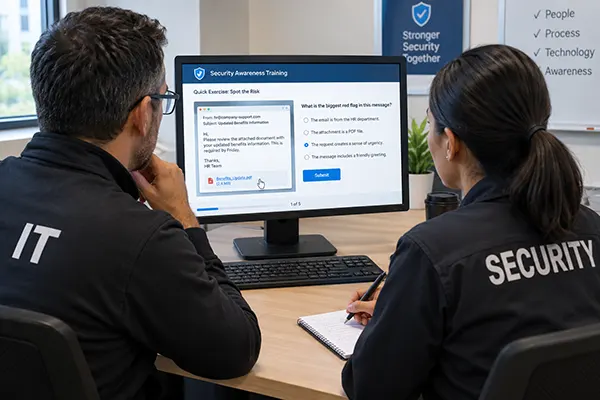
At any time in the morning, as a payroll analyst, you receive a warning message from an IT team at your company asking you to confirm your identity just by entering your Microsoft 365 password into a portal. Even if you feel hesitant after knowing the message source is authentic. You have a specialization in payroll, and still feel cautious.
The reason is to clarify that your company conducts a security training test in situations where high risk is involved, and decision-making is important to secure the system.
A practical exercise gives every security team confidence to recognise the sources and identify every threat possibility, including warning signals. Make smarter decisions, report problems without wasting every single minute.
Quick Answer
You must create short courses that every employee can participate in. Keep the focus on one decision at a time with real-life examples and display the working procedures. Train some professionals who can handle such situations when you are live. Save time and effort. Focus on a single framework.
What Fast Training Must Change
When your security course is completed, it doesn’t mean that security is maintained. Every employee passes the test and still faces issues, because awareness in real situations teaches the most. Whether you are a beginner or experienced, this security doesn’t meet the requirements you actually want.
Keep an eye on common risks, like phishing attempts, password leaks, and file-sharing faults. A short lesson makes every employee clear on what to do while practising, inspecting suspicious activities, and reporting fault messages.
A really interesting guideline of cybersecurity awareness tells you what the real training ground actually looks like and the steps involved to identify the threat received.
Quick insight: A simple and short session explains the situation better when it comes with real-life situations: what procedure to adopt when an unauthorized request is received for a verification code?
Give Each Role a Different Practice Task
Every employee in every department faces different situations at different levels of threat, for the helpdesk technician resetting accounts. A set of different role training indicates the tasks received in short lessons.
NIST’s NICE Workforce framework provides support for team requirements. This is especially important for IT leaders who have to address serious risk problems that harm the system.
You always prioritize work related to the risk involved. A professional needs a specialist who can identify the situation and review the session with better capabilities.
You should also take serious steps to record the rules followed by every employee. And instruct them to teach the working procedure whenever required.
The comparison table shows how different domains practice sessions and implement them securely:
| Professionels | Task to be practiced during session |
| Finance and Account expert | Verify bank account details with previously verified accounts established to make payment with a protected layer. |
| Administration | Identify what is fake or which request has credibility prescribed in rules and regulations. |
| IT support team | Confirm the caller’s identity to make sure to exchange information. Then try to reset account credentials. |
| Sales and Marketing team | Check all unexpected file-sharing links that are related to documents, reports, and customer sensitive information. |
| Management Team | Verify the access details carefully and keep your company’s confidential details secure. |
| Employee or Staff members | Keep an eye out for suspicious behaviour, protect details from being leaked, or, if it happens, report it to a higher authority. |
Build a Short Training Sprint in Five Moves
This special training session gives your employees better concentration to provide quality work. The rules you need to follow are:
- Check a single activity first: make clear and important steps when you follow an unexpected request; verify the channel from a trusted source for any password-change request that appears.
- Try to understand how the workflow actually works: collect all details regarding the workflow system. This includes steps involved, reporting processes, and recovery procedures.
- Focus on a single portion of a real situation: help the employee choose a single realistic condition. Attempt it and share the report by explaining which process they chose.
- Details are to be verified: make your system review the screenshot taken, instructions followed, policies made, and the security decision to remove threats.
- Examine the situation before going live: try to have a few employees attempt it. Inspect the conditions, remove the errors found, and retest them before launching it.
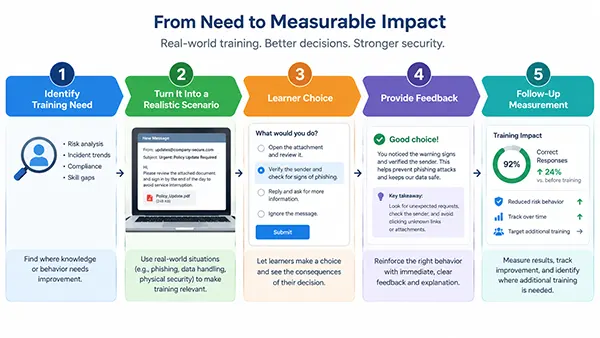
Make the Lesson Look Like the Real Work
If your employee faces such a situation in real work, live experience from the training exercise generates the capability of an employee.
Let’s understand with an example: a suspicious log-in alert on Microsoft 365 and an employee executing tasks to review their sources, verify requests, and select an appropriate response. An attacker tried fake login details to access the company’s information and check what comes next.
For the security teams, the tasks related to support tickets, warning signs, and current mistakes happened to revoke them. These choices enhanced their work efficiency. Safer responses, employees’ steps involved in reporting files.
The more realistic the situation, the greater the responsibility an employee handles safely, without making errors and following the procedure without any complaint to higher authority.
Did You Know?
The study also confirms that a business email scam reported nearly $2.8 billion lost during an attack. The FBI also states to focus on verifying payments received, handling the responses made, and executing action applied when the real threat knocks it.
After Launch, Measure and Maintain
Review activities every employee does. Result comparison is made when training is completed.
Note every mistake that is repeated and improve it to secure the security-level workflows processed.
Measure the Decision, Not the Click
If your employee completed the course successfully and unknowingly clicks on some phishing links, then all the security measures learned are wasted.
First, your employee is capable of tracing suspicious activity when your business is live. Whether it takes safer steps, reporting activities and messages that they don’t identify as a threat, and genuinely stops the errors repeatedly.
NIST’s phishing scale always has problems addressing the difficulties that are generally automated.
Let them understand that the threat is to learn from the situation and execute without difficulties.
Don’t diminish your employees’ confidence level; try to make them understand the learning opportunity from this situation.
Quick insight:
If every employee identifies the real threat, like a suspicious message, then half the work is completed. If they know the threat, then possible steps are easy to follow. Review the results to identify whether the training session is going in the right direction. The real security tip is to identify the threat before it can harm you.
Keep the Lesson Current Without Rebuilding It
It is necessary to stay updated with your security parameters because tools, policies, or threats keep upgrading.
Make sure you create a short learning session that is easily recorded by an owner and attempt to review it.
Check your plans when the system updates, ensure all security incidents are addressed, and verify policies that may influence the system.
Try to change the instructions accordingly, and place the screenshot at the proper destination. Make sure the employee practices the new solution that comes with updates.
Feedback must be assessed individually if the same mistakes happen with all existing employees. Keep it loud and clear to ensure they understand.
Small and regular updates are necessary to protect the channel’s security level. If you continuously rebuild the entire ecosystem, it can gradually change everything.
Make the Safe Choice Easier to See
Try to follow the easier option, not the difficult task, because it can lead to major faults during larger threat situations.
You should follow the simpler steps, which you should learn in a test that tries to identify suspicious activity, then report it securely; if not, the data is recovered, and don’t try to make the situation even worse.
Prompt reporting is a better choice for reporting any theft; keep practicing in real situations and update according to new system upgrades.
Implement what you have learned in what to execute while working. Review updated activities accordingly to implement in test activities.
Frequently Asked Questions
How Long Should an IT Security Training Module Be?
Does Annual Security Training Cover Every Risk?
All the security training procedures are helpful but not the ultimate option unless they are executed correctly. Simply create a short teaching guide that is updated when security methods change, such as policies, software, attacks, and threat procedures.
How Should a Team Measure Training Success?
The team assesses its activity by the decisions made by every employee, reporting, accuracy, and errors repeated in ongoing situations. Completing the course does not change the employee’s attitude towards such situations.
Should We Use Phishing Simulations?
Yes, when simulations are safe, realistic, and followed by useful feedback. Compare results across exercises of similar difficulty, encourage employees to report suspicious messages, and use mistakes to improve training rather than publicly shame individuals.
Related Posts
Using HeyGen AI for Sales and Customer Onboarding
It’s best to use HeyGen AI to create videos for you that answer a particular question or pain point. You…

Search Console Forgets Everything After 16 Months: How to Back Up Your SEO Data
After completing the period of 16 months, all the data and access are deleted from Google Search Console’s database. After…

Why Digital Transformation Projects Stall: A Resourcing Playbook for Project Managers
Digital transformation projects are on the rise at this time. From government-backed initiatives to enterprise cloud adoption and AI integration.…
How Email Hosting Providers Store and Protect Business Data
Where does your business email go when you click the send button? The impression is that the email just goes…
Best CI/CD Platforms for Coding Agents and AI-Native Development
CI/CD has changed its job because coding agents now write a growing share of the changes that reach a repository.…

Mavlers Agency on Why Global Agencies Are Turning to Offshore SEO Teams
An offshore SEO team in India is becoming more and more an option for great profit for global agencies; it’s…

How to Change Signature in Outlook: A Complete Guide
How do you change signature in Outlook? It sounds simple until you realize that the steps vary across Windows, Mac,…
Best 7 AI Development Companies for Data AI Solutions for Your Project: Guide for…
Buying model work before the data work is the most expensive order to do it in. The pilot shows well,…

Top Software Development Companies Backed by GoodFirms Reviews
In September 2026, GoodFirms listed 853 software development companies in California. The group had a median hourly rate of $37,…