
It designs and optimizes systems that transmit and receive wireless signals while ensuring stability and minimal interference.
How Advanced RF Engineering Is Enabling the Future of Wireless Communication
 Reviewed By Brijesh Kumar Singh
  Upasna Deewan
Updated on: May 01, 2026

“Any sufficiently advanced technology is indistinguishable from magic.”
— Arthur C. Clarke (Writer)
Wireless technology often feels like magic. A video streams instantly, a call connects across continents, and satellites guide you in real time.
But behind that “magic” sits something very real: RF engineering.
From 5G networks to orbiting satellites, every signal that reaches your device depends on it. And today, this field is no longer just about sending signals. It’s about protecting them, refining them, and pushing them further than ever before.
Let’s break it down.
KEY TAKEAWAYS
- RF engineering is essential for transmitting, receiving, and protecting wireless signals.
- Reverse power protection prevents costly damage and improves system reliability.
- Core components like amplifiers, filters, and antennas enable modern networks.
- 5G growth and upcoming 6G innovations are heavily dependent on RF advancements.
What Is RF Engineering?
RF (radio frequency) engineering focuses on designing systems that transmit and receive signals through the air.
They bring information from one device to another. Consider your cell phone, your wireless router, your car’s GPS… You use it.
But here’s the problem…
Wireless signals are delicate. They can reflect back, be distorted, or even harm the system that transmits them. This is why RF engineers have to devote so much attention to creating systems that maintain clean, stable, and safe signals.
Modern RF engineering handles three big jobs:
- Signal transmission — sending clean signals over long distances
- Signal reception — picking up weak signals without losing data
- Signal protection — stopping signals from damaging the hardware
Get any of these wrong and the whole system fails.
Why Reverse Power Protection Matters
One of the biggest hidden threats in RF systems is reflected power. Occasionally, when a signal is transmitted, part of it is reflected back. This reflected power can fry expensive amplifiers and take down entire base stations. Not good.
That’s why reverse power protection is one of the most critical aspects of modern RF engineering. Ingenious devices like circulators and isolators are able to steer RF signals in a single direction only. By doing this, they prevent reflected power from ever reaching the transmitter. Engineers have achieved clean signal isolation with sophisticated circulator designs that provide robust reflection shielding mechanisms for sensitive RF equipment in base stations, radar, and satellites.
The benefits of solid reverse power protection are huge:
- Longer equipment life — expensive amplifiers don’t burn out
- Better signal quality — less interference means cleaner data
- Higher network reliability — networks stay online and running
Reverse power protection keeps modern wireless networks from falling apart. Every base station, radar system, and satellite uses some form of it today.
The Core Components Driving The Next Wave
The RF components market is booming, projected to grow from more than $49 billion in 2025 to $186 billion by 2035.
But why is this growth so significant? The fact that each new generation of wireless devices requires even more RF components than the previous one.
Here are the key parts making next-gen communication possible…
- Circulators & Isolators: These route signals in the indicated directions. They protect signal reflection and protect transmitters from reflected energy.
- RF Amplifiers: An amplifier strengthens a signal so that it can be transmitted over longer distances. Modern amplifiers are more compact, efficient, and can amplify higher frequencies than ever before.
- RF Filters: Filters clear unwanted noise out of a signal. That’s vital for 5G because the 5G spectrum will be so crowded with competing signals. Without good filters, you get messy data.
- Antennas: Antennas have evolved significantly. Modern phased-array antennas can beamform a signal to a particular user, resulting in a dramatic increase in speed and coverage. Isn’t that neat?
Each one of these plays a key role. Remove any, and the system fails.
How RF Engineering Powers 5G And Beyond
5G didn’t just improve wireless communication; it redefined it.
In fact, global 5G connections reached 2.25 billion by the end of 2024, four times faster than 4G at the same point in its rollout. That’s massive.
And 5G relies heavily on advanced RF engineering. Here’s why:
- Higher frequencies — 5G uses mmWave bands that need specialised components
- More devices — billions of IoT gadgets are now connected worldwide
- Lower latency — every millisecond of delay needs to be squeezed out
Without adequate reverse power protection, 5G base stations would cook themselves. With adequate reflected energy control, 5G base stations run for years without issue.
The next frontier is 6G. The technology is still in the research phase, but it’s believed that the first commercial rollouts will happen in the next decade. This will take wireless systems innovation to the next level with exotic materials like graphene, quantum communication hardware, and more.
Satellite constellations (such as those in low-Earth orbit) are also creating demand for better RF equipment. Space equipment requires specialised components that can withstand harsher conditions and travel further.
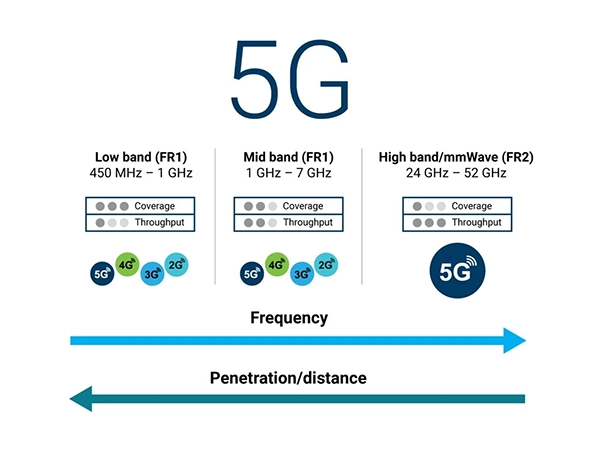
This is important as communication tech is boosting throughput, but the coverage is getting affected:
Where The Wireless Industry Is Headed
You might think that with so much tech already in place, the pace of change in wireless communication will slow down. Well, it’s accelerating.
Here are the biggest trends shaping the future of RF engineering…
- Smaller, smarter components: RF components are shrinking while taking on more tasks. This is essential for applications such as wearables, IoT devices, and ultra-miniature sensors that must be squeezed into very limited spaces.
- AI-powered RF design: Engineers in wireless systems are starting to turn to artificial intelligence (AI) to model RF circuits. It’s a lot faster than traditional methods and results in better designs. Good news all around.
- Green technology: Low-power RF components are a hot area of growth. Operators want cheaper energy bills. Governments want cleaner wireless networks. Look for this trend to continue to expand.
- Mass deployment: Over 647 mobile operators in 191 countries are rolling out 5G networks. All these deployments require robust RF hardware with strong reverse power protection.
Companies pouring money into these areas are already in the lead. The companies that figure out effective reflected signal handling will win.
That’s just how it works in this industry.
Final Thoughts
Radio frequency systems design is defining the future of wireless communication.
Powering everything from your mobile device to global satellite systems, RF technology is the secret sauce. As 5G and IoT expand (and 6G emerges)… The need for high-performance RF components will only increase.
Quality RF design engineers and companies will be building the future of wireless communication. The rest of the industry will be playing catch-up.
The future of wireless is already here… It’s just being built, one clean signal at a time, on the foundation of advanced RF engineering.
Frequently Asked Questions
What does RF engineering actually do?
Why is reverse power protection important?
It prevents reflected signals from damaging components like amplifiers, improving system lifespan and reliability.
What are the main components in RF systems?
Key components include amplifiers, filters, antennas, circulators, and isolators.
How does RF engineering impact 5G and 6G?
It enables high-frequency operation, supports massive device connectivity, and ensures low latency, which is critical for next-gen networks.
Related Posts

8 Best AI Presentation Makers for Business-Ready Slides
Making a presentation doesn’t just mean designing slides. It’s about defining a clear structure, using defined logic, useful visuals, and…

Queue Management Software Troubleshooting Guide: 8 Common Faults and Fixes
The long wait times and ineffective management of customer queues can have a significant impact on customer satisfaction and business…

How to Use Similarweb Website Traffic Data for Competitor Research
Competitor research without traffic data is guesswork. You can guess who your rivals are, guess how big they are, guess…

Choosing the Right Hosting Model for Scalable Digital Platforms
The performance of digital business is directly related to website speed, uptime, and scalability. Slow page performance has a negative…

How Data-Driven Performance Tools Are Transforming Employee Recognition in Tech Companies
“People work for money but go the extra mile for recognition, praise, and rewards.” — Dale Carnegie (Writer & Teacher)…

Why Businesses Struggle to Collect Reliable Data from the Web
Almost every company that depends on data runs into the same problem: although they can find the data they need,…

Why Financial Data Recovery Matters for Businesses
Financial data supports every part of a business, directly affecting cash flow, payroll, tax reports, audits, customer billing, and daily…

CMMC Compliance Is Coming for Manufacturers. Here Is What You Need to Do
“Cybersecurity is much more than a matter of IT.” — Stephane Nappo (Cybersecurity Professional) For manufacturers working within the defense…

How Data-Based Tools Influence Learning Performance
Learning has transformed in the modern age with the integration of new technologies to help students and professionals prosper in…