An increase in the tech team had been equated to an increase in the number of staff. It will be known what your data is in 2026. The reason is that here is the truth: Companies are not having a hard time growing; they are having a hard time growing efficiency. Indeed, 74 % of employers around the world complain of the inability to find the appropriate talent, and the average hiring of specialized tech positions requires 88 days.
Such a delay is not only inconveniencing, but it is costly. Late product release, deadlines, and overworked teams are summed up. This is precisely why augmentation of IT staff has ceased being a short-term solution and has become a fact-based growth strategy. Companies are no longer making hiring choices based on guesses; they are determining who to hire based on performance, workload, and skill deficiencies.
Key Takeaways
Decisions based on data remove speculations in scaling a team.
In 2026, staff augmentation will be necessary due to the lack of skills.
Smarter hiring is guided by performance and workload.
Accuracy of talent matching is enhanced by AI and analytics.
Augmentation supported by data results in improved and quicker outcomes.
Why Data-Driven Decisions Are Essential for IT Staff Augmentation
New tech teams are working in rapid and complicated conditions where assumptions fail to work any longer. Data-driven decisions can assist organizations to determine precise skill deficiencies, avoid over-hiring or under-hiring, reduce onboarding mismatches, and improve delivery timelines.
Having more than 81 % of organizations experiencing shortages in technology skills, using intuition as a single tool can prove to be a ‘not-so-smart’ move for organizations. That is why many companies have started shifting to smarter solutions like https://techloomglobal.com/staff-augmentation/.
PRO TIP Conduct a skill gap audit before employing anybody. You will also discover that the specialist will often get what the three generalists fail to do.
Key Data Points to Evaluate Before Scaling Tech Teams
You must know your existing team well before scaling tech teams. The following are the most crucial details:
Team delivery speed and velocity: Do you always have delayed projects? That was no coincidence.
Skill gap: The current projects demand specialization (AI, DevOps, cybersecurity). Special problems will not be resolved through generic hiring.
Workload distribution: Burnout and poor quality come about as a result of overloaded developers.
Project complexity: The complicated projects need specific addition, not the addition of more hands.
Time-to-hire data: In case of a months-long hiring process, augmentation is a quicker option.
The trend that the companies are shifting towards now is skills-based hiring rather than role-based hiring, where emphasis is on what one can do rather than his/her job title.
How Data Analytics Improves IT Staff Augmentation Strategies
Data analytics make staff augmentation not a staffing activity but rather a performance-based strategy.
Performance Metrics:Though the analysis of KPIs such as sprint completion rates, nig frequency, and deployment success. You will be able to see precisely in what areas the support is required.
Workload Analysis: Data reveals: What are the overlooked teams? Where bottlenecks occur? Where productivity drops. This assists in the acquisition of talent in areas where it is required and where it is pressing.
Skill Mapping: Modern systems map existing team capabilities, required project skills, and missing expertise. This ensures that you are getting the appropriate experts and not more developers.
The use of AI-based tools has become increasingly popular to find a match between candidates and actual project data and skills fit to enhance precision and hasten.
Tools and Technologies for Workforce Data Evaluation
You require the right tools to turn data into action. Common categories include:
Analytics Platforms: Give information on team performance and delivery measures.
Skill Assessment Tools: Assess tea, strengths, and weaknesses.
AI Recruitment Tools: Automate matching and evaluation of talent and candidates.
With the assistance of these tools, organizations are transported out of:
“We believe we should have more people so that we are fully aware of whom we require and why.”
Benefits of Data-Driven IT Staff Augmentation
Staff augmentation provides quantifiable outcomes when driven by data.
Faster Time-to-Market: Projects are started at a faster rate without protracted recruitment periods.
Availability of International Talent: You are no longer geographically constrained.
Cost Efficiency: Expense proficiency on demand – no large overheads.
Better Project Outcomes: The right skills result in improved execution.
Scalability on Demand: Teams may expand on contract depending on the need at a particular time.
Speed, flexibility, and precision are the three elements that enable companies that use augmentation to gain a competitive advantage.
INTRIGUING INSIGHTS
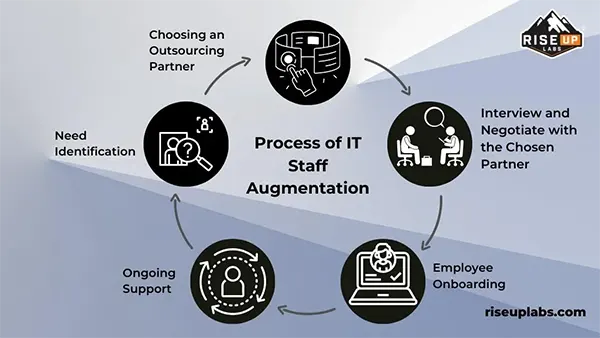
The infographic below provides a closer look at how staff augmentation looks like in the IT sector. Have a look and learn how capable candidates are hired in IT.
Conclusion
In 2026, it will not be about scaling a tech team by adding more people, but adding the right people at the right time. And that decision starts with data.
Back-end insights are what make the difference between high-performing teams and struggling teams, whether in performance metrics, skill mapping, and so on. When data-driven, IT staff augmentation is not just another hiring model but a scaling engine.
You want to create smarter, faster, and more robust tech teams, and you can begin here: Examine your data, make sense of your gaps, and scale intentionally. In the age of technology, growth does not come by chance. It is the result of knowing.
Frequently Asked Questions
What is IT staff augmentation?
It is a form of hiring that allows companies to hire outside tech specialists to assist their own staff on a temporary or permanent basis.
Why is data important in staff augmentation?
Information assists in determining precise skill deficiencies, workload concerns, and performance requirements so that improved hiring choices are made.
What do you consider the greatest difficulties with tech team scaling?
The most prevalent ones are talent deficiency, protracted hiring process, and skills mismatch.
What is the benefit of using data analytics in hiring?
It gives information about the performance of the team, anticipates requirements, and aligns the right talent with the right positions.
Does staff augmentation outperform customary recruitment?
It is not a substitute, but a more scalable and flexible way of having teams on demand.

 Reviewed By Brijesh Kumar Singh
  Mahima Dave