
Indeed, a combination of the two will provide an integrated approach to customer behavior, both online and offline.
Lead Tracking vs Call Tracking: Which Is Better for Collecting User Data?
 Mahima Dave
Updated on: Feb 05, 2026
Table of Contents
- What Is Lead Tracking and How Does It Work
- What Is Call Tracking and How Businesses Use It
- Key Differences Between Lead Tracking and Call Tracking
- Benefits of Lead Tracking for Data-Driven Businesses
- Advantages of Call Tracking for Customer Engagement
- When to Use Lead Tracking vs. Call Tracking
- Final Consideration
- Frequently Asked Questions
The State of Marketing Report conducted by HubSpot revealed a surprising fact: generating traffic and leads is the greatest challenge for marketers (more than 61 percent of them), which is why proper data collection and tracking systems have become a necessity today.
It is at this point that the lead tracking and call tracking software are involved. Saying the two are valuable, however, they are used for different purposes. The right choice (or both) would have a massive influence on your data-based approach to marketing.
Key Takeaways
- Lead tracking is concerned with online activities, and call tracking is concerned with offline activities.
- Tracking of leads is suitable for online marketing.
- Call tracking enables the analysis of the intent-customer dialogues.
- The combination of both tools gives a holistic view of the customer journey.
- The appropriate system would be based on your business objectives and channels.
What Is Lead Tracking and How Does It Work
Lead tracking is tracking and analyzing the interaction of potential customers with your brand on digital platforms. It tracks information since the time when a user initially visits your website or campaign.
Capturing User Data Through Forms and Website Interactions
The information that is gathered by lead tracking is mainly collected by contact forms, newsletter sign-ups, landing page submissions, or chatbots and pop-ups. Such information assists companies in acquiring important information like the visitors’ names, emails, phone numbers, user preferences, and visiting habits (visits to the site, time spent). This data is organized and can be used in segmentation and targeted marketing.
Tracking Customer Journeys Across Digital Channels
Lead tracking tools enable companies to trace the rest of the customer journey:
- Initial visit (ads, SEO, or social media visits)
- Involvement in various touchpoints
- Conversion actions
This helps identify the most popular challenges in terms of leads, the points where users drop off, and what kind of content performs the best.
DO YOU KNOW?
When companies receive a lead in 5 minutes, they are 21x more successful on it, so however good your tracking method is, it won’t do you much good unless it is fast.
What Is Call Tracking and How Businesses Use It
Call tracking software is a program that concentrates on the phone calls between companies and their clients. It uses different phone numbers for each campaign, or a source to identify the call source. One prominent feature that is commonly used here is the IPl Lookup, which assists in determining the approximate location of the caller and adds user information.
Business people use call tracking for:
- Marketing calls to phone calls
- Record and examine conversations
- Measure call time and performance
- Enhance the level of customer service and sales.
Key Differences Between Lead Tracking and Call Tracking
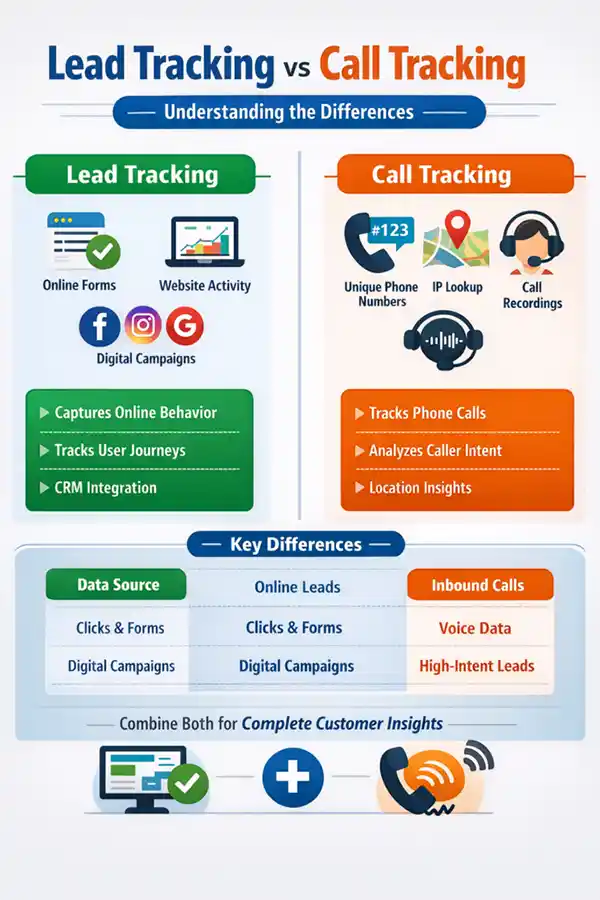
The table below provides a comprehensive comparison between lead tracking and call tracking.
| Aspect | Lead Tracking | Call Tracking |
| Data source | Online interactions | Phone calls |
| Data type | Structured (forms, clicks) | Conversational (voice data) |
| Tracking method | Cookies, pixels, CRM tools | Unique phone numbers, call logs |
| Insights | User behavior, journey mapping | Customer intent, real-time feedback |
| Use case | Digital campaigns | Offline + high-intent intercations |
Both systems contribute to a data-driven marketing strategy, but they focus on different stages of the customer journey.
To understand better, here is an infographic showing the differences between lead tracking and call tracking in real-world marketing scenarios.
Benefits of Lead Tracking for Data-Driven Businesses
Lead tracking is a necessity among companies that are quite dependent on digital channels. Its key benefits include:
- Improved audience stratification
- Better campaign targeting
- Higher conversion rates
- Advanced conversion rates
- Advanced user behavior analytics
- Seamless CRM integration
It also allows marketers to make decisions grounded in factual user behaviors as opposed to supposition.
Advantages of Call Tracking for Customer Engagement
The call tracking would shine in terms of customer intent and enhanced direct communication. Major advantages include:
- Gets high-intent leads (callers are usually willing to buy)
- Gives live insights into customers
- Improves the performance of the sales team with records of calls
- Enhances the offline tracking of ROI
- Facilities for individual customer relations
When to Use Lead Tracking vs. Call Tracking
It is a matter of business model and marketing channels.
- Use lead tracking when you depend upon the internet traffic and web conversions, you are a PPC, email, or SEO, and you require minute user journey analytics.
- Use call tracking when your company relies on answering phones (e.g., services, healthcare, and real estate), you do offline advertising (billboards, radio, print advertisements), and you want to evaluate customer discussions.
In the case of modern businesses, the combination of the two, and in particular when combined with other tools such as AI video ads, has developed a powerful and full-funnel tracking system.
Final Consideration
It does not have a one-size-fits-all answer. Tracking of leads and tracking of calls are different yet necessary purposes. In case you want to collect full user data, the most appropriate methodology is integration.
Learn lead tracking to know about the digital behavior. Record intent and human engagement with the use of call tracking. Collectively, they present a 360-degree perspective of your customers, assisting you in maximizing campaigns, enhancing engagement, and making conversions.
Frequently Asked Questions
Is it possible to have a combination of both lead tracking and call tracking?
Does call tracking only benefit the big companies?
No, it is of great benefit to small and medium businesses, particularly those that depend on phone inquiries.
Is there any technical setup for lead tracking?
The majority of the tools are easy to use, through simple configuration, such as the addition of tracking codes, which is needed.
Which is more suitable to measure ROI?
Both are useful in their own right, with lead and call tracking, measuring the online ROI, and offline and high-intent conversions, respectively.
Related Posts
8 Best AI Presentation Makers for Business-Ready Slides
Making a presentation doesn’t just mean designing slides. It’s about defining a clear structure, using defined logic, useful visuals, and…
Queue Management Software Troubleshooting Guide: 8 Common Faults and Fixes
The long wait times and ineffective management of customer queues can have a significant impact on customer satisfaction and business…
How to Use Similarweb Website Traffic Data for Competitor Research
Competitor research without traffic data is guesswork. You can guess who your rivals are, guess how big they are, guess…
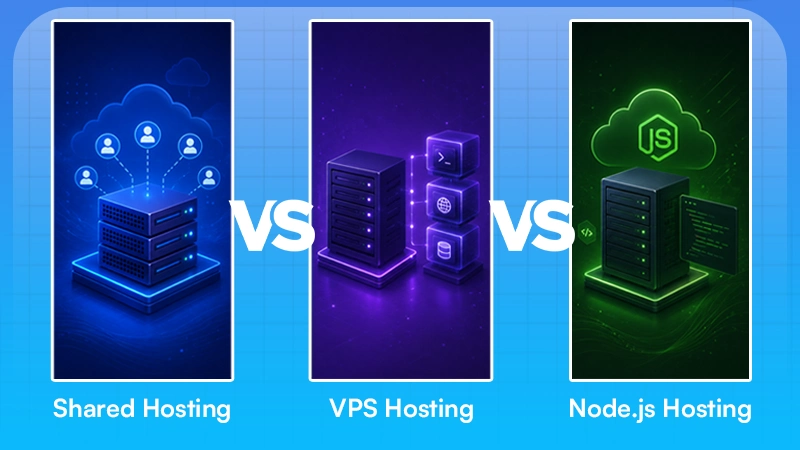
Choosing the Right Hosting Model for Scalable Digital Platforms
The performance of digital business is directly related to website speed, uptime, and scalability. Slow page performance has a negative…

How Data-Driven Performance Tools Are Transforming Employee Recognition in Tech Companies
“People work for money but go the extra mile for recognition, praise, and rewards.” — Dale Carnegie (Writer & Teacher)…

Why Businesses Struggle to Collect Reliable Data from the Web
Almost every company that depends on data runs into the same problem: although they can find the data they need,…
Why Financial Data Recovery Matters for Businesses
Financial data supports every part of a business, directly affecting cash flow, payroll, tax reports, audits, customer billing, and daily…

CMMC Compliance Is Coming for Manufacturers. Here Is What You Need to Do
“Cybersecurity is much more than a matter of IT.” — Stephane Nappo (Cybersecurity Professional) For manufacturers working within the defense…

How Data-Based Tools Influence Learning Performance
Learning has transformed in the modern age with the integration of new technologies to help students and professionals prosper in…