
Because vendors are often easier to breach. Instead of attacking a well-defended enterprise, criminals look for smaller partners with weaker security and use them as a gateway.
Proactive Cyber Resilience: Protect Customer Data Through Supply Chain Risk Management
 Mahima Dave
Updated on: Jan 12, 2026
Table of Contents
Most companies today understand the significance of having a patched-up security system. According to reports by Cybercrime Magazine, businesses typically allocate 10-20% of their total IT budget to security, with the average annual spending for smaller businesses ranging from $8,500 to $78,000.
That’s quite a lot! Yet breaches still happen, be it through a vendor or a service provider that seemed perfectly safe at first. And this is why proactive cyber resilience is essential to tackle numerous threats lingering in your supply chain, that even you might not be aware of.
Key takeaways
- Your cybersecurity posture is only as strong as your weakest vendor.
- Continuous monitoring matters more than one-time assessments.
- Cloud security requires shared responsibility.
- Strong backups are a resilience strategy, not just an IT task.
- Proactive supply chain risk management protects both data and customer trust.
What is Cyber Supply Chain Risk Management?
Cyber supply chain risk management means identifying, assessing, and reducing cybersecurity risks that might originate from third-party providers.
To reduce digital vulnerabilities, organizations must shift to proactive strategies and double-check their systems instead of just trusting that vendors are secure. They should actively evaluate vendor security standards, monitor third-party access to systems, limit unnecessary data exposure, and establish accountability through contracts and compliance.
It is all about managing risks before they become a breach and turn out to be an expensive mistake.
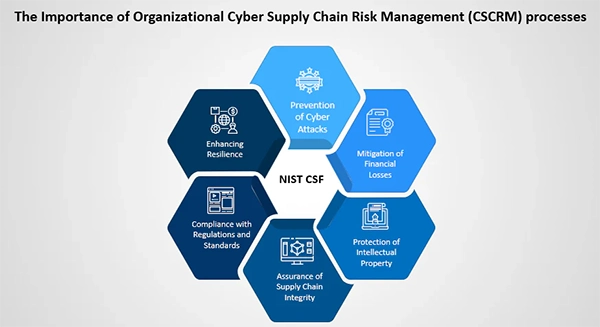
To explain further, the infographic below shows the importance of organizational cuber supply chain risk management processes.
Understanding Supply Chain Risks in Data-Driven Environments
Supply chains can serve as an open channel for cybercriminals, becoming the “just right” opportunity they look for to hack into systems.
- Third-Party Vendors: Marketing agencies, payment processors, IT consultants, software providers, etc., often deal with sensitive customer data. And if the vendor has weak access controls, attackers may treat it as an easier entry point.
- Cloud Platforms: Cloud platforms have made business workflows more flexible than ever, but at the same time also introduced shared responsibility. Companies must keep their configurations, permissions, and data usage all patched up from every side.
- Data Exposure Risks: Customer data keeps moving constantly across internal systems, APIs, analytical dashboards, and automated integrations. This increases the risk of information exposure at each step.
Key Strategies for Proactive Cyber Resilience
Reactive strategies are of little to no use in this era of evolved threats. Hence, you must build resilience that is about anticipating threats rather than waiting for them:
Continuous Monitoring
Cyber risk is dynamic. Which means that a vendor that you might have tested and employed last year might not be secure today. This makes continuous monitoring a ‘non-negotiable.’ Keeping an eye on workflows allows you to track any unusual access patterns, review vendor security updates, monitor system integration, and scan for exposed credentials or data leaks, allowing you to detect any out-of-the-ordinary things immediately.
Risk Assessments
Regular risk assessments provide you with the answers to questions like:
- What data bendor can access
- How sensitive that data is
- What controls are in place
- What would happen if a breach occurred
Knowing all this helps prioritize resources and reduce high-impact vulnerabilities first.
Compliance Checks
Accountability is a major factor in data protection, even when breaches originate from third parties. Compliance checks ensure vendors align with the standards of particular data privacy laws and governance policies. These not only reduce legal exposure but also play a major part in building client trust.
Data Backup, Migration, and Recovery Considerations
Cyber attackers continuously evolve and refine their strategies, which means that there are increasing ways for cybercriminals to compromise supply chains. It can be anywhere from inserting malicious code into software to exploiting vendor login credentials.
That is why organizations must keep the following considerations in mind:
- Maintaining secure, encrypted backups
- Test recovery procedures regularly
- Ensure backup data is isolated from production environments
- Validate integrity after migrations
In case any third-party breach disrupts systems, rapid recovery becomes the difference between temporary inconvenience and long-term reputational damage.
Best Practices to Strengthen Supply Chain Data Security
Supply chain data security should be treated as a priority. By leveraging the best practices mentioned below, businesses can strengthen their supply chain security.
Vendor Vetting
Before onboarding any partner, check their security certifications, incident history, data handling policies, and security audit reports. These will give you a glance at how they handle client data and judge whether they are worth trusting or not.
Access Controls
Limit vendor access strictly to what’s necessary; providing them with extra information won’t do them any good but only put your data at risk. So, implement role-based access, least-privilege principles, time-bound credentials, and multi-factor authentication.
Incident Response Planning
No system can be thought of as an inevitable, 100% secure one. Therefore, practicing response scenarios can be a smart measure.
- Define communication protocols
- Assign roles and responsibilities
- Include vendor coordination procedures
- Outline customer notification processes
PRO TIP
Map your digital ecosystems: Many organizations don’t fully know how many vendors access sensitive data. Visibility is step one.
Conclusion
Cyber resilience has become a strategic cross-functional commitment that extends across your entire supply chain. Customer data rotates across different systems, and this raises security concerns.
Organizations that understand this and put measures rightly at place win this challenge and get customer trust as a reward. Smart businesses proactively assess vendors, monitor integrations, enforce access controls, and maintain recovery readiness to position themselves better to withstand disruptions.
Frequently Asked Questions
Why are attackers targeting supply chains instead of companies directly?
If we use a trusted cloud provider, aren’t we already secure?
No, choosing a trusted cloud provider does not automatically mean secure systems. Cloud providers secure their infrastructure, but you’re responsible for how you configure access, permissions, and data handling.
How often should we assess vendor risk?
At onboarding, and regularly after that, as risks are not static. A vendor’s security posture can change over time.
What is the biggest mistake companies make in supply chain security?
Assuming trust equals security is the biggest mistake companies make in supply chain security. Trust should always be backed by verification and monitoring.
Related Posts

8 Best AI Presentation Makers for Business-Ready Slides
Making a presentation doesn’t just mean designing slides. It’s about defining a clear structure, using defined logic, useful visuals, and…

Queue Management Software Troubleshooting Guide: 8 Common Faults and Fixes
The long wait times and ineffective management of customer queues can have a significant impact on customer satisfaction and business…

How to Use Similarweb Website Traffic Data for Competitor Research
Competitor research without traffic data is guesswork. You can guess who your rivals are, guess how big they are, guess…
Choosing the Right Hosting Model for Scalable Digital Platforms
The performance of digital business is directly related to website speed, uptime, and scalability. Slow page performance has a negative…

How Data-Driven Performance Tools Are Transforming Employee Recognition in Tech Companies
“People work for money but go the extra mile for recognition, praise, and rewards.” — Dale Carnegie (Writer & Teacher)…

Why Businesses Struggle to Collect Reliable Data from the Web
Almost every company that depends on data runs into the same problem: although they can find the data they need,…
Why Financial Data Recovery Matters for Businesses
Financial data supports every part of a business, directly affecting cash flow, payroll, tax reports, audits, customer billing, and daily…

CMMC Compliance Is Coming for Manufacturers. Here Is What You Need to Do
“Cybersecurity is much more than a matter of IT.” — Stephane Nappo (Cybersecurity Professional) For manufacturers working within the defense…

How Data-Based Tools Influence Learning Performance
Learning has transformed in the modern age with the integration of new technologies to help students and professionals prosper in…