
Not at all. Small and mid-sized businesses often feel disruptions more severely because they have fewer resources to recover quickly. In connected environments, resilience matters at every scale.
What Is Data Resilience? The Role of Data Resilience in the Future of Corporate Connectivity
 Kartik Wadhwa
Updated on: Dec 19, 2025
Table of Contents
One of the most important assets businesses today have is DATA. Collected from client interaction, internal decisions, cloud logins, and real-time collaborations, data keeps a business alive. And when this access breaks, everything tends to break down.
According to Gartner, the average cost of IT downtime is $5,600 per minute, and for data-heavy enterprises, even a short disruption can spiral into massive financial and reputational losses. This is where data resilience comes to the rescue. It makes sure your data can survive disruption, adapt to change, and recover fast, without compromising corporate connectivity.
So, let’s learn more about this topic and understand the role of data resilience in the future of corporate connectivity.
Key Takeaways
- Data resilience keeps businesses connected when disruption hits, whether it is a cyber attack, outage, or system failure.
- Availability, integrity, and recoverability must work together; missing even one weakens the entire data architecture.
- Strong data resilience supports cloud, hybrid, and distributed systems, which are now essential to modern corporate connectivity.
- Weak resilience creates cascading failures, where one system outage spreads across connected platforms and operations.
- Resilient data builds trust, helping organizations protect revenue, reputation, and customer confidence in a connected world.
Data Resilience in Modern Enterprises
Modern businesses work in settings where revenue, reputation, and consumer trust can all be instantly impacted by outages, data loss, or corruption. The ability of an organization to tolerate, adjust to, and bounce back from data-related interruption while preserving ongoing business activities is known as data resilience. Natural catastrophes, human error, system malfunctions, cyberattacks, and connectivity outages can all cause these interruptions.
Data resilience, as opposed to basic data protection, combines security, recovery, availability, and integrity into a single approach. Resilient data architectures are becoming more and more important as businesses embrace cloud services, remote work methods, and real-time data interchange. Without them, even short-term disruptions have the potential to ripple through interconnected systems, impacting internal operations, customer platforms, and supply chains.
Core Elements That Define Data Resilience
The following are the basic elements that can define data resilience for you:
Data Availability
The availability of data guarantees that information is available when it is required. Applications, staff, and clients depend on real-time access to data across various platforms in linked business environments. By using load balancing, redundancy, and failover techniques, high availability reduces downtime.
Data Integrity
Maintaining the quality, consistency, and dependability of data throughout its lifecycle is the core goal of data integrity. Data often flows between applications, the network, and environments in connected systems, which raises the possibility of corruption or unauthorised alteration.
Data Recoverability
The capacity to promptly and fully restore data following an incident is known as recoverability. This covers recovering from unintentional deletions, ransomware assaults, and infrastructure failures. Recovery time objectives (RTOs) and recovery point objectives (RPOs) are clearly defined by effective recovery strategies.
How Corporate Connectivity Depends on Data Resilience
Corporations are more prone to finding the best and most efficient connectivity, which totally depends on data resilience. Here is how:
Hybrid Infrastructure
These days, the majority of businesses run a hybrid event solution that blends cloud services and on-premises systems. Flexibility is increased by this networked configuration, but complexity is also increased. Data resilience guards against component failures and guarantees smooth data transfer between environments.
Cloud Connectivity
Cloud systems, which facilitate worldwide access, scalability, and collaboration, are essential to contemporary business connectivity. But depending too much on cloud services comes with dangers, including shared responsibility gaps, misconfigurations, and failures.
Distributed Systems
IoT networks, edge computing environments, and contemporary applications are all powered by distributed systems. Multiple nodes, often located in disparate geographic locations, process and store data. This raises the risk of errors and inconsistencies even while it enhances performance and scalability.
PRO TIP
The biggest sign your data recovery plan is fragile is that it depends on a single system, location, or vendor. True data resilience assumes something will fail and plans for it in advance.
Business Risks of Weak Data Resilience in Connected Environments
There are serious implications for organisations with poor data resilience. Extended outages have the potential to stop business operations, interfere with customer support, and harm a brand’s reputation. Financial losses, legal repercussions, and regulatory sanctions may result from data loss or corruption.
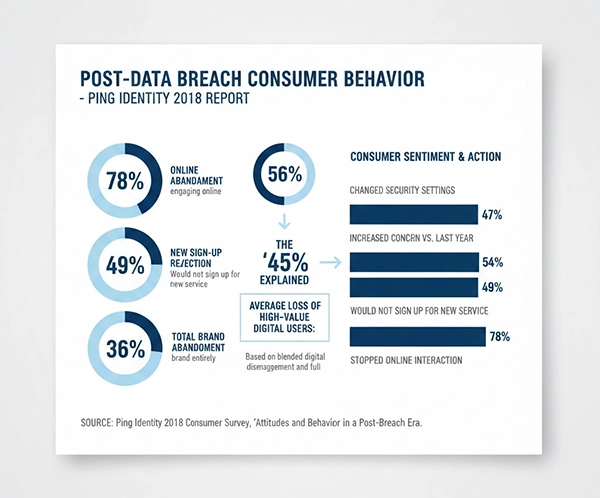
Customer trust is fragile; nearly 45% of users abandon brands after repeated outrages or data loss, as cited in the infographic above.
Poor availability and recoverability are exploited by cyberattacks, especially ransomware. Businesses may have to pay ransoms or experience prolonged outages if they don’t have robust infrastructures. Furthermore, if one system loses connectivity, it might spread to other networks, increasing the overall effect. Resilience failures are rarely isolated in a highly interconnected business environment; instead, they impact the entire company.
Data Security and Compliance in Resilient Data Architectures
Data security and data resilience are closely related. Strong security measures, including network segmentation, identity management, encryption, and ongoing threat monitoring, are all incorporated into resilient infrastructures. These safeguards maintain data availability and recoverability.
Strict controls over data access, storage, and recovery are necessary to meet compliance standards such as GDPR and SOC2 across sectors. Data retention, auditability, and breach response capabilities are frequently required by regulations. By guaranteeing safe backups, defined recovery procedures, and uniform data governance across interconnected systems, resilient data strategies assist organisations in meeting these objectives.
Conclusion
Data resilience is becoming essential as corporate connectivity develops; it is no longer a choice. Businesses need to get ready for a future in which data moves constantly between dispersed, cloud, adn hybrid systems.
Organisations can safeguard their operations from disruption and foster innovation and expansion by prioritising availability, integrity, recoverability, and security. Data resilience is the primary facilitator of trust, continuity, and long-term company success in a world that is becoming more interconnected by the day.
Frequently Asked Questions
Is data resilience only important for large enterprises?
Can data resilience prevent all outages and failures?
No system can prevent everything. What data resilience does is limit the damage. Instead of long outages or total data loss, resilient systems help businesses recover faster and keep critical services running.
How often should businesses test their data resilience plans?
More often than most do. At minimum, testing should happen once or twice a year; but anytime there’s a major system change, cloud migration, or new integration, it’s worth revisiting recovery plans.
Is data resilience expensive to implement?
It can be, but unplanned downtime, lost data, and damaged trust actually cost far more. Many organizations discover that resilience is less about spending more and more about designing smarter systems.
Related Posts

How Image and File Corruption Happens (and How to Prevent It)
When people think of file corruption, they typically picture something large and visible, like a broken USB stick, a dead…

Key Features to Look for in Log Management Software
Every action within your systems – let it be logins, errors or updates – creates a log. Most of these…

Turning Organizational Data into Actionable Business Insights
Every day, businesses generate huge volumes of data – yet identifying what truly needs improvement and what should be focused…
Data Domains in Enterprise Data Management: Tools and Strategies to Maintain Data Effectively
Most enterprises do not struggle due to the lack of data but because they fail to manage it properly. And…

How Marketing Consultants Can Benefit From Data-Driven Marketing Strategies
A few years back, marketing advice was all about instinct and guess work. Experience mattered; creativity ruled. And, yes, these…

7 Best Web Scraping Tools in 2026: Features, Pricing & Honest Reviews
Extracting data from websites shouldn’t feel like solving a Rubik’s Cube blindfolded. Yet for many businesses, web scraping remains frustratingly…

How to Find the Best Enterprise EDI Integration Provider for Your Supply Chain Business
Supply chain systems are all about accuracy. Because even the slightest error can reflect on a series of tasks: one…
Document Databases: Strengths, Weaknesses, and Comparison With Relational Databases
Data is no longer a byproduct of business; it is the business. With every click on an e-commerce site, organizations…

Backing Up Your Study Files Automatically: Student Setup Guide
You don’t know how much you rely on your laptop until it acts up. The cursor stops moving. The fan…