
It means security systems, which are capable of expanding and changing along with growing data and infrastructure requirements.
Enterprise Data Security: Scalable Solutions to Build a Protected Network Environment
 Reviewed By Brijesh Kumar Singh
  Kartik Wadhwa
Updated on: Feb 17, 2026
Table of Contents
- Understanding Scalable Data Security in Large Organizations
- Key Components of a Secure Enterprise Network Environment
- Scalable Security Solutions for Data Protection
- Role of Data Backup and Recovery in Enterprise Security
- Best Practices for Implementing Scalable Data Security Solutions
- Conclusion
- Frequently Asked Questions
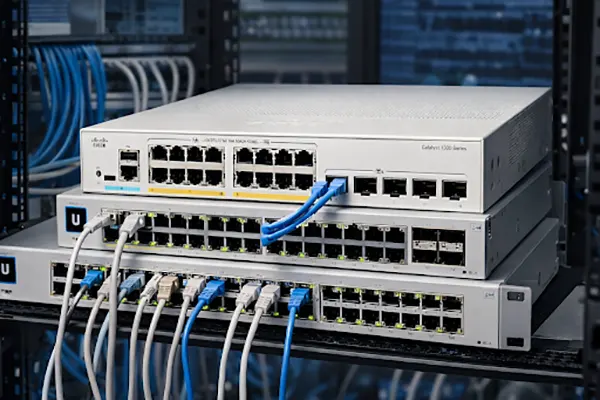
Data is the biggest asset for any business today. Every second, businesses generate massive volumes of data in the form of customer records, financial transactions, and internal communications; all flowing across networks that must remain fast, accessible, and above all, secure.
But with all this comes a challenge: the more a business grows, the more it becomes highlighted in the eyes of a cyberattacker. And IBM’s 2024 Cost of a Data Breach report confirms this. 72% of the scaling businesses have fallen prey to cybercriminals, revealing a high risk to their data.
With the expansion of businesses, the amount of sensitive data that they deal with also increases, including information about customers, financial data, and intellectual property. This necessitates the need to implement scalable data protection systems that not only safeguard the current resources but also address the growing digital environments of an organization.
Key Takeaways
- Enterprises that have high volumes of data need scalable data security.
- Flexible and cloud-based security models provide greater protection and flexibility.
- Reliable tools enhance data recovery and reduce downtime.
- Business continuity depends on backup and recovery systems
- The application os multi-layered and proactive is to guarantee long term data security.
Understanding Scalable Data Security in Large Organizations
Scalable data security is a system and strategy that has the capacity to scale as the size of the data required by the organization increases without affecting the performance or protection of the data.
Adapting Security Measures to Growing Data Volumes
As more businesses grow, they produce large volumes of structured and unstructured data. Conventional security systems are usually not able to cope with this magnitude and become vulnerable. Scalable solutions overcome this by self-adaptation to augmented data loads, supporting distributed environments, and providing protection uniformity of all endpoints.
Importance of Flexible and Cloud-Based Security Models
Enterprise cloud adoption is on the rise in modern times. Hybrid and multi-cloud systems provide flexible security models with live tracking and intrusion detection, decentralized access and centralized control, and cost-effective scalability.
Cloud-native security tools are used to make sure that businesses are secure, no matter the location of their data.
Key Components of a Secure Enterprise Network Environment
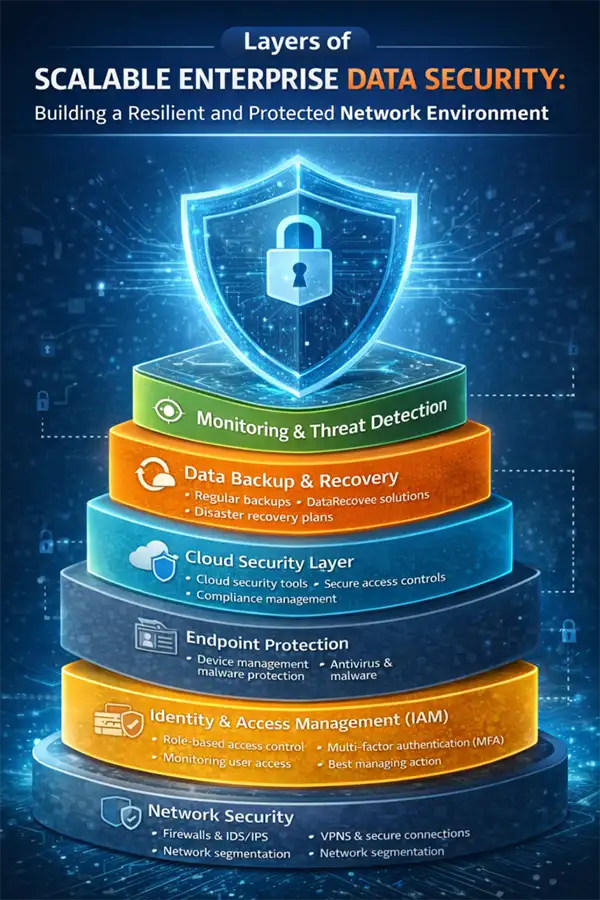
Layered security in the network involves several levels of security that need to interact efficiently with each other. Core components include:
- Firewalls and Intrusion Detection Systems (IDS): Avoid unauthorized access.
- Encryption Protocols: Protect data when transferring and storing it.
- Identity and Access Management (IAM): Regulate who has the right to what data.
- Endpoint Security: Secure network-connected devices.
- Segmentation of the Network: Restrict proliferation of threats.
The combination of these factors forms a strong security architecture that reduces risk.
Here is a visual breakdown of how different layers of scalable enterprise data security work together to protect your environment.
Scalable Security Solutions for Data Protection
Businesses require solutions with both scalability and reliability so as to successfully safeguard enterprise data. Many used Ubiquiti equipment as a cost-effective way to scale without turning every upgrade into a budget crisis. Another one of such methods is introducing the state-of-the-art tools such as DataRecovee into the security systems.
Leveraging solutions like DataRecovee helps support scalable data recovery, facilitates automatic backup and recovery, minimizes downtime caused by cyber attacks or system outages, and grows as data volumes and infrastructure requirements grow.
With the integration of reliable tools, the organization can ensure data access control and be sure that its data is available and safe even during unexpected interruptions.
Role of Data Backup and Recovery in Enterprise Security
The recovery and data backup are two essential cornerstones of any security plan. Even the most sophisticated defenses cannot help in their absence. Here is why they matter:
- Insure against loss of data related to cyberattacks, hardware failure, or human error.
- Uphold business continuity in the face of disruptions.
- Facilitate rapid recovery of essential systems.
For that, an effective backup plan must consist of regular automated backups, cloud storage or off-site storage, and intersectionality and redundancy.
This will make sure that businesses will be able to recover fast and reduce the effect of operations.
Best Practices for Implementing Scalable Data Security Solutions
The best practices to achieve the best performance with scalable security systems include:
- Implement a Zero Trust approach: Authenticate all users and devices prior to access.
- Patch and update systems regularly: Eliminate vulnerability exploitation.
- Carry out security audits and risk analysis: Find vulnerabilities.
- Educate workers about cybersecurity: Lessen staff errors.
- Use multi-layer security mechanisms: The interrogation of several tools can be more powerful
- Take advantage of automation and AI: Improve threat detection and response time.
Such practices are beneficial in establishing a proactive but not reactive security environment.
PRO TIP
Test your backup and recovery systems on a regular basis because a backup is only handy when it is functional when you need it most.
Conclusion
Enterprise data security is not just about firewalls, tools, or technical frameworks; it’s about keeping your business’s heart beating. And today, you can’t trust old or rigid systems with every file, customer record, and transaction.
As a business grows, its security needs follow closely. Scalable solutions make this possible by keeping them one step ahead of threats instead of always trying to catch up. It’s about making a system that not only protects, but also changes, learns, and heals what it needs to.
That’s where tools like DataRecovee really help. No matter how strong your defenses are, being able to recover quickly is important. In the end, the ultimate goal is peace of mind. Knowing your data is secure, your systems are resilient, and your business is ready for whatever comes next.
Frequently Asked Questions
What is scalable data security?
What is the reason behind data backup in enterprise security?
It makes certain that information is easily recoverable in case it gets lost, and the downtime and damage are reduced.
What is the effect of cloud security on scalability?
Cloud solutions can scale security due to the flexibility of the resources and real-time monitoring.
How do tools like DataRecovee help?
They assist in effective data recovery, which is business continuity in case of disruption.
What is the Zero Trust model?
The security method that assumes that no user or device can be trusted by default, even in the network.
Related Posts

8 Best AI Presentation Makers for Business-Ready Slides
Making a presentation doesn’t just mean designing slides. It’s about defining a clear structure, using defined logic, useful visuals, and…

Queue Management Software Troubleshooting Guide: 8 Common Faults and Fixes
The long wait times and ineffective management of customer queues can have a significant impact on customer satisfaction and business…

How to Use Similarweb Website Traffic Data for Competitor Research
Competitor research without traffic data is guesswork. You can guess who your rivals are, guess how big they are, guess…
Choosing the Right Hosting Model for Scalable Digital Platforms
The performance of digital business is directly related to website speed, uptime, and scalability. Slow page performance has a negative…

How Data-Driven Performance Tools Are Transforming Employee Recognition in Tech Companies
“People work for money but go the extra mile for recognition, praise, and rewards.” — Dale Carnegie (Writer & Teacher)…

Why Businesses Struggle to Collect Reliable Data from the Web
Almost every company that depends on data runs into the same problem: although they can find the data they need,…
Why Financial Data Recovery Matters for Businesses
Financial data supports every part of a business, directly affecting cash flow, payroll, tax reports, audits, customer billing, and daily…

CMMC Compliance Is Coming for Manufacturers. Here Is What You Need to Do
“Cybersecurity is much more than a matter of IT.” — Stephane Nappo (Cybersecurity Professional) For manufacturers working within the defense…

How Data-Based Tools Influence Learning Performance
Learning has transformed in the modern age with the integration of new technologies to help students and professionals prosper in…