
It is a pricing strategy where prices change automatically based on market conditions and data analysis.
Dynamic Pricing Algorithms Guide: Implementation, Data Models, and Real-Time Adjustments
 Reviewed By Brijesh Kumar Singh
  Mahima Dave
Updated on: Mar 25, 2026
Table of Contents
Today, businesses are set in the highly competitive digital market where the price can vary within minutes depending on the demand, competition, and customer behavior. Dynamic pricing algorithms are being used by businesses across a wide range of sectors to maximize revenue and efficiency, from ecommerce giants and airlines to ride-sharing services and hotels. Implementing advanced pricing strategies driven by analytics and AI can have a huge impact on profitability for companies in any industry, according to McKinsey & Company.
Dynamic pricing systems look at real-time data to make real-time pricing adjustments. The technologies enable businesses to meet demand, changes in inventory, and competitor activity more quickly, and provide pricing accuracy and scalability.
Key Takeaways
- Dynamic algorithms calculate pricing in a real-time manner and take into consideration marketing conditions.
- The pricing decisions are affected by customers’ behavior, competitor pricing, and inventory level.
- Machine learning is used to enhance price accuracy and forecasting.
- Automation helps to update pricing faster and more scalably.
- Data security and price precision are key aspects of compliance and customer trust.
What Dynamic Pricing Algorithms Are
Dynamic pricing algorithms are computer systems that are used to dynamically change the price of a product or service based on certain rules, data analysis, and market conditions. Unlike fixed pricing models, the business optimizes the prices continuously using algorithms for maximum profit and competitiveness.
Advanced pricing software systems are frequently connected to modern pricing systems, which track data and support automatic pricing modifications to digital avenues.
Businesses use dynamic pricing as it improves revenue generation, proactively meets market needs in a timely manner, stays competitive, optimizes inventory movement, personalizes customer offers, and automates pricing decisions.
To understand better, here is an infographic showing what is dnamic pricing actually is and how it works in businesses.
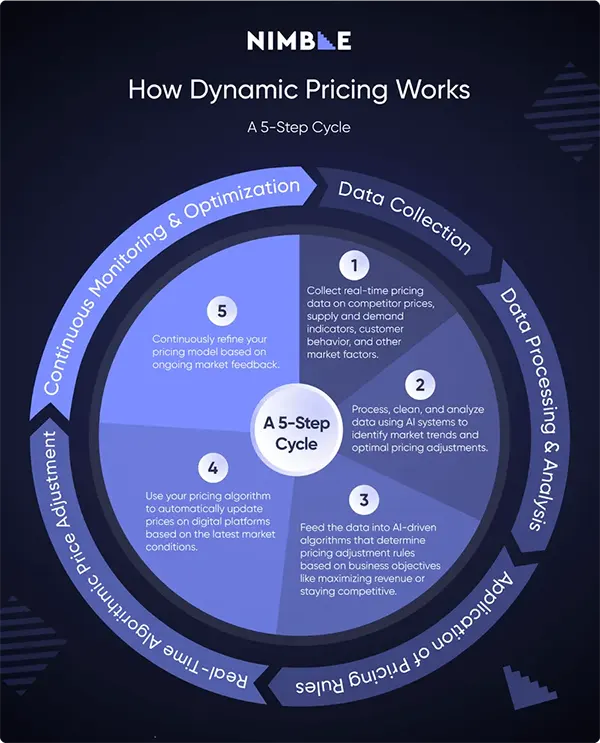
Key Data Inputs Behind Dynamic Pricing Decisions
There are a number of relevant data types that can affect real-time pricing.
Customer Demand and Buying Behavior
Consumers’ usage of the product is a key factor in pricing. It signals product search trends, purchase history, cart abandonment behavior, customer location, and peak shopping periods. This helps companies adjust prices as per the fluctuations in demand.
Competitor Pricing and Market Signals
This is because businesses can track their competitors, remain competitive, and safeguard their profit margins. Common market inputs are competitors’ pricing updates, industry pricing trends, promotional campaigns, and market demand fluctuations. In dynamic markets, real-time competitor monitoring can help businesses make quicker price adjustments.
Inventory, Seasonality, and External Data
This price is also determined by inventory levels and seasonal fluctuations. The eternal factors are product availability, seasonal demand spikes, weather conditions, economic trends, and supply chain disruptions. When you integrate several data sources, you have more accurate pricing and forecasting.
Common Types of Dynamic Pricing Algorithms
The pricing models vary in accordance with the complexities of operation and the requirements of various businesses in the industry. These models can be used to make informed decisions about pricing strategies.
Rule-Based Pricing Models
In a rule-based system, a business can establish pricing rules for the machine. Example rules: refrain from reducing prices during peak demand, decrease prices when there is surplus stock, and match competitor pricing automatically. These models are easy to apply and are appropriate for small businesses.
Machine Learning Pricing Models
Machine learning models process vast amounts of data, and they continuously ramp up their precision in pricing based on customer behavior and market trends. The key advantages include adaptive pricing optimization, better personalization, faster market response, and improved forecasting accuracy. The better these systems git over time, the more data they use.
Predictive Analytics and Demand Forecasting Models
Predictive pricing models rely on historical information and analytics to forecast future pricing trends. The main benefits are that it helps anticipate pricing trends, improve inventory planning, reduce revenue loss, and be supportive of long-term business plans. The models are popular in the manufacturing sectors that have varying demand cycles.
DO YOU KNOW?
One of the first industries to implement dynamic pricing systems was the airline industry, which uses real-time pricing algorithms to determine ticket prices based on demand and availability.
How to Implement Dynamic Pricing in Business Systems
It is not enough to simply deploy software for it to be a success. Pricing systems need to be incorporated into current business operations and data systems. Organizations need to set up some pricing aims and monitoring systems before implementing dynamic pricing.
The key implementation steps include:
Step 1. Define pricing objectives
Step 2. Gather Quality market information
Step 3. Choose suitable pricing models
Step 4. Integrate pricing systems with inventory and sales systems
Step 5. Schedule regular tests of pricing rules
Step 6. Track customer response and performance metrics
Additionally, businesses should keep the pricing transparent and avoid causing any surprises for their customers. A phased approach helps to maximize risks during operation and maximize system reliability.
Real-Time Pricing Adjustments and Automation Workflows
Today’s dynamic pricing systems are highly automated to quickly adapt to market fluctuations. Automation workflows enable companies to adjust pricing without having to do it manually on a regular basis.
Real-time pricing automation offers the following benefits:
- Faster market responsiveness
- Reduces manual workload
- Improved pricing consistency
- Better revenue optimization
- Increased operational scalability
Factors that can result in pricing changes through automation systems include:
- Demand spikes
- Inventory shortages
- Competitor changes
- Seasonal events
- Customer engagement patterns
Data Security, Accuracy, and Compliance Considerations
Dynamic pricing systems have to handle a lot of customer data and market data, so security and accuracy are paramount. With poor data quality or insecure systems, pricing errors, compliance problems, and reputation damage are possible.
Important security considerations:
- Protect customer data
- Secure pricing databases
- Restrict unauthorized system access
- Monitor algorithm performance
- Maintain audit logs
Why pricing accuracy matters:
- Revenue loss
- Customer dissatisfaction
- Legal compliance
- Brand reputation damage
Conclusion
Dynamic pricing algorithms have become a crucial component in today’s business landscape, and they enable businesses to quickly accommodate the ever-evolving demands of customers, market trends, and competition.
Businesses can leverage real-time data, automation, and predictive analytics to fine-tune pricing strategies and enhance profitability and efficiency. Dynamic pricing technologies are continually evolving in sectors like ecommerce, travel, and retail, with some systems as simple as rules-based, while others are increasingly sophisticated and integrated with machine learning.
But good data governance, security features, and pricing clarity are also essential for success to keep customers and regulators happy. Companies with smart pricing can and will be more successful in increasingly data-driven markets by investing in real-time automation workflows.
Frequently Asked Questions
What is dynamic pricing?
What industries use dynamic pricing?
Retail, travel, hospitality, logistics, and ecommerce commonly use dynamic pricing systems.
How does machine learning improve pricing?
It analyzes customer and market data to optimize pricing decisions automatically.
Is dynamic pricing legal?
Yes, but businesses must comply with pricing transparency and consumer protection regulations.
Related Posts

8 Best AI Presentation Makers for Business-Ready Slides
Making a presentation doesn’t just mean designing slides. It’s about defining a clear structure, using defined logic, useful visuals, and…
Queue Management Software Troubleshooting Guide: 8 Common Faults and Fixes
The long wait times and ineffective management of customer queues can have a significant impact on customer satisfaction and business…

How to Use Similarweb Website Traffic Data for Competitor Research
Competitor research without traffic data is guesswork. You can guess who your rivals are, guess how big they are, guess…

Choosing the Right Hosting Model for Scalable Digital Platforms
The performance of digital business is directly related to website speed, uptime, and scalability. Slow page performance has a negative…

How Data-Driven Performance Tools Are Transforming Employee Recognition in Tech Companies
“People work for money but go the extra mile for recognition, praise, and rewards.” — Dale Carnegie (Writer & Teacher)…

Why Businesses Struggle to Collect Reliable Data from the Web
Almost every company that depends on data runs into the same problem: although they can find the data they need,…

Why Financial Data Recovery Matters for Businesses
Financial data supports every part of a business, directly affecting cash flow, payroll, tax reports, audits, customer billing, and daily…

CMMC Compliance Is Coming for Manufacturers. Here Is What You Need to Do
“Cybersecurity is much more than a matter of IT.” — Stephane Nappo (Cybersecurity Professional) For manufacturers working within the defense…

How Data-Based Tools Influence Learning Performance
Learning has transformed in the modern age with the integration of new technologies to help students and professionals prosper in…