


No. It records what an auditor observed during a window that has already closed, and it may deliberately exclude the subcontractor you care about most.
Business Process Outsourcing: What IT Teams Should Vet Before Handing Over Data Access

Most people assume the security review happens while a business process outsourcing vendor is being chosen. It doesn’t.
By the time IT gets a look, the contract is usually signed, the kickoff is booked, and somebody has already promised a go-live date.
That ordering is the whole problem. It is also the cheapest thing here to fix, because it costs nothing except a calendar invite.
Below, I’ve set out what to settle before you look at vendors, what a SOC 2 report actually proves, and which answers belong in the contract itself.
Key Takeaways
- Which records does this vendor genuinely need, and which will they simply be able to see?
- Does their access end when the contract ends, or does somebody have to remember to revoke it?
- Who else sits on their side of the line?
- If the vendor’s own hosting provider has an incident, who is responsible for telling you about it?
The Security Review Usually Happens Last
The mistake most companies make is that they often think about the security of data in the end, when technically it should be the first thing to ask. The sequence most companies follow is: someone identifies a gap or problem in the existing system, a shortlist appears, finance teams question the cost that fixing this will incur, and only then does anyone think to ask where the data will physically sit.
Most managed service providers (MSPs) and IT firms like Elevated Networks prioritize letting the buyer know about their real-world achievements and technical capabilities rather than security in a B2B linear sales cycle. And weirdly enough, prospects also check out their services first; once they are satisfied with the skills, they move on to understanding the price positioning and ROI of the firm. After a prospect is comfortable with everything, security turns up as a form of a security questionnaire where the MSP only has to fill it out as a formality to prove they meet standard compliance, data handling, and encryption protocols.
None of this comes as a shock, since the roots of outsourcing can be traced back to the 1880s, when textile mills in England began shifting their manufacturing operations to the Carolinas. Steven Pearlstein made that point in the Post back in 2012, and the shape of the argument has barely moved since then.
The whole point of doing this was to set up manufacturing in a place where labour costs were low, regulations were not that strict, and operational expenses were cheaper. Workers resent it because it takes away their livelihood; executives call it inevitable and see it solely as a business necessity; and economists defend it, stating that lower manufacturing costs lead to lower selling prices, which overall has macro benefits on the economy of a country.
What has changed is what gets handed over. It used to be work. Now it’s access.
Scope the Access Before You Score the Vendor
The best approach to utilise when managing third-party vendors is to decide and define what information these vendors can know and touch before you ever sit to talk with them.
This principle is popularly known as “least privilege,” as stated by NIST, and it is usually far easier in theory than when you actually sit down to apply it in organizations. Under this theory, it is advised to give precise access to people, one that is enough for them to carry out their designated tasks efficiently rather than giving them every access they ask for. While it sounds logical, it is not practical to use because organizations that work under a ‘go-live’ deadline usually do not have the time to approve thousands of micro access requests, and so they usually end up granting broader permissions to not miss the deadline.
Write the scope around the needs of your company first, in writing, before anybody demos anything. This helps because the scope vendors actually propose is a lot wider, which means you’re directly giving them access to your entire database. On the other hand, offering restricted access takes more time both on the vendor’s side and the company’s side, as they have to engineer a way where these restricted permissions do not hinder the workflow of a vendor or company.
Decide the expiry at the same time. Access granted with no end date is access that outlives the contract, the project, and usually the person who requested it.
What Does a SOC 2 Report Actually Cover?
Most people think just because a vendor handed you a SOC 2 Report, it is safe and trustworthy, but that is usually not the case. Almost every BPO vendor can hand you that report, and usually prospects file that report somewhere in their software without ever actually reading past the cover letter.
A Type II report is an auditor’s opinion about a stretch of time that has already ended. Useful. Also historical.
It Describes a Past Window
The report covers an observation window, often three to twelve months, which closed before the document ever reached you. Nothing in it claims the controls are still working today.
The Carve-Out
This is the part I find quietly amazing. A vendor’s SOC 2 can exclude its own subservice organisations from testing altogether, using what auditors call the carve-out method, and it is entirely legitimate. The description still has to name that subcontractor and explain how the vendor monitors it. But the auditor never tested it.
So if the thing worrying you is the vendor’s hosting provider, you may be holding a report written specifically to leave it out. Getting that provider’s own report is your job.
The Controls You Were Supposed to Run
Most reports carry a list of complementary user entity controls. In plain words, the things the auditor assumed you would handle at your end for the vendor’s controls to work at all. Revoking leavers. Configuring single sign-on properly.
Almost nobody reads that list. It is the closest thing these documents have to a warning label.
The Support Desk Is a Data System
Most people believe that support desks are only designed to help customers and hence do not have access to a wider database, but that is exactly where they go wrong because support desks see more than people expect.
For example, when you contact an agent regarding a problem in your billing transaction, they aren’t just looking at your bill copy; they are also reviewing other details of your account like your address, payment history, and sometimes even your confidential information like identity documents. The ticketing software used acts as a portal to the company’s central database, which has a friendly interface.
All of this requires access to a wide database for solving such queries quickly, and since most businesses value customer satisfaction over security, they tend to grant these permissions for maximized speed. The third-party vendors are measured for their quality of work through metrics like average handle time and customer expectations, which pushes in precisely the wrong direction for access discipline.
Since the access that a support desk has is so broadly open, even a minor phishing attack on one account can create a big impact on the entire database.
Where the Work Actually Happens
Things to check before you give complete access to your database to a third-party vendor to avoid security complications in the future:
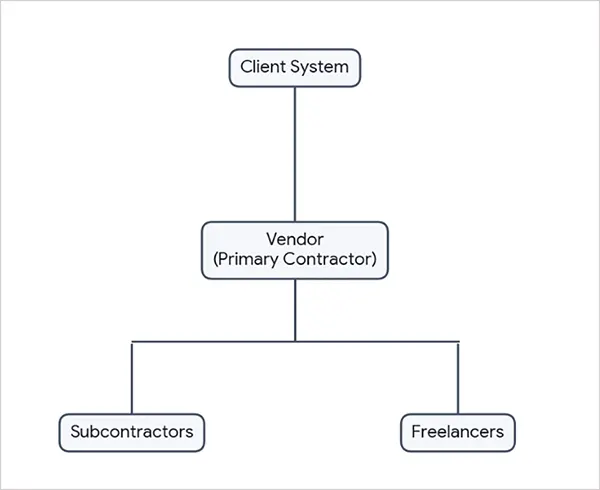
- The vendor’s own employees, named in the contract
- Subcontractors used for overflow, night shifts, or holiday cover
- Freelancers brought in for particular pieces of work
- The vendor’s software suppliers, who often hold support access to the tooling
That list is the answer to a question most contracts never ask. A vendor taking on content creation or localisation will routinely pass parts of it to people who appeared on no org chart you were ever shown. None of that is sinister. It is just how capacity works.
Intriguing Insights
Verizon’s 2026 Data Breach Investigations Report found third-party involvement in breaches climbing 60% year over year, turning up in close to half of everything they analysed. The people with access to your data are increasingly not the people you signed with.
Write It into the Contract
A typical standard security questionnaire is empty compliance paperwork, and these should be replaced by enforceable contracts that a lawyer can actually use for keeping the company safe. So, legal leverage matters more than paperwork when it comes to ensuring the security of a company and its database.
The virtue of outsourcing is equally as dangerous as it is helpful. When third-party vendors are hired, you save time in handling tasks because now a significant part of tasks is lifted off your plate. But this can also be harmful, as now your company’s database can be accessed by third-party vendors who can internally damage the data without you knowing until it’s too late.
So the clauses worth arguing over are the dull ones:
- Named subcontractors: This prevents vendors from handing over your data to a cheap and unverified site without your knowledge or permission.
- Breach notification timelines: This ensures that your vendor reports a data breach to you either immediately or within 72 hours, rather than letting the data stay as is even after a breach, which can cause further security complications.
- Access that expires with the contract: This implies that when your contract with your vendor ends, their access to your system and database also ends.
- Right to audit without ninety days’ notice: Checking a vendor’s system after a ninety-day notice gives them time to clean up their systems before you look, but it doesn’t guarantee quality work even after that check. So, a clause for checking their systems instantly when you feel suspicious should be added in the contract.
Thus, accountability always beats promises. This means that in practice, a two-hundred-question form makes you believe that a vendor and its system are safe. However, only a sharp contract that binds stricter operational regulations gives a company real security.
Final Thoughts
None of this makes a vendor untrustworthy. Most BPO providers are competent, and plenty take security more seriously than their clients do.
The asymmetry is simpler than that. They are managing risk across dozens of clients at once, and you are managing it for exactly one. Nobody on their side is going to raise a question you didn’t think to ask.
So ask the boring ones early, while you still hold the one real advantage in the whole process, which is not having signed anything yet.
Frequently Asked Questions
Is a SOC 2 report enough on its own?
What access should a BPO vendor get on day one?
The narrowest set that covers the first month of work, with an expiry date attached. Widening access later is trivial; narrowing it after go-live becomes a negotiation.
Who should own vendor access reviews?
The system owner, on a quarterly cycle. Commercial owners rarely have any incentive to take access away, so leaving it with them means it quietly never happens.
Related Posts
Search Console Forgets Everything After 16 Months: How to Back Up Your SEO Data
After completing the period of 16 months, all the data and access are deleted from Google Search Console’s database. After…
Why Digital Transformation Projects Stall: A Resourcing Playbook for Project Managers
Digital transformation projects are on the rise at this time. From government-backed initiatives to enterprise cloud adoption and AI integration.…
How Email Hosting Providers Store and Protect Business Data
Where does your business email go when you click the send button? The impression is that the email just goes…
Best CI/CD Platforms for Coding Agents and AI-Native Development
CI/CD has changed its job because coding agents now write a growing share of the changes that reach a repository.…

Mavlers Agency on Why Global Agencies Are Turning to Offshore SEO Teams
An offshore SEO team in India is becoming more and more an option for great profit for global agencies; it’s…
How to Change Signature in Outlook: A Complete Guide
How do you change signature in Outlook? It sounds simple until you realize that the steps vary across Windows, Mac,…
Best 7 AI Development Companies for Data AI Solutions for Your Project: Guide for…
Buying model work before the data work is the most expensive order to do it in. The pilot shows well,…
Top Software Development Companies Backed by GoodFirms Reviews
In September 2026, GoodFirms listed 853 software development companies in California. The group had a median hourly rate of $37,…

What Is a Blockchain Explorer? How to Track Crypto Transactions
A blockchain explorer is a searchable interface for viewing data recorded on a public blockchain. You can look up a…