


The retrieval mechanics overlap heavily, so good technical SEO still applies. What changes is the target: being quoted and cited rather than ranked.
Generative Engine Optimization Explained: Technical Insights for IT and Security Brands
Table of Contents
- What Generative Engine Optimization Actually Optimizes
- Why Blocking the Crawlers Is the Most Common Mistake
- The Control Token That Does Not Do What You Think
- How to Check What the Answer Engines Can Reach
- What Actually Makes You Citable
- How Do You Know If Any of It Worked?
- Final Thoughts
- Frequently Asked Questions
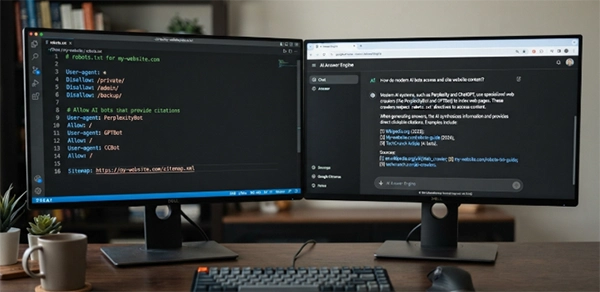
Block AI crawlers. On most infrastructure teams, that isn’t a debate; it’s the default, applied long before anyone asks what it costs.
Then marketing asks why the company never appears in ChatGPT’s answers, and the two facts turn out to be one.
Generative engine optimization is mostly an infrastructure problem for companies like yours. The content part is real enough. It is also the easy half.
This guide covers how answer engines build a response, which of your own controls quietly remove you from it, and what to measure afterward.
What Generative Engine Optimization Actually Optimizes
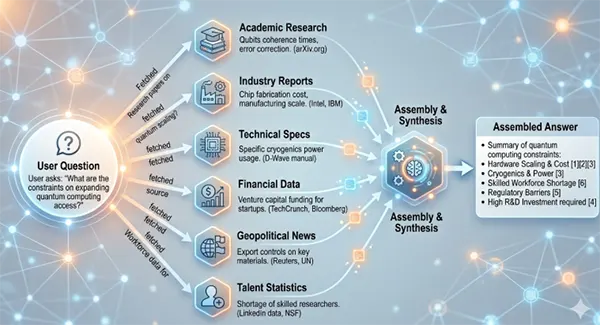
What a generative engine does is that, instead of giving you ten links for an answer, it compares all of that information from all of the sites and hands you back one single answer so that you don’t have to waste your time switching tabs. It also provides citations for every site used to dig out information so that you can actually go on those sites if you want, for further information.
What this does is save you time and energy. One question often gets narrowed down to several questions which have to be independently asked and understood to get a complete understanding of that topic. But by using the mechanism of “fan-out,” as called by Ahrefs, the answer you get already gets built up from several of those narrow questions that you otherwise would have had to search separately.
For example, if a person asks about what a mid range back-up equipment costs, the AI handling it runs six queries instead of running just one including: pricing, capacity, deduplication ratios, support terms and two named competitors.
No keyword covers that. You are either present across the spread of sub-questions or absent from most of it.
Why Blocking the Crawlers Is the Most Common Mistake
Security teams block bots. That is the job. Correctly, most of the time.
The crawlers feeding generative answers look exactly like the ones you spent years learning to stop — same request patterns, same indifference to your rate limits. Teams tune those rules for uptime and online performance, and the answer engines get caught in the same net as the scrapers.
The infrastructure has moved that way too. Cloudflare now asks every new domain at sign-up whether to allow AI crawlers, and said over a million customers had already chosen to block them. That was July 2025.
None of it is wrong. But a blanket block is a decision about revenue as well as load, and it is usually made by someone who was never told that.
The Control Token That Does Not Do What You Think
Plenty of teams add Google-Extended to robots.txt and consider the question handled.
Google has clearly stated in the documentation that adding the Google extended token does not guarantee that a site will not be included in your Google search; it only governs if your content is being built to train future Gemini models. Which means adding just the Google extension is not enough of a protective measure.
It also has no user-agent string of its own, which I find quietly wonderful. It exists purely as a word in robots.txt, so nothing ever arrives claiming to be it. It never shows up in your logs.
So what did you think you turned off?
How to Check What the Answer Engines Can Reach
Step 1: Give a thorough check of robots.txt and read every disallowed line. This step is important because there are several lines whose existence nobody can explain the existence of.
Step 2: Then, export bot-mitigation logs and WAF logs recorded over the duration of a week. These should be grouped together by user agent and should be filtered down to only those that have blocked requests.
Step 3: Next, to see what a retriever crawler can actually see, take your three highest value pages with no cookies or referrer. Fetch them simply as an anonymous client.
Step 4: So if the specifications only appear after JavaScript runs, assume nobody reads them. Also check whether those pages you just fetched as your client are rendered server-side or not.
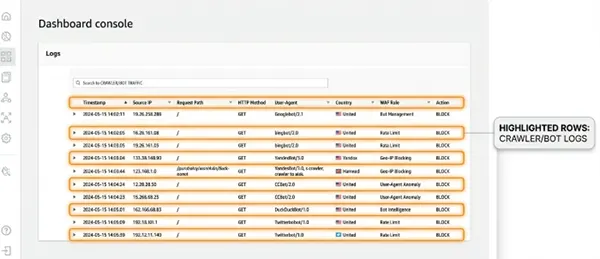
Also, one disallowed line that was added in a hurry and has been existing in the system ever since cannot be outrun by two years’ worth of content. Thus, a good approach is to run these steps before you commission any new single page to avoid your content going to waste or to retrieve crawlers.
What Actually Makes You Citable
After a retrieval system has reached you, it has to trust you. That only happens on the kind of content you have published for that subject. A good domain cannot save a lack of content on a particular subject. So the retrieval system doesn’t judge your entire domain; it only judges you on whether it has a reason to trust you per topic or not.
During the 2024 Google API link, there were two major signals that were pointed out by Ahrefs: site focus and site radius. Site focus basically comprehends how concentrated your content is around 1 particular subject. This means it tests and scores how much expertise you provide to a user based on one topic alone.
Site radius calculates how far this information and your site are being made available. This usually has a higher score when your content is good, and people actually tend to read it, instead of opening the site and leaving it under two minutes.
And for a security vendor, this difference matters a lot because your guides build on the incident response factor and build your content from the ground up. However your post about the work please culture give it a reason to spread and give the whole guide a context.
People assume that only good reviews and quantity can save content, but that’s not entirely the case. Off-site brand mentions count too, and relevance often beats volume. This means that including one citation from a niche security publication is always going to outweigh a stronger domain that has nothing to do with your field.
PRO TIP:
Put product specifications in real HTML tables with real headers, not in a diagram or a downloadable PDF.
Retrieval systems quote what they can parse. A spec sheet locked inside an image is one nobody can cite.
How Do You Know If Any of It Worked?
Rankings do not ever tell you if your optimisation performed well because an answer with changes according to the requirements of every question has to be rebuilt from scratch every single time and hence cannot hold any position at all.
What you can do to actually check the optimization and its efficiency is to track whether your brand appears at all, how it gets described when it does, and which competitors sit beside it.
This process is split into 4 pieces according to pure visibility, with each piece being as important as the next: mention tracking, citation movement over time, a competitor comparison, and alerting on sudden shifts.
The one piece out of this would be that most people tend to skip it because they think that it is not important: alerting. However, alerting makes up one of the most crucial factors of an optimization at all because a search engine can drop you, or start describing you wrongly, without anything changing on your end.
Give it two quarters. Ahrefs puts meaningful movement at six to twelve months.
Final Thoughts
The most common part that most people tend to get wrong is that they believe all of this belongs to marketing. But it hardly ever is that way. Different parts of search engine optimization belong to different sectors of a company, and placing them all under one is where things go wrong.
For example, robots.txt sits with infrastructure. WAF rules sit with security. Rendering sits with engineering. Whether your specifications are parseable sits with whoever built the product pages.
Marketing owns none of those, and gets asked anyway why the brand is missing from answers it has no way to influence. So pick an owner with access to all four.
Frequently Asked Questions
Is generative engine optimization different from SEO?
Will blocking AI crawlers protect our intellectual property?
It keeps your content out of training sets, a legitimate goal. It also keeps you out of the answers those systems generate, so treat it as a trade with a price rather than a free safety measure.
Does structured data help with AI visibility?
It helps by making your facts unambiguous and machine-readable. Mark up products, FAQs, organization details, and author credentials before spending anything on new content.
How long does this take to show results?
Expect six to twelve months for anything measurable. The exception is a blocking problem, where fixing the rule can change what retrieval systems see within weeks.
Related Posts
Search Console Forgets Everything After 16 Months: How to Back Up Your SEO Data
After completing the period of 16 months, all the data and access are deleted from Google Search Console’s database. After…
Why Digital Transformation Projects Stall: A Resourcing Playbook for Project Managers
Digital transformation projects are on the rise at this time. From government-backed initiatives to enterprise cloud adoption and AI integration.…
How Email Hosting Providers Store and Protect Business Data
Where does your business email go when you click the send button? The impression is that the email just goes…
Best CI/CD Platforms for Coding Agents and AI-Native Development
CI/CD has changed its job because coding agents now write a growing share of the changes that reach a repository.…

Mavlers Agency on Why Global Agencies Are Turning to Offshore SEO Teams
An offshore SEO team in India is becoming more and more an option for great profit for global agencies; it’s…
How to Change Signature in Outlook: A Complete Guide
How do you change signature in Outlook? It sounds simple until you realize that the steps vary across Windows, Mac,…
Best 7 AI Development Companies for Data AI Solutions for Your Project: Guide for…
Buying model work before the data work is the most expensive order to do it in. The pilot shows well,…
Top Software Development Companies Backed by GoodFirms Reviews
In September 2026, GoodFirms listed 853 software development companies in California. The group had a median hourly rate of $37,…

What Is a Blockchain Explorer? How to Track Crypto Transactions
A blockchain explorer is a searchable interface for viewing data recorded on a public blockchain. You can look up a…